Saturday, June 13, 2015

Jeepers Creepers (2001) Review:

Every horror franchise has its issues, whether it be a lack of attention to detail or cliched writing there's usually something a horror fan will expect to happen at least once during the running time. Unfortunately like a lot of other genres, these tropes end up making these films too generic in most respects resulting them in either being a one-time watch or possibly not even finished. For director Victor Salva, although this is not his most critically acclaimed piece, it is probably the one that sticks with him the most. For what is given, it's actually not a bad film at all. Regrettably though, it has writing issues that if addressed, could have made it more entertaining than it already is. The story is about a brother and sister heading home from spring vacation through a rural community when they witness a man dropping what appears to be a body down a giant shoot. Curiosity gets the better of them and soon enough, what they go looking for ends up following them.

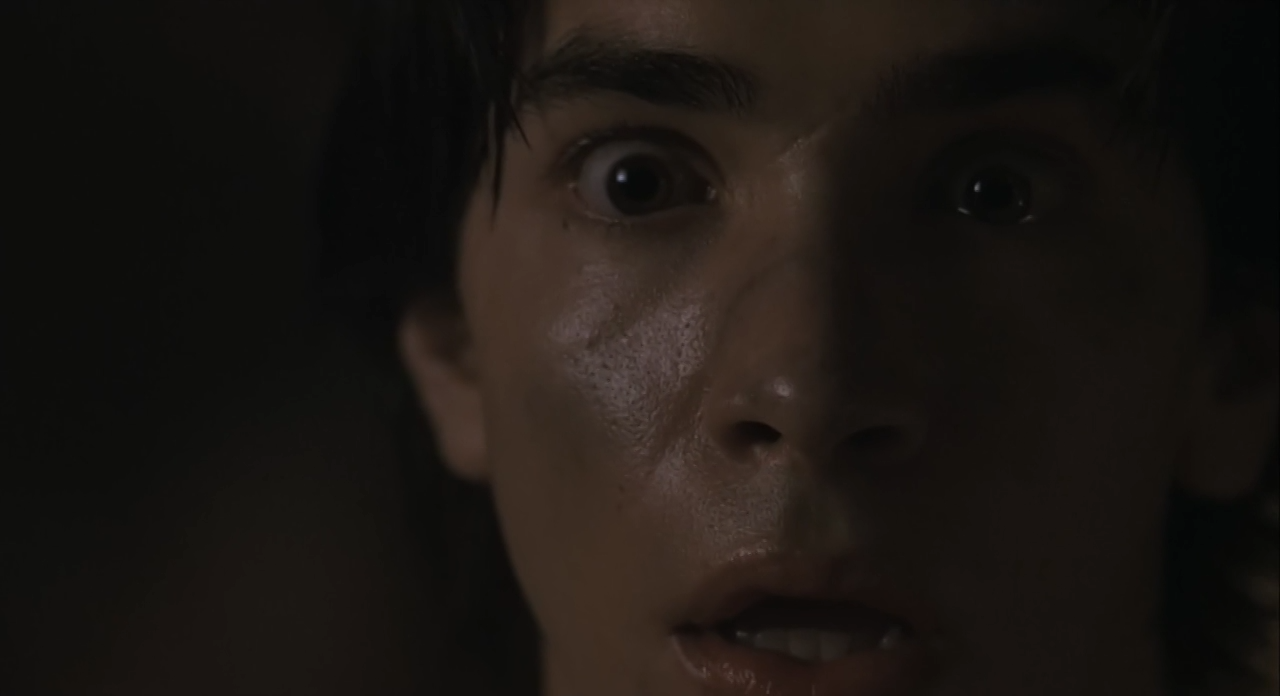
Justin Long's doofiest shock face
What distinguishes this cautionary tale of minding your own business from other horror films is that its writing contains very little, if none at all of the usual horror tropes. As stated before the main characters are brother and sister. That already is a big difference from other films. Most plots rely either on a group of people (as fodder for the killer) or focus on only one person. Also the people who are killed are not the same either. Even the jump scares aren't as obligatorily noticeable. This is a game changer because a lot of generic horror films are still produced this way and these kinds of antics get old really fast. Now if only Salva was able to fix the rest of his script, then this would've been some horror film. For one thing, the brother, Darry (Justin Long) and Trish (Gina Philips) are not exactly what you would call the most likable of protagonists. It's not that the audience would despise them but they don't exactly cooperate well nor do they have the best of attitudes. I mean yeah, siblings bicker sure, but there's no scene that shows their softer side so it’s hard for its audience to fall behind the main characters. And personally, Justin Long has the doofiest shock face.

The other parts of the writing Salva forgets to elaborate on is the exposition to the antagonist and clearing up other reasons. Along their travels, the brother sister duo meet a psychic named Jezelle (Patricia Belcher) who has the ability to see visions into the future. Mind you she's been having these trances for several years and she has no clue why she has them. Ummm,...okay. As for the antagonist known as "the creeper" (Jonathan Breck), which kind of honestly he is, the reasons why he kills is explained but why he doesn't, goes unexplained. Plus, he has a grotesque side hobby that involves something along the lines of preservation. What exactly is it for? No idea. Since Jezelle is the only one who even knows about the creeper (and for so long) how come she knows so little? She's literally the creeper's creeper. Writer/director Salva could've went into more detail on this but didn't so this doesn't exactly help with fleshing out the villain's backstory.

Aside from this however, the rest of the film will manage to keep its audience's attention. The most effective part to this film's credit is in fact, its creep factor. The idea of knowing that someone is always following you and wants something from you (and you don't know what it is) is beyond unnerving. Plus after seeing what he does with his victims, who would want to stick around? As for the gore aspect of this horror feature, it exists but it's not abundant like one would expect it to be. The good thing is that Victor Salva ensures that certain in scenes when the creeper attacks is not what a viewer would normally predict. The director of photography belonged to Don E. FauntLeRoy who handled each scene nicely by giving it a grainy feel like that of Daniel Pearls’ work from Tobe Hooper's The Texas Chain Saw Massacre (1974). I am curious as to why it’s always in the middle of nowhere that crazy people exist. Why is that? Why is it always the rural communities? Can people really go mad out there that easily?

The Creeper
Bennett Salvay brought the film score forth. Although much his tracks are anonymous sounding with no real signature, there are a couple that demonstrate Salvay is a competent composer. This mostly belongs to the themes surrounding the brother sister duo or other family related subplots. However, his other tracks are just drudging brass instruments, which emphasize the dread headed their way. But even with this, the tracks do help elevate the tension to an intense level because as said before, director Salva doesn't have a script with your everyday horror cliches. There is also one more piece of music that is creepy and that is the actual "jeepers creepers" song from the early 1900s. This is used as a motif for the creeper himself. Because the song sounds so jolly, the fact that its being played with a dark character is, well,....creepy.

Sadly, most of its writing doesn't explain much about its antagonist and the main two protagonists aren't exactly the most enjoyable. However, everything else from its special effects, violence, creep factor, music and cinematography work well together. Its screenplay even contains a number of original ideas that don't follow your regular horror films.

Points Earned --> 6:10

Thursday, June 11, 2015

Kickassia (2010) Review:

One must remember when it comes to amateur movies, there has to be a level of expectation set prior to the viewing experience. One of the biggest things audiences have to accept is that the budget is significantly lower than normal professionally made movies. This will obviously affect the look of the film in a number of ways. The idea behind it though is that the people working on it are putting in as much effort as possible to make their endeavor the best it can be. For the crew behind Channelawesome.com, there's no doubt that they are a group of people that love what they do. With each sub-section of the site having different internet personalities covering various mediums, the range at which this team can expand is endless. As flawless and creative as it sounds, being ambitious has its uphill battles and making a feature length movie is no easy walkthrough. With that said, sacrifices have to be made.

"Follow me heathens!"
A very large component to this feature length movie that was renounced is the story believe it or not. It's funny how Doug Walker (AKA The Nostalgia Critic), the guy who can't stand bad movies, makes a movie with no story. What a paradox. The film is about The Nostalgia Critic wanting to takeover a 1-acre plot of land called Molassia. That's really all that it is and it's done rather quickly. The rest is the NC and his followers going through the stages of a dictatorship, i.e. - oppression, then revolution. It's very bare bones to say the least. Joining the NC are a number of other recognizable internet personalities like the Cinema Snob (Brad Jones), The Nostalgia Chick (Lindsay Ellis), Linkara (Lewis Lovhaug), Spoony / Dr. Insano (Noah Antwiler), Joe Vargas (Angry Joe), Phelous (Phelan Porteous), Film Brain (Matthew Buck) and several others. For the characters listed above, it's difficult not to enjoy who they play because they're playing who they are on the main site. They all have their own special qwerks that make them, them. The only possible downside to this is that if you don't view the site from time to time, the viewer may feel more alienated than familiar with the cast.

But aside from the actors’ respective character roles, the writing once again suffers from a lack of any clear motivations or background info. The reason for The Nostalgia Critic to want to go stark raving world domination crazy goes largely unexplained. That is except for the fact of just starting small and then slowly taking over the world. But to be honest, it's out of character because Doug Walker is still The Nostalgia Critic, so why and when did he get so maniacally evil? An example of background information going unused is the character of Spoony with the alternate personality of Dr. Insano. Where did Dr. Insano come from? There must be an origin for him. Anyone watching this for the first time with no other prior channelawesome experience won't have a clue how Dr. Insano materialized. However, even with this second giant defect, the comedy saves this almost script-less movie.

There are certainly a number of laughs to be had here. Whether it be The Nostalgia Critic yelling at high pitches, Film Brain being overly dramatic, The Cinema Snob talking with a snarky attitude, Spoony being too paranoid or Phelous being super sarcastic, the actors looked like they had fun doing their takes. Plus, the facial expressions these actors make are quite hilarious. Another good point is when the cast breaks the fourth wall by acknowledging the budget the film was on. It's not clever but it still is funny. Either that or watching goofy fight choreography with stock footage punching noises that sound like it was taken off a Mortal Kombat video game. Heck, they even got The Angry Video Game Nerd (James D. Rolfe) for a quick, as he would call it an "obligatory cameo". Rightfully so and well said. The only other element that feels obligatory and also bad is the special effects.

Phelous is not happy....
Again, it's understood the budget was limited for this production but some of it really looks out of place. Maybe post-production was rushed? It just didn't look right in certain scenes. Then again, camerawork was decent for its finite budget. Cinematography by Rob Walker (Doug Walker's brother) maintains a steady hand for his shots and even gets a number of interesting action choreography. Although, it is hypocritical that there are several shots where the camera is hugging an actor’s face. For anyone who doesn't know, Doug Walker loathes that kind of camerawork with a passion so how he let that go, I'm not sure. Weird isn't it? The final ingredient that worked in this film's favor was the music provided by Michael "Skitch" Schiciano. Accept for a couple scenes, which involved borrowed music, much of his composition sounded original. Again due to cost issues, there's a good chance that the way the music was orchestrated was on a very tight budget. Understandable and considering the final product, it deserves a pass.

For Doug Walker's earlier film entries under his alter ego The Nostalgia Critic, the end result is a watchable romp for its comedic moments, its diverse bunch of internet personalities, appropriate music and camerawork (although its special effects are quite shoddy). As for a story, a plot barely exists with little back-story or motivations fleshed out.

Points Earned --> 6:10
Tuesday, June 9, 2015

Vice (2015) Review:

When it comes to lower budget film releases, the movie genre to probably have the most trouble looking anywhere near authentic is in the realm of science fiction. Most science fiction films today require a lot of heavy CGI and high tech gadgetry in order to look somewhat presentable for its genre and the audience viewing it. However, people tend to forget how ambitious their plans may be and the error of their ways ends up showing up in the end product. For this particular feature though, this is only one of a number of issues that is noticeable. Directed by Brian A. Miller, this would-be sci-fi thriller has a tough time throwing out any original ideas to the table that haven't already been used. Writers Andre Fabrizio and Jeremy Passmore (both San Andreas (2015)) don't seem to have a full grasp on what exactly they wanted the movie get across.

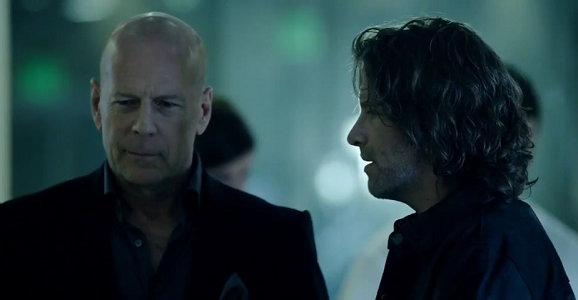
"So tell me,...you here for a paycheck too?"
The story takes place in some undated future where a new society arises called Vice. Established by a man named Julian (Bruce Willis), Vice was created as an outlet for the public, so that for any fantasy they wanted to make for themselves was possible. That meant no laws, no government, no responsibilities and no consequences. Making sure that any acts of violence were performed humanely, the company made A.I. units who looked, acted and lived like normal human beings but underneath there was software and electronics. After one A.I. unit named Kelly (Ambyr Childers) begins having repeated flashbacks of past events, she flees with Vice security on her tail hoping that Kelly won't reveal to the public a unit became self aware. Also following closely behind is Roy Tadeski (Thomas Jane), a lone cop who's not too fond of Vice for generic reasons pertaining to the attitudes people end up adopting after leaving the facility.

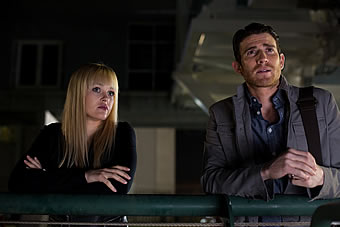
Writing wise, it isn't the absolute worst but it isn't well thought out either. The screenplay tries to tackle a number of social and idealistic issues by borrowing ideas from older films like Westworld (1973), RoboCop (1987) and even The Purge (2013), but much of it is just underdeveloped and underplayed. The actors themselves are okay at best but you would figure, both Thomas Jane and Bruce Willis, who both have enough experience to act would make some kind of an impression. Thomas Jane has a couple of humorous moments in the film but much of it is just him mumbling through a toothpick. Willis is even more disappointing because his role really just feels like a call in. It would actually be more appropriate to say that Ambyr Childers as the rogue unit and Bryan Greenberg, who plays an important character in the plot, are far more interesting to watch than the two veterans previously mentioned. The story itself is not new but it can be tolerated. What isn't tolerated is how it was executed like a standard cat and mouse chase.

Because the majority of characters are quite predictable, there isn't much tension to be found among the scenes that have time constraining ordeals. Another aspect to this movie that isn't exploited properly are the sci-fi elements. Of everything described previously involving A.I. units and software, there is only one scene that looks remotely scientific. This involves rewiring a fuse inside a unit. The rest of the would-be science fiction like A.I. scenes are all done indirectly. An example of this is when Kelly receives an upgrade, which is done off screen. How disappointing - that's really trying to stretch the audiences' gullibility. The other major component that is sorely lacking any exploration is the paradise of Vice itself. The only thing audiences get to see in Vice are acts of murder, drinking and sex. Yeah these are pretty much the kinds of things most people would want to get away with, but with no laws wouldn't there be more to that? Surely someone would be more creative do something crazier than that, of which isn't it kind of the whole point?

Ambyr Childers & Bryan Greenberg
Also how does a visitor to Vice know the difference between a human and a unit? There really wasn't any explanation given. The only science fiction like credit that can be given is the set production to the film. At least that looked somewhat apocalyptic in some respects and they didn't look cheap either. The shootouts are alright but nothing inventive. The part that worked against that however was the cinematography shot by Yaron Levy. There were two things Levy kept doing that will probably annoy the viewers. First, there are two many shots with dutch and other cockeyed angles. The second is that when Levy’s camera is lateral, the camera keeps doing rotating 360 circumference shots. This is better than shaky camera by far but still frustrating at times. The film score however was better than expected. Composed by a trio of artists who call themselves Hybrid did an okay job. There was no main theme but they did have a number of tracks that worked, especially the ones involving Ambyr Childers and Bryan Greenberg. The thing I can't believe is that the filmmakers actually thought that this movie would get a sequel with an extremely obvious cliffhanger.

Its set production and music display decent quality with okay acting by the main cast but it's more of a time waster than it is worth a watch. The writing is below average, the camerawork is frustrating at best, the action is too standard and the science fiction elements are barely used for a story based on it.

Points Earned --> 4:10

Saturday, June 6, 2015

Insidious: Chapter 3 (2015) Review:

Sadly when it comes to prequels to famous movies, it is not the easiest to make this particular kind of entry the best it can be. That comes down to a big key point. The idea is that prequels cover the origins of initial franchise starters (most of which were praised critically and performed well at the box office). The problem with that is, most prequels only explain the backstory to what ended up happening in the first installment. It's more or less only effective in its factual delivery in a historical context. This is good for some areas but not all. The other drawback is that prequels do not add anything new to mix in execution. A good example of this was The Thing (2011) prequel which had spot on explanations to what events lead to John Carpenter's The Thing (1982), but the execution felt nearly identical.

"Don't mind me,...just hanging out here"
The same goes for the directorial debut of James Wan collaborator Leigh Whannell. It's not that viewers will loathe Whannell's work in this entry but unfortunately it lacks a lot of originality. This is also some of the errors many filmmakers have when they end up crediting themselves as actor/writer/director. It is a lot of work and perhaps Whannell didn't have what it took to do all three tasks this time. The story is what unfortunately makes this prequel subpar. After a young girl named Quinn Brenner (Stefanie Scott) tries to contact her mother who passed a year back, a demon hears her through the further realm and slowly begins latching onto her soul. As compared to the original, the story feels awfully similar. The only clear difference is that Brenner is not in astral form and can't reach her physical body. The only writing Whannell incorporates that actually makes any connection to the original is how Elise Rainer (Lin Shaye) meet up with Specs (Whannell) and Tucker (Angus Sampson), briefly referencing the Lambert Family and the crossdresser villain from Insidious (2010) and Insidious: Chapter 2 (2013).

That's the only part of the screenplay that actually works. For that, the fans can sit back and say "Ahhh ok, so that's where that came from". Anything dealing with the Brenner family feels almost non-important though. This is not to say they can't act however, they just feel like they come secondary to everything else, which is sad to see. All actors involved perform decently at portraying the appropriate emotion for each scene. Stefanie Scott as Quinn and her father (Dermot Mulroney) feel believable in their roles but it is frustrating to see that a lot of the time daddy doesn't believe her daughter (even though the situation would be difficult to understand). Angus Sampson and Leigh Whannell maintain their chemistry from the first two films but they do come in rather late in the running time.

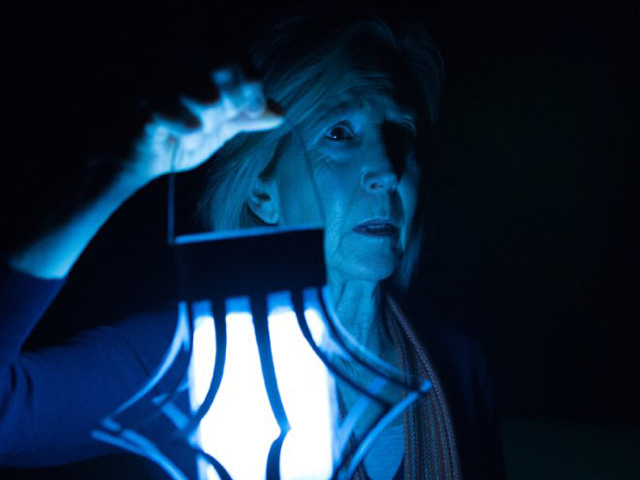
Lin Shaye looked like she enjoyed her role again and even shows some unknown strength later on. The only character that isn't very creative in personality is the ghoul who latches onto Quinn. Played by Michael Reid MacKay (who has also played other horror creatures), the demon he plays here is quite generic looking. The only thing that defines him are his bloody footprints (like the bloody handprint from the first movie) and making gurgley noises through a gas mask. Sure it's creepy, but as the main villain....not exactly memorable. Actually, from what the ending of Insidious: Chapter 2 (2013) gave, it seemed as if this movie would be the prequel about the ghoul that Elise saw behind the girl in the wheelchair. Guess not.

Lin Shaye
Even with this cliched character however, there are a number of effective jump scares and some cringe worthy gross scenes. As cliche as the jump scares are, Whannell at least was able to throw in some tricks here and there, which would have audiences believe the scene is prepping for a jump scare when in fact it's happening at a different time. As long as that works, that means something’s working on the scare factor. The cinematography on the other hand was rather a disappointment. Shot by Brian Pearson (best known for Final Destination 5 (2011)), his view of the further is just as clean cut like the other films but sadly the further is barely used in this movie until the final act. The whole point of the Insidious (2010) franchise is going into the further realm and this entry doesn’t do enough of that. The only other good element to the film is composer Joseph Bishara's film score. Unlike the last two scores which entailed more screeching and whispering violins, this time Bishara actually uses more soft emotional tunes. It's different because normally Bishara doesn't compose tracks like these in such volume. However, this shows Bishara has the talent to produce some really beautiful music when required.

It still has its moments of being creepy, the backstory to all the original characters are nicely explored and Bishara's film score impresses a little more than usual. Even with that said however, the main plot isn't much of anything new, the further realm is not really existent in the running time and the villain is far from memorable.

Points Earned --> 4:10

Thursday, June 4, 2015

Sphere (1998) Review:

Michael Crichton, a science-fiction novelist and screenplay writer for several of his own adaptations has had many of his ideas become successful and iconic pieces in cinema. The best of Mr. Crichton's work is by far everyone's favorite prehistoric predator film, Jurassic Park (1993). That and Westworld (1973) twenty years before. There's something about Crichton's work that has many of the same motifs that show up in a lot of his other written works. One of the most notable elements is the discovery of a new science by humans and it ends up becoming more than humanity can handle. Re-emphasizing this again is in this Crichton adaptation that went largely unnoticed. Was it because it was bad? No but as a final product, there's a lot left to be desired with this sci-fi thriller.

Hoffman, Jackson & Schreiber
The story to this movie is about a group of doctors in different fields that travel to the bottom of the ocean to analyze a UFO that has something mysterious inside. The mysterious plot device that's inside the ship is a giant perfectly shaped golden sphere. After visiting it, strange things begin occurring on the ship and it’s up to the small crew to figure it out. Directed by Barry Levinson (who has produced other Crichton adaptations) shows that he has competent direction in how he wanted the story to play out. Yet his pair of writers didn't seem to know how to make it work to the fullest extent. The writers on board for this production were Stephen Hauser (which was his only credit) and Paul Attanasio. Both of which flesh out the characters and do create some high-strung tension scenes with minor psychological elements but when it comes to explaining the orb, they miss it almost entirely.

The underwater crew is made up of Dustin Hoffman (a psychiatrist), Sharon Stone (a biochemist), Samuel L. Jackson (a mathematician) and Liev Schreiber (a doctor in physics) and two operators; Peter Coyote and Queen Latifah. Of these characters, only Latifah (who has a minor role) seemed slightly out of place; all the rest act fine in their roles. That means distinctive personalities and charms. The actor who viewers would probably find the most likable is Hoffman who has a knack for being mostly nonchalant through each situation he's put into. I guess shrinks are supposed to be this calm? Not sure, but it gives him the right amount of charm. The connection these characters have is that they were all associated with Hoffman's role. Funny how popular 80s singer Huey Lewis even had a small scene stealing moment at the beginning of the movie. Random but a treat.

The sphere plot device is also a treat when things start rolling (pardon the pun). However, this is exactly when the problems begin to arise. In order for strange events to happen, there's got to be reasons to back up and justify these moments. For this case, there is only one explanation given amongst a slew of other questions that go unanswered. One thing that really threw me off was when Hoffman's character discovers a cabinet worth of a specific item. Who stocked that thing? I could see if it was a mind game or hallucination but it was for real. Tell me who had the time to do that? I have to admit, moments like those will keep its audience guessing and with Hoffman's character being a shrink, the psychological aspect to the film does help make the tenseness quite intellectual. The only problem is that parts of it only theorized possible reasons but never gave definitive solutions. These of which were all based on observation.

Hey,...watch out for that fang tooth now
The only other negative part to the presentation of this movie is how it deliberately splits up its acts into chapters. There is no need, for two reasons. One being that, the audience will figure out when the next act is because each "chapter" if you want to call it that fades out to black. The other reason is that giving a title for the next sequence can somewhat spoil the upcoming surprising scene that audiences may not see coming. Instead, audiences are presented with giant bold print stating exactly what's headed their way. Why go through the trouble of shooting yourself in the foot like that? But enough on that, the last bits of the film still work in its favor. This belongs to the cinematography shot by Adam Greenberg (The Terminator (1984) and Rush Hour (1998)) and the music composed by Elliot Goldenthal. Since Greenberg has been the director of photography before for bigger projects, he shows that can effectively conceal the illusion during the underwater scenes. As for music, Goldenthal who isn't always the most memorable actually surprises this time. That means creating themes for certain aspects of the film, which includes creepy piano keys and quite wondrous sounding strings. It really stuck.

The film has competent acting, cinematography, music, interesting psychological elements thrown in and some tense thrills. However, the writing sorely lacks in clearing up much of the plot device that is directly involved in the story other than giving a small assumption only based on observation. That and the chapter segments are a bit unnecessary.

Points Earned --> 6:10

Tuesday, June 2, 2015

The Waterboy (1998) Review:

Adam Sandler has always been one of those known comedians to be grouped into the category of you either love him or you hate him. Very few audiences find him somewhere in the middle. After proving his comic ability on Saturday Night Live, Sandler began moving towards the movie business, getting into bigger and bigger projects. As for director Frank Coraci, it would not be until him, Sandler and writer Tim Herlihy met together to make The Wedding Singer (1998). From there, the three would pair up to make a number of future films. Of this list, this would be their second feature and probably second most respected of that bunch. According to many to be the 1990s highest grossing football game (until later films), this comedy isn't clever in a lot of ways but isn't completely void of laughs either.

Barbecued alligator.....yay
The story is about Southern son of Kathy Bates' momma's boy Bobby Boucher Jr. (Sandler) who gets nothing but disrespect by the people he tries to help stay hydrated. After being on the job serving beverages to Coach Beaulieu (Jerry Reed) and team for 18 years, Bobby gets fired. Looking to keep doing what he's good at, he finds Coach Klein (Henry Winkler), a coach who can't find a way to get his team to accomplish anything. Initially, no one respects Bobby's entrance but soon, they and Bobby discover that he has a knack for tackling others. With that, Bobby is recruited to play for the team as well, leading to unexpected results. For what was written, Tim Herlihy was competent in the construction of the story. All subplots are started and completed and the character develop is noticeable for certain individuals. Possibly the best message this movie sends to its audience is to always try and better yourself. It doesn't exactly come out and say that but watching Bobby progress as a character speaks that in some respects.

The other enjoyable aspect to the writing is watching how Bobby's life begins to turn around. Initially Bobby doesn't have any friends except his mom (Kathy Bates). But as time goes on, the respect and size of Bobby's circle increases in diameter so much, it's hard not to like the guy. This leads to the performances and comedy. For both, it’s half-and-half. Sandler as Bobby makes his character sound and act innocent (which is what makes him likable) but the way he goes about it is a slight bit obnoxious at points only because of how he talks. This involves a squealy voice that only can be made by the way Sandler shapes his mouth. Surely there could've been another way to make his role sound just as innocent without looking so obviously prepared. Seriously, nobody talks with their jaw in that position. But this is the least of silly comedy. Because the setting to this story takes place in the Southern States, a number of exaggerated stereotypes are used in order to make the viewers laugh. One example of this is making Bobby's mom full on rural, no education, alligator barbecuing, the devil is everything wackjob.

Really? There's no problem portraying Southerners and accentuating their culture but there's no reason to be going over-the-top ridiculous about it to the point of absurd and deranged. Another example of this is the character Blake Clark plays, which is being a deep voice mumbler who nobody understands. Who the heck cares about this character? He's just wasting time. However there are other characters that make up for these overblown fabrications like Henry Winkler who's goofy in his right and Jerry Reed (his last role) as the anti-football coach for being nothing but greedy. Fairuza Balk (best know for playing Dorothy from Return to Oz (1985) who plays Bobby's love interest also has more of grounded personality than other Southern supporting characters. Even wrestler Paul Wight has a brief role that isn't as superfluous as it could have been made out to be.

Henry Winkler
There's still a couple of things left to look at. Unfortunately the cinematography covered by Steven Bernstein isn't much of anything significant. Much of the shots taken are very plain looking with nothing that really grabs its viewers’ attention. However, the football games are engaging but not because of the camerawork. This is based more on the how the game is played and how characters react and work together as a team. Even for the silly comedy that it is, the game still feels like there's something riding on it that can't be missed. Finally the music provided by Alan Pasqua (which is his last film composition thus far) worked when it needed to. There was no main theme or anything and much of his music was substituted for other well-known songs to help with the comedy. The only reason why his music is getting a pass is again going back to the football games. Although they were not intense and as engaging as the game, the tracks did help elevate the viewing experience.

The story itself is written properly and the energetic football games are what this comedy really has to offer. The comedy works at times but the stereotyping and exaggerations do get overdone, especially when it comes to Southern culture. Thankfully, the main protagonist is portrayed in an innocent manner that allows it audience to at least like Adam Sandler's performance.

Points Earned --> 6:10

Monday, June 1, 2015

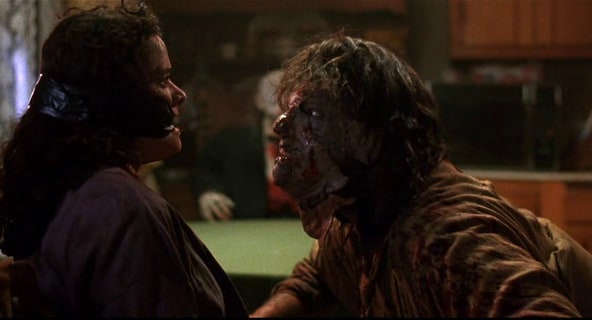
The Texas Chain Saw Massacre III: Leatherface (1990) Review:

It's strange how some horror trilogies work. Most start out groundbreaking. Then the second entry just doesn't satisfy as much as it could have. It had bits and pieces that demonstrated there were possibilities, but the advances were not taken further enough. Then there's the third installment, which most consider to the worst with the least amount of care or effort put into the mix to make any kind of decent product. Some chapters however do step up to the plate from time to time. Some are quite obvious to what has more of the upper hand over the rest, while others however are up for more of a debate on what really was the worst. It just depends on what was found to be of better quality in the production (and that doesn't just mean visuals).

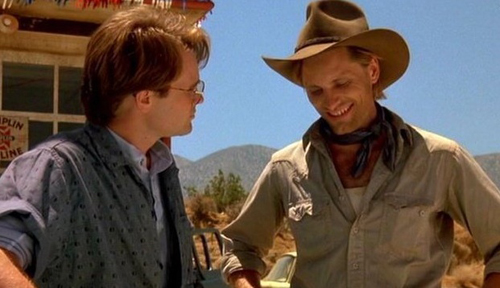
William Butler & Viggo Mortensen
The story for this sequel is as copy and paste verbatim as it gets. When a couple, Michelle (Kate Hodge) and Ryan (William Butler) travel through Texas from California to get to Florida, they run into the alleged Sawyer family. It is that straightforward; there's nothing else. Why should writer David J. Schow even get writing credits for this? Well, even though his story telling skills are very mediocre here, he still manages to draft a couple of acceptable characters but that's about it. On their travels the couple encounters Benny (Ken Foree, best known from George A. Romero's Dawn of the Living Dead (1978)). Of these characters, the only few that remain somewhat interesting are Michelle, Benny and some of the sick-minded Sawyer family. Hodge, like other actresses give their lead courage at certain instances and that's commendable. Foree is praiseworthy in his role because he at least provides good support to the leads. As for some of the Sawyer family, the thing that makes them fun to still watch is how they act as a family; what makes them have a good time and how they improved their way of hunting for food. One of the creepier Sawyer family members is the mom played by Miriam Byrd-Nethery.

As for the other actors, they are intriguing to see at such an early time but they do not provide anything worth while to the plot. William Butler (who would later be the creator behind the el-cheapo Charles Band The Gingerdead Man (2005) franchise) plays an unlikable match to Michelle and does nothing but nags and complains. R.A. Mihailoff as Leatherface is decent but doesn't give the infamous killer any kind of personality other than trying to make a toy understand he wants food. And what's the hair? Is that Jeff Daniels' hair from Dumb and Dumber (1994)? Joe Unger and even Viggo Mortensen have defining roles but don't exactly make themselves act differently from other characters before. On a production level, the only areas that look decent are the special effects, gore and cinematography. Unfortunately, with lots of the original gore being cut, it isn't always on screen but when it is, it is still grotesque and ugly. The camerawork by James L. Carter is acceptable. Nothing groundbreaking but at least is lit in a way that conceals its antagonists rather than putting them out in bright neon lights like the first sequel.

The only other possible credit that can be given to Schow is at least reverting the tone back from being too goofy from that of Tobe Hooper's first sequel. However, this does not excuse the giant gaping holes in this particular sequel's story. Like the past two films, the opening credits begin after narration explaining the events of the past. The difference for this is that this entry seems to be taking place after the first but before the second film. Yet there's a slew of contradicting evidence to try and prove this true. At the end of the first movie, Leatherface cuts his leg so this would support it being an intermediate sequel because in this movie Leatherface has a leg brace. But then there's issue of when did Leatherface have a totally different family and,...a daughter? But this has to be true, because Leatherface was impaled and blown up in the second film right? There's even a scene with actress Caroline Williams (who played Stretch in the previous sequel) playing a reporter. So was Stretch initially a news anchor before a radio host? But the title to this movie clearly states the it's the third.....well at this point it’s undetermined.

"Tell me, do I have spinach in my teeth?"
Then there's the issue of unexplained errors either for characters or events. This for the most part goes parallel to the time in which this film takes place in accordance with the prior films before it. Sometimes parts of this movie alone feel like it was made for a Friday the 13th film, that means including false jump scares and unreliable truths shown on screen. This film is also one of the few to not follow the cliché horror tropes but only through one of these unexplained errors, so its hard to say if it counts really. Finally, the music is an even further step down. Forget what was said about Hooper's score from the first sequel. The musical score composed by Jim Manzie and Patrick Regan is even more unoriginal. There's no main theme again and there's no frantic sounding synths either. Now it's just notes that drudge through each scene that sound more muddled than usual. Topping that off is an occasional rock anthem that'll blast in and come out of nowhere. It's quite jarring to say the least. This is no wrestling match.

It still has the majority of its cast pulling the required weight, the special effects and gore are still good, along with competent cinematography. In spite of that however, its writing suffers from large continuity errors, unexplained justifications and a paper cut out of a plot. The music is also a step down from before, while including unnecessary hard rock in a couple scenes.

Points Earned --> 5:10

Sunday, May 31, 2015

Armageddon (1998) Review:

Back around the late 1990s, Hollywood started becoming obsessed with making movies about the end of the world. Some of which bordered on the edge of unrealistic while others wanted to really scare the crap out of its audience with what sounded and looked like plausible science. Whether it be shifting plate tectonics like Volcano (1997) or the devil himself in End of Days (1999), someone thought up of some way the world would end. For director Michael Bay, his idea was more patriotic, although perhaps a little too self-righteous. Although the plot of the movie is not mentioned to be in accordance with the Mayan calendar, the way it comes across is pretty much "the end of the world"-ish. What's more surprising is that Michael Bay finds this to be his worst movie. I think he should check his list again.

Yeah,....I cared more about this,.....
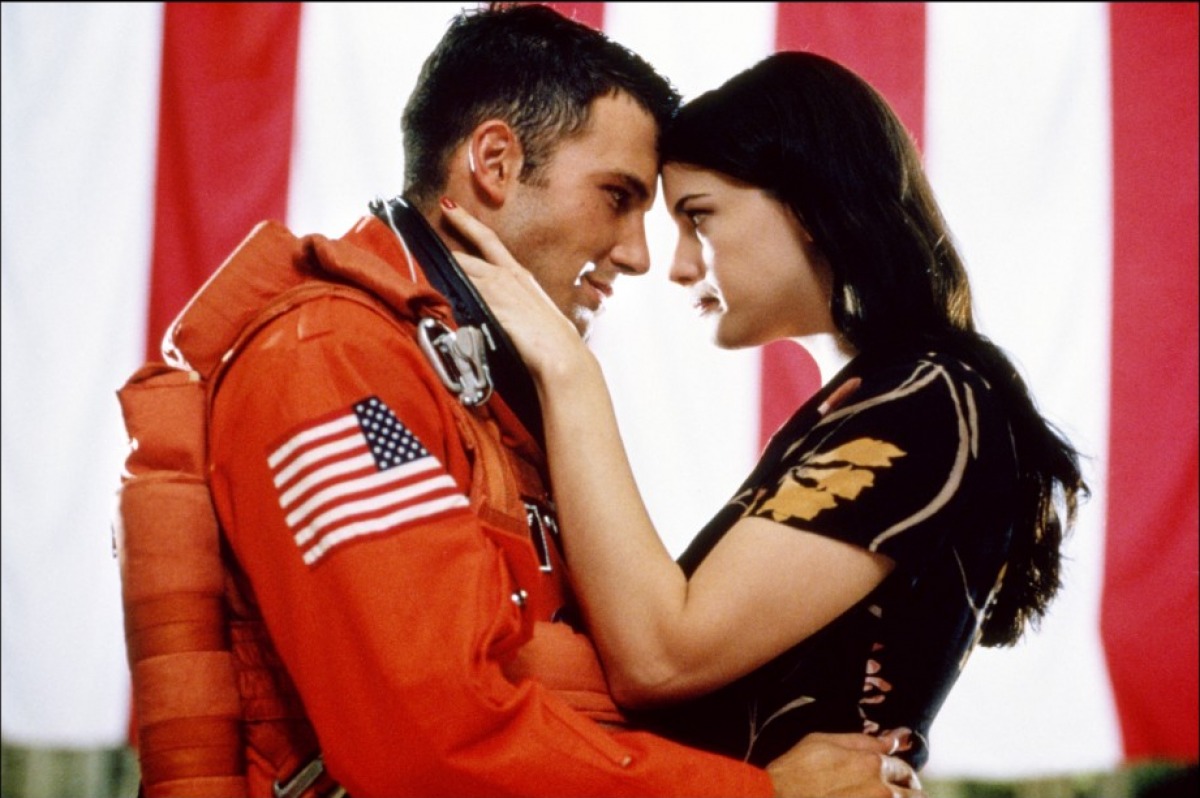
After NASA discovers a gigantic meteor the size of Texas is headed towards Earth, the head of NASA named Dan Truman (Billy Bob Thornton) orders the recruitment of oil driller Harry Stamper (Bruce Willis) to head up to space to knock the "global killer" out of orbit. Stamper accepts but only after the rest of his drilling crew comes with him. The rest of the drilling crew contains AJ Frost (Ben Affleck) who's also dating his daughter Grace (Liv Tyler), Chick (Will Patton), Rockhound (Steve Buscemi), Bear (Michael Clarke Duncan), Max (Ken Campbell) and Oscar (Owen Wilson). The supporting cast also includes William Fichtner, Jessica Steen, Peter Stormare, Keith David and Jason Isaacs. Thankfully, for a cast this huge Michael Bay had some credible writers for this production. Penning the official screenplay for this film was none other than Jonathan Hensleigh (Die Hard: With a Vengeance (1995) and Jumanji (1995)) and a young J.J. Abrams. As a whole, the story is proficient at working with what it has. Most of the characters mentioned prior do have a definitive personality and also portray genuine emotion.

Then again, there are some moments that hint at the typical Michael Bay shtick that always feels unnecessary. Being that the movie is 2 and a half-hours long, there definitely could have been some trimming on the sides. Some scenes either had no relevance or meaning to the story and did not further the plot. All they did was emphasize how silly some characters can be written. Most likely the running time could have been cut down to 2 hours. The only other part that wasn't needed was the love subplot going on between AJ and Grace. It felt forced and cliched. Making matters worse was Liv Tyler's acting ability. She wasn't horrible but she had a very stiff face and in some cases she became quite obnoxious portraying her character. Delightfully, there are enough supporting characters to make-up for her. The most interesting belonged to William Fichtner’s role as a space astronaut caught between his code by NASA or what his gut says. His exchanges with Bruce Willis are quite the attention grabber.

The most entertaining act of the film (and rightfully so) is the final act. It is there that we see Harry Stamper and his crew work as a real team and seeing that happen and how they handle various situations is an intense ride from beginning to end. This also goes pretty much for the cinematography and special effects. All of which blended in nicely as well. The director of photography for this production was John Schwartzman and for what was depicted on screen, it still holds up today. There are large wide panning shots of landscapes but most of it belongs to the meteor, which does look heavy on CGI. Again though, the special effects are something to admire too. For it's time, it could have looked a lot worse but even today it still looks decent.

,......than this
Musically related, the score was composed by Trevor Rabin. Rabin, who's main forte is in the synthetic aspect of film score, does not deviate from what listeners would normally hear. Much of his music contains the same kind of generic electronic keyboard rhythms and action cues. Surprisingly however, Rabin provides a very memorable and emotional power anthem that acts as the movie’s main theme. Although there was no Armageddon 2 (and hopefully never will) the fact that Rabin made such a memorable theme for the movie is commendable. It has a very heroic like tune that makes the jobs being done truly feel a difference is being made. As a recommendation for anyone looking to collect Rabin's score, the best would be to go with the bootleg edition. Most of Rabin's score do not contain more material than 30 or so minutes. But the bootleg for Armageddon (1998) is a little over an hour and a half. It's hard to find film scores with such detail so if you can get a hold of it, I suggest you do.

Like other Michael Bay films, it has a few areas that needed trimming with unnecessary scenes that make the movie longer than it needed to be. Plus, Liv Tyler's acting is noticeably irritating on screen. Other than that, Bruce Willis and the rest of the supporting cast work well, the music is recognizable and the third act to this sci-fi nail biter is quite a ride.

Points Earned --> 7:10

Fruitvale Station (2013) Review:

Controversial topics are never easy to bring up because people can get fired up quite quickly. Yet this kind material needs to be resurfaced again and again in order for people to understand and digest the events that go on around them from day to day. For subject matter like this, there are several mediums the material can be sent through to grab the target audiences' attention. Written works such as books or newspaper articles are one, while the more popular method is on video via biopic, documentary movies or even nowadays, handheld recorded phone video. As for this movie, it's a combination of all three video mediums. The beginning of the film bookends the story with live footage and a documentary style conclusion of the true story that this film was adapted from. The meat and potatoes of the movie is where more of the biopic like execution comes in but only covering one day of the main character.

FVS_162_DF-01547.jpg (4992×3328)
Michael B. Jordan & Melonie Diaz
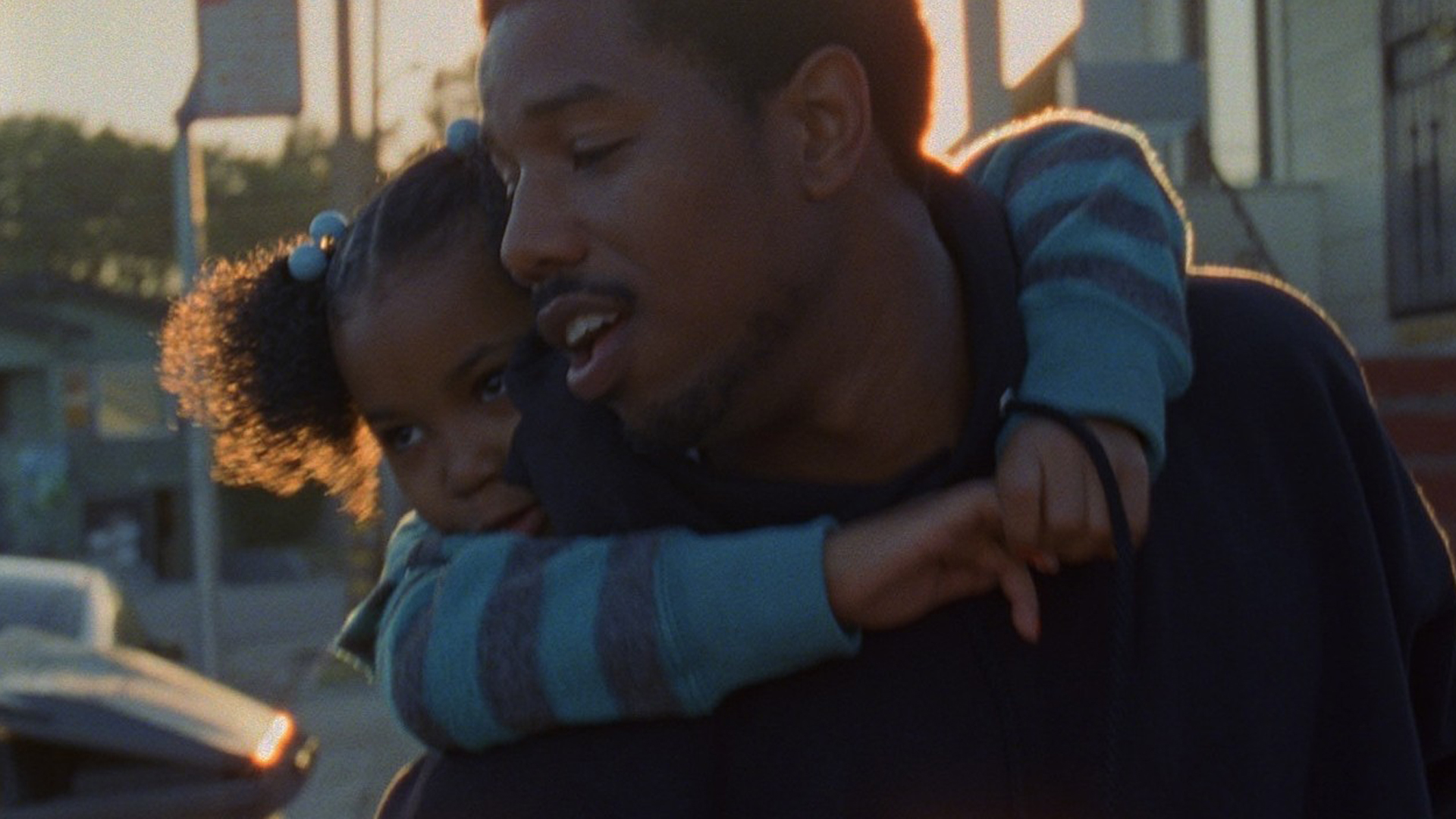
The story follows Oscar Grant III (Michael B. Jordan) from New Year's Eve to New Year's Day, showing the different people he comes in contact with and how he interacts with them. This includes his girlfriend Sophina (Melonie Diaz), daughter Tatiana (Ariana Neal), his mother (Octavia Spencer) and several other characters. It's interesting how one day a lone can display so much character to its viewers. Debuting as writer and director, Ryan Coogler displays the ability to cohesively write and direct this project efficiently to get the point across to his target audience. Every character and every scene has it's own message of which then all tie together in order to tell the story (of which has already occurred). The other notable key skill Coogler has is giving each character the ability to develop in their own way, which then also effects the overall play out of the movie. It'll end up making the audience think on the character's decisions as well too.

The character portrayals is what really moves the story here, mostly because the actors can portray all the right emotions. Michael B. Jordan was a sufficient choice to play Oscar. Jordan represents the misunderstood guy; the one who's making it by but could use a little more of a boost to start living better than he could be already. Oscar knows his living conditions are not top notch but he does what he can to make a good impression on others and be a good role model for his daughter. A good example of Oscar showing that he's working at being a better person is helping out a stranger played by (Ahna O'Reilly), who initially felt uncomfortable with him approaching her due to how he talked and dressed. Melonie Diaz as Oscar's girlfriend shows the strength when needed and that's usually around Tatiana. The chemistry between Diaz and Jordan also feel authentic and match their settings easily with their co-stars.

Ariana Neal as Oscar and Sophina's daughter is one of those rare child actors who show strong promise at an early age. Not only is her acting believable, but the intelligence and innocence that she gives the character of Tatiana is likable. Octavia Spencer as Oscar's mom also demonstrates the needed traits to be the mom of her older son. Spencer's chemistry really matches with Jordan's. Besides these main characters there are a number of other scenes that help define them and their surroundings. All of which go through the same motions most other people do everyday; sadness, euphoria, intimacy and frustration. This all goes back to the social commentary the film's message is trying to get across. Although individual's have troubled pasts, that doesn't mean any of them can change. Some are always working to be better than they were and the unfortunate thing is, sometimes society doesn't see that. Thus, making it a continuous uphill battle for the misunderstood.

Being a father
The musical score composed by Ludwig Göransson is decent for what it gives. There is no main theme but that's expected because this isn't a franchise anybody was looking to make. Plus, the score is fairly simplistic and minimalistic, yet effective. It is a little difficult to make out what instruments are being used mainly because the tracks aren't very long. But one of the best cues however is when the scene focuses on Oscar being a dad, this uses oscillating guitar chords making it sound innocent and home-like. It's those moments that work the best. There's only one element that could've used some improvement and that's Rachel Morrison cinematography. For what Morrison shows, much of them were good shots. The only problem was the camera’s stability. Surely this movie was not filmed by a camcorder, yet many of the shots are constantly wiggling around. For some scenes it can more understandable than others but most just requires the camera to be observing the events not being active in it. Perhaps Morrison was trying to make it feel as real as possible, maybe.

Aside from camerawork that is a bit too unstable for no apparent reason other than maybe to be as realistic as possible, the overall execution to this biopic/documentary is strong in its message to its audience. The music, writing and characters are all well developed and the actors that portray them suit the roles well, especially Michael B. Jordan as the main lead.

Points Earned --> 8:10

Thursday, May 28, 2015

Hellraiser IV: Bloodline (1996) Review:

When movie franchises begin to get "long on the tooth", everyone from the director and the film crew to the studio producing the film, are required to come up with new ways to make the viewing experience fresh for the audience that follows it. These are the guidelines that should be followed when occurrences like this happen. Of course we all know that's rarely the case except for the few. Most money hungry studios end up taking the full reign of the production and end up demanding the final result being fairly an exact copy of previous entries made or drastically changed the concept itself. Thus leading to the trend of diminishing returns. For Clive Barker's Hellraiser (1987) franchise, the trend is mostly the same, except the issues are in other places this time.

"Who knew this box, would be such a hit"
Compared to Hellraiser III: Hell on Earth (1992), this entry doesn't really surpass it, but it does at least feel more on track than the prior one does. Originally Kevin Yagher (a make-up and special effects artist who had experience in other horror films) was set to direct as his debut film. Unfortunately, Miramax Studios, which then owned the rights fought with Yagher, causing him to quit. However, one man who hasn't left since Hellraiser II: Hellbound (1988) was writer Peter Atkins, who once again penned the script. In this chapter, the year is 2127 and audiences are introduced to Dr. Merchant (Bruce Ramsay) an inventor who has discovered a way to destroy Pinhead (Doug Bradley) and his followers forever. Regrettably, he is stopped before he is able to finish by a group of soldiers who came to take him away. To stall time, Merchant convinces Rimmer (Christine Harnos) to listen to why he needs to finish what he was doing. The story Merchant tells is how the Cenobites were first released and how they connect to his family ties.

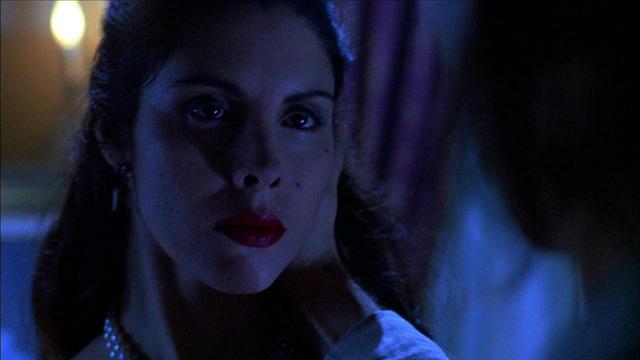
The fact that Atkins went in even further than before to explain the back story to Pinhead and his origins is again commendable, but sadly this new information totally contradicts the three films before it. None of the main characters in the prior entries were related to Merchant, so why did their fate have them come in contact with Pinhead? Also what about the multiple boxes that Dr. Channard had in his office from the second film? If these boxes act as portals, what makes you think destroying one box will keep Pinhead out forever? It just doesn't add up. Along with that is a new pseudo-villain named Angelique (Valentina Vargas) who also has a past with Merchant, but only him. Of the characters in the story, the only people that matter and viewers will enjoy is Dr. Merchant, Angelique and Pinhead. Bruce Ramsay (who ends up playing different versions of himself) manages to at least be competent in his role and certainly more convincing than Terry Farrell from the previous movie. As for Vargas and Bradley, they both looked like they enjoyed their roles. Doing all kinds of evil acts and such.

On the flip side, the rest of the cast is completely forgettable. There is no character development, not even for Rimmer who listens to Dr. Merchant. There's also a young Adam Scott and an older Kim Myers (from A Nightmare on Elm Street 2: Freddy's Revenge (1985)) and they too have no real significant importance. But aside from characters, Atkins did change a number of things for the better. One being the tone; the third movie had a completely different tone to that of the first two. Many fans took it as too goofy and cheesy where Pinhead was portrayed more as a generic slasher villain. Here, Pinhead still kills just cause, but he's not as blood hungry either. Another plus is the creativeness of the cenobite designs, which unlike the third film looked quite gimmicky. Here, they look more like what Pinhead's followers would look like. Then again, fans may also complain because there really isn't a lot of new additions. Throughout the whole film, only three new cenobites appear of which one wasn't even human and they also don't receive a lot of screen time. Along with that is a possible dislike for the smaller amount of gore too. With that it may not be as scary either.

Angelique (Valentina Vargas)
Yet, the kill scenes are still quite gruesome. Another interesting edition to the mix of the franchise is the use of CGI, which doesn't look that bad. It's used minimally which is how it should be used. The cinematography shot by Gerry Lively is a slight improvement over his work in Hellraiser III: Hell on Earth (1992). This time instead of showing Pinhead in the sunlight all the time, he is kept in the shadows and this helps him feel more mysterious and dangerous. Finally for the musical score, Daniel Licht who would later be known for his music in the Dexter (2006) TV show composed the tracks. Thankfully, Licht exceeds Randy Miller's score from the prior film by adding new themes for the cenobites and making a variation of Christopher Young's original theme that was created from the first film. Much of these tracks use the same string build up, choral echoes and percussion but its the deviations that make it more appealing to listen to than recycled tracks.

It still doesn't anywhere match the first two original movies and most will probably find it equal to that of the Hellraiser III: Hell on Earth (1992) quality, but even for the production troubles that it had and nonsensical story telling, it can be a more entertaining watch. Although the likable cast is few, it is made up with more back-story, a better-written tone, appropriate costume design, acceptable special effects that don't look dated and a better film score.

Points Earned --> 5:10

Tuesday, May 26, 2015

Liar Liar (1997) Review:

By the middle to late 1990s, Jim Carrey had solidified his presence in Hollywood history by moving from Saturday Night Live skits to major box office grabs like Ace Ventura: Pet Detective (1994), The Mask (1994) and Batman Forever (1995). It seemed as if Carrey was destined to always play some kind of supernatural character that had no limits as well as not being able to live on the common social level at the time. That is until he starred in this movie. For this role, it was actually a step down from the weird and crazed out parts Carey had played in the past. It is by no means as toned down as his performance he would later play in The Truman Show (1998) but at this point, it was the beginning of that transition. The story follows Fletcher Reede (Carrey), a lawyer who loves doing what he does by unethically lying to get by; that also means his family. After missing out on his son's birthday, Max (Justin Cooper) wishes that his dad couldn’t lie for one whole day, which ends up coming true.

Can you trust that sad face? - Carrey's I mean
The catch is, Fletcher has a huge case coming up which if he wins (by lying) he could earn the big bucks. The script written by Paul Guay, Stephen Mazur and directed by Tom Shadyac (who has worked with Carrey before) prepare and execute the story properly. Specifically the way the characters are written is a big part. The Reede family show that his son and divorced wife Audrey (Maura Tierney) try endlessly to work with Fletcher's schedule of lies but it wears thin quickly. Making things tougher is Jerry (Cary Elwes) a friend who's moving out and wants Audrey and Max to come with him. Another large strain are the characters that take part in the court case, mainly Samantha Cole (Jennifer Tilly) the defendant and Fletcher's boss Miranda (Amanda Donohoe). All of these smaller threads are taken care of and provide the right character development for Carrey's role. The other interesting spin the writers put on this story is how the plot uses morals, ethics and social commentary on the judicial system as a backdrop for the entire message of the film.

The only problem to the writing is the wish that Fletcher's son, Max makes. Up and until the wish is made and takes full effect, the audience gets the idea that the world they are in is the real world. However, when the wish is made Fletcher can't control himself. By what means made this come true and what's keeping him from making a lie? Most would consider this very nitpicky and too critical but it is a giant question in the film's story. Who has the power to grant these wishes? Do they apply to other children or people in general? All unanswered questions that probably the writers had no time to think about. The best supporting element to the story however is Jim Carrey's comedy. These are the moments that allow Jim Carrey to be himself and be spontaneous with his responses were which many are sure most lines were unscripted. But it's also not just the lines, the actions Fletcher takes to make sure that he doesn't get himself into trouble is hilarious too. Some of which situations are so extreme it makes the viewer wonder if one would go to such measures too.

"The pen is,.....Rrrrrrr---oyal blue!"
The other elements that work in this film’s favor are the music and cinematography. The director of photography belongs to Russell Boyd who is competent in his work at getting the right shots from the courtroom to the office hallways. However, the best things Boyd does is when Fletcher starts going crazy. This leads to various angles at which the camera portrays other objects in the room as other living things. That's clever because audiences then begin to believe the object being focused on is living. As for music composed by John Debney who didn't have many well-known scores released at the time manages to pull off the comedic and dramatic scenes quite well. The only negative thing that can be said is that it sounds very dated with its familiar like 90s family comedy drama sound. It sounds so 90s. Finally the only other thing that dates the movie more than it should have were the visual style of the haircuts and dressers back then. Haircuts like Jerry's are just really old looking now. Other than that it's good.

The dated sounding music and visual appearance of the actors don't let it age well. Plus the reasoning behind how Max's wish came true weren’t explored. But for the most part, the writing is spot on with well-developed characters, downright laugh out loud scenes, and the story's subtext commentaries it addresses.

Point Earned --> 7:10

Sunday, May 17, 2015

A Nightmare on Elm Street 3: Dream Warriors (1987) Review:

It's a rare case when a sequel makes a comeback in a franchise that begins going downhill in quality. Unfortunately with the law of diminishing returns it's not easy for that to happen. When audiences start figuring out that the connections between stories are not being regarded and nothing new is being added to create a cohesive part by part saga, they begin to ignore and not support the cause. Once that happens, it becomes very difficult for the name to come back with something that'll make everyone forget the bad taste that was put in peoples' mouths. Yet for horror franchises, it’s much harder for this issue to occur since many just went to view the picture for the kills. But this is a unique case where the third entry (which usually is the worst in a trilogy) ended up being better than the second.

Heather Langenkamp looking much more like a woman O_O
However, the only big problem this installment has is where it lies in the timeline. The title suggest that it takes place after A Nightmare on Elm Street 2: Freddy's Revenge (1985) yet throughout the running time, nothing is mentioned about the events of this film's first predecessor (which also happened to acknowledge the original). Plus the original had a false ending so how did Nancy escape Krueger at the end of A Nightmare on Elm Street (1984)? This makes it confusing because many Krueger fans believe that Part 2 shouldn't exist, but it was made, so with this productions four writers, something could've been quickly added in to reference the last film. Besides this though, the rest of the writing works aggressively at making sure its audience will enjoy and care more about this set of characters than the last movie. When a bunch of kids start suffering from dangerous dreams at a mental ward headed by Neil Gordon (Craig Wasson), Nancy Thompson (Heather Langenkamp) returns to help the struggling fatigued youths fight back against Freddy Krueger using the powers of their dreams.

The reason behind Krueger attacking these kids is that they are all that remain of the Elm Street kids of the parents that killed Freddy. This time, the motivation for Freddy is clear. Why not for Part 2? We'll never know. Making his directing debut and partially writing for this entry is the underrated Chuck Russell. Co-writing with Russell is the return of Wes Craven, Bruce Wagner and future 3 time oscar nominated Frank Darabont. For this alone, it only feels right that the story has more substance this time around. Having John Saxon and Heather Langenkamp reprise their roles was a major plus and the new set of youth  or dream warriors as they call themselves, are certainly more charismatic than the last bunch from Part 2. The dream warriors consist of Roland (Ken Sagoes) the tough guy, Joey (Rodney Eastman) the mute, Taryn (Jennifer Rubin) the punk, Phillip (Bradley Gregg) the geek, Kristen (Patricia Arquette) the believer and a couple others all of which have a distinct personalities. Heck even Laurence Fishburne has role in this movie!

Veteran actress Nan Martin plays a specific role that is pretty creepy for the story. Again Langenkamp and Saxon provide just the right amount of nostalgia for the fans so that they have plenty to fall back on from the original film. Even Craig Wasson's character is quite useful through the story. Of course we can't forget Robert Englund as Freddy Krueger himself. Like every time before, Englund looks like he's having a blast and any line that he says is darkly funny in its own right. The writing also includes more interesting scenes whether it be the dream sequences or back story information to Freddy Krueger. It additionally doesn't follow the normal horror tropes either which is commendable. The dream sequences whether it be the kills or the act of fighting back go hand-in-hand with the special/practical effects and cinematography shot by Roy H. Wagner. This makes the dream scenes and kills much more creative, diverse and gruesome than the prior entry.

.....and Freddy's on Dave Lettermans lol
Lastly, the only other element besides continuity that doesn't sit well with this sequel is the musical score composed by Angelo Badalamenti. Future horror composer Christopher Young composed the musical score from Part 2 and sadly it was a let down. This was due to Young omitting the original A Nightmare on Elm Street (1984) theme composed by Charles Bernstein. For this score, Badalamenti reprises the creepy main theme that composer Bernstein created. except it feels rather shoehorned in a couple times than it is effectively put into the right places. Along with that are horror cues that sound even more synth keyboard emphasized that Bernstein's score. It might be more accurate to say that it resembled that of Richard and Charles Band production quality; it really sounds cheap. This is baffling considering everything else with this entry had such better quality, the music should have received a boost as well, but it didn't.

The continuity is vague in its timeline placement and the musical score sounds cheaper than usual even with the return of the memorable creepy theme. However, with better dream sequences, kills, a cast of new dreamers, the return of original characters and a story with more clear motivations, this sequel gets very close to the original.

Points Earned --> 7:10

What About Bob? (1991) Review:

There have been movies released before about crazy or uncontrollable characters let loose to follow a certain somebody and drive them up a wall. The most recognizable of comedies that had this kind of set up were films like Ben Stiller's dark comedy The Cable Guy (1996), Duplex (2003) or Kurt Russell's Captain Ron (1992). Both of which were about main characters’ mental issues that somehow were able to get away with everything, meanwhile simultaneously annoying the living crap out of the person they cling on to. This is no different on a narrative level; the formula is all there. The only change are the leads, their positions on the social ladder and the location. The real element that will win over its viewers will be Bill Murray - if you’re a big fan of him.

"I'm on top of the world!"
To be realistic it is not a bad performance and Bill Murray doesn't play the worst character. However, he's still not that likable. In fact, none of the characters any actor plays is that likable. The day before Dr. Leo Marvin (Richard Dreyfuss) leaves for vacation, a fellow psychiatrist transfers one of his patients, Bob Wiley (Bill Murray) to be checked out. After visiting Dr. Marvin, it is revealed to Bob that Dr. Marvin is going on vacation. With that, Bob does everything he can to see his Dr. again for psychiatric help. Tom Schulman best known for writing Dead Poets Society (1989) and Honey, I Shrunk the Kids (1989), penned the script for this comedy with the legendary Frank Oz directing.

The strange thing is, like stated before, the execution isn't anything new. The direction is too well known - crazy person introduced to potential host, host becomes victim of crazy person’s antics while nobody else believes them. Unlike The Cable Guy (1996) and Duplex (2003) which were mean spirited comedies and Captain Ron (1992) being more dimwitted than anything else, this just plays out irritating. Thankfully, Bill Murray's character wasn't written to be mean spirited, in fact his role is more innocent by nature. The problem is he just doesn't take a hint when someone says leave. With that Bill Murray comes off as more obnoxious than anything else. He's not sick-minded or a jerk, so that kind of makes him acceptable but not likable really because there's little to sympathize for. Bob could be a likable character if he was written more as a character than knows he's causing trouble but can't help it. Instead, Bob causes pain to others and doesn't even notice it. Then again though, that may be due to his dumb surrounding characters.

It truly is amazing to how oblivious people can be. Since when are family members so accepting of a professional's patient to show up on vacation, sleep with them in the same room and eat at their table. Not to mention teaching their kids bad words. Doesn't that raise a couple, if not more than a couple red flags? Haven't they heard of the phrase, "don't bring your work home with you"? Dr. Marvin seems to be the only one who notices and understands that. It's weird because everyone else is so accepting of Bob and yet they don't deal with him in the same manner as Dr. Marvin. Plus, some of the smallest things Bob does everyone finds it hilarious, especially Mrs. Marvin (Julie Hagerty) who is quite annoying too. Saying "MmmmmmMMMMmmm" after every bite of food at the dinner table really stirs up that many chuckles ? It's because of their lack of concern and care for the victim that makes them unlikable as well and contain no charm. Clearly stated in the movie, one of the reasons why people like Bob is because he's fun and old man Dr. Marvin wasn't.

"Isn't he so fun dad?"
Maybe writer Tom Schulman was trying to get the message across; that you can't live life being a stick-in-the-mud all the time (meaning relax now and then). But aside from one subplot about Dr. Marvin's son trying to learn how to dive, there is no indication of Dr. Marvin being a father who can't have fun. The only reason why nobody finds Dr. Marvin fun is because he's trying to get rid of a patient that is following him and can't get rid of. Wouldn't that make you act rotten too? These supporting characters are so thickheaded. The only actor that is funny on occasion is Richard Dreyfuss. The reason for this being that even going back to the years of Jaws (1975), when Dreyfuss got frustrated, his yelling was more comical than it was dramatic. Nonetheless, since this is a comedy, Dreyfuss is funny in a number of areas because his character has no other way of dealing with the problem (being Bob). Cinematography this time by Michael Ballhaus  wasn't anything important, it doesn't showcase much. The music however, composed by Miles Goodman is alright, although it does sound very close to that of his more popular score a year later from The Muppet Christmas Carol (1992). It's not terrible but it isn't good comedy either, unless you're a true Bill Murray fan.

Hardcore Bill Murray fans should have no problem with this but if you tire of formulaic host comedies where some crazy person makes everyone turn on the already label victim, it'll be a frustrating sit. It's not the worst because Richard Dreyfuss is funny and Bill Murray's role isn't mean spirited, but the whole play out is just annoying to sit through anyway.

Points Earned --> 4:10

Swamp Thing (1982) Review:

There's something about lesser-known comic book characters when it comes to being adapted to film. For odd reasons they don't receive as much critical or financial success. Yet it has been proven that these characters can become popular if done right. An example of this is James Gunn's Guardians of the Galaxy (2014). Heck nobody even knew they were a Marvel property until the studio announced they were being put to the big screen. This only shows that the right people have to be involved with how the production is conceived and executed. The antithesis of that example is Man-Thing (2005), also produced by Marvel but in no way taken care of in the same manner. Like the character of Man-Thing, DC also had their version called Swamp Thing, which received its rendition way before Man-Thing's film was even thought of. But being that it was the second DC character to be portrayed on the big screen, one would think it would have done as well as Superman (1978) and Superman II (1980) for being new and different.

Dr. Holland & Alice Cable
Instead, the film went underground and gained a cult following. It's not that it was bad but it certainly was not written anywhere near the same depth as Superman (1978) and its sequel. The story follows Alice Cable (Adrienne Barbeau) who meets Dr. Alec Holland (Ray Wise) in a new discovery where plant cells can be fused with animal cells in a solution. To Holland's dismay greedy man Dr. Arcane (Louis Jourdan) wants his findings for himself and destroys his lab. Attempting to escape, Dr. Holland accidentally collides with his experimental solution and mixes in with his swampy surroundings. This leads to him becoming Swamp Thing, a creature with super strength, regeneration and healing powers. Written and directed by indie horror fanatic Wes Craven, thankfully this feature does entertain on some level. It is surprising though that Wes Craven works with such a toned down picture. The violence is nothing compared to his works before like the dreaded The Last House on the Left (1972) and The Hills Have Eyes (1977).

The cast of characters isn’t extremely unique but they do portray the proper emotion and do have their own personality. Ray Wise makes Dr. Holland sound very intelligent yet not bookworm-ish enough to be a total geek. Adrienne Barbeau as Cable is charismatic and even demonstrates some tough behavior, which is always encouraged for most female lead characters. Cable also meets a funny kid named Jude (Reggie Batts – which is his only film credit). It's weird how this actor didn't continue because he had some comical lines throughout the film. Playing the Swamp Thing character was Dick Durock and for the 1980s, his look is close to that of the comic. The only actor who isn't the most interesting is Louis Jourdan as Dr. Arcane. Besides being a jerk for his selfish reasons there really isn't much of a personality behind the character. I'll admit his voice is a bit captivating though.

Aside from acting, the writing does miss in one particular area. This belongs to Swamp Thing's powers. The strength boost is explained, but how he knew what makes him regenerate and healing others is left unchecked. All Craven needed to do was add in one scene that shows how Swamp Thing discovered these abilities and that would at least cover half the problem. Sadly, the powers are just thrown in for the scenes that needed it. The ability is different but there's no development to how it came about. Also the middle section to the movie does drag because of a long-winded chase scene. Unfortunately adding to that are some standard action sequences. Most of the events that happen are very 80s era type tropes. That's not to say all of it is, but most and because of the rather underwhelming action, the pace of it slows. No reason to be too concerned though, that's it for the big issues. The visual style of the film is something to behold though.

That's some camoflage....
One of the most interesting visual techniques used is the transition editing by Richard Bracken. Not every change between scenes is different or the greatest looking but a number of scene changes involve comic book like transitions, which really help solidify the feeling like the viewer is watching a comic book movie. As stated for Dick Durock's Swamp Thing portrayal, the practical and special effects are dated in some areas but are also something to admire for at least having the ambition. One note being that the solution Dr. Holland develops has the same color and glow to that of the serum Dr. West would use in Stuart Gordon's Re-Animator (1985). Robbie Greenberg's cinematography looks great too with wide shots of the swamp with plenty of sunlight and color. Lastly is composer Harry Manfredini's score. Unfortunately, due to him working consistently on the Friday the 13th (1980) franchise years prior, much of his music sounds reminiscent to that of those scores. That means tinkering keys and blaring horns for the tense moments. However, there is one musical cue that makes it worth while and that is the love theme for Cable and Alec. The theme uses a clarinet and harp and the tune is completely memorable. If it weren't for that, Manfredini's score would be considered unoriginal.

DC's second original comic book movie isn't as smartly written and doesn't have the massive action spectacle to that of Richard Donner's Superman (1978) but it is still highly watchable. The leads can act, the music works, the effects are decent and Swamp Thing as a character is unique all by itself.

Points Earned --> 6:10

Saturday, May 16, 2015

Rocky IV (1985) Review:

It's interesting how fate works. Sometimes it seems like no matter how hard someone tries to move on from his or her current state, just can't cut a break. A few people may believe that it is a calling of higher purpose. Something of which an individual cannot or try to escape. After three prior entrees, it feels as if Rocky Balboa (Sylvester Stallone) can't find a way to unbind himself from his boxing roots. There were some words thrown around in Rocky II (1979) and the seed was finally planted in Rocky III (1982) after losing Mickey. Once Clubber Lang was defeated, it seemed as if Rocky was decisively taking a step down from his lucrative pastime or so he thought.

"Welcome to Russia, where I must break you..."
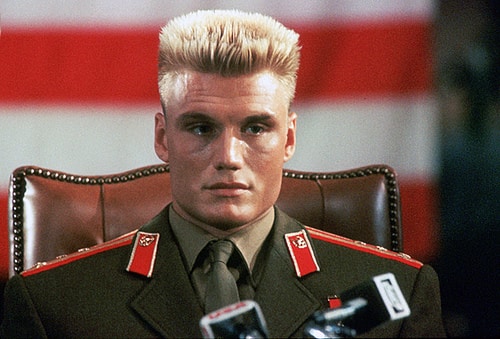
Enter Ivan Drago (Dolph Lundgren in his first starring role), the heavy weight boxing champion of Soviet Russia. A man of few words whose height towers among many and has a penetrating stare. Believing that his opponent should only be Balboa, Apollo Creed (Carl Weathers) steps in first to face Drago. Sadly, Creed underestimates Drago and dies in an exhibition match. Looking to avenge his long time friend, Rocky decides to take the rematch to mother Russia himself. And right when Balboa thought he was about done! This installment again retains a number of key elements that help made the original such a hit but just as well misses in areas too. Once again Stallone is credited as writer/director of which this time keeps most of the direction focused this time. Unlike Rocky III (1982) which focused on the glam of fame, this chapter returns to what made Rocky likable and that's his family, friends and how he interacts with others.

Although the run time is shorter than the predecessors are, the chemistry between all the characters felt more equal than Rocky III (1982). Burt Young as Paulie still has his funny lines and Talia Shire as Adrian shows her concern for the people she cares about. Audiences even get to see Rocky interact with his son this time! For Carl Weathers, as his last appearance in the series is great to watch too. There is one specific scene where Balboa addresses Creed about him fighting Drago and whether it is worth it. The words exchanged feel meaningful and put the situation into the right perspective. Some may think otherwise though because Lundgren's character has very little to say. However, when looking at Drago from the perspective of which he grew up in, it's not like his training real gave him a reason to say much. He was trained to win and winning was all he knew. However, this does not excuse these other particularly questionable areas in the film.

An example of this are two montage scenes that are supposed to be throwbacks to the past films but it's done in such a random order than it doesn't quite work. With that, the scenes feel like filler, making viewers feel like they're beginning to waste their time. Another thing that doesn't make much sense is Creed's motivation to fight Ivan Drago. Didn't Creed remember what happened to Balboa when he was so eager to fight Clubber Lang from the previous entry? When you make haste without thinking or preparing, serious consequences may come your way. Creed knows this, so why did he not remember it? The whole USA vs USSR backdrop makes sense but again, why didn't Creed prepare properly for the match? His decision was rash and it cost him dearly. Wouldn't it have been more effective (emotionally) if Rocky and Creed prepared and then Creed lost?  Wouldn't that be more heartbreaking? This is something Stallone could've included in his script but (obviously) wasn't used.

Even for a boxing film, Bill Butler gets nice scenery shots
Another aspect that is sorely lacking is the musical score. This time the music was composed by Vince DiCola (best known for The Transformers: The Movie (1986) score). This was also DiCola's first entry in the film score profession. To say that it’s bad is unnecessary. In fact, DiCola actually uses the Rocky and training montage theme in his score; the problem is he doesn't utilize it to its fullest capacity. Instead, the themes are hinted at only briefly. Other than that, the rest of the tunes belong to synth orchestration, which doesn't really fit the Rocky series except for the occasional pop song. With Bill Conti's signature piano, string and horn absent there aren't enough instruments for the audience to get attached to per scene. Even the emotional scenes aren't as effective as they could've been because the score doesn’t match. However, the film isn't devoid of entertainment. The fight scenes are still lively. Lundgren and Stallone really throw the punches in this entry. Plus cinematography by again Bill Butler worked at its job. Once you do a certain job for so long you end not having to change much. Butler has maintained a consistent look in the Rocky series and he hasn't disappointed yet.

This entry is fairly equal to Rocky III (1982), it just has problems in other areas. The writing and direction is a tad better which focuses more on its characters than it does fame and glory and Dolph Lundgren's debut is nothing short of good entertainment. However, it still suffers from unnecessary scenes, a contradictory motivation for Creed and a disappointing musical score, which unfortunately lacked the Bill Conti touch.

Points Earned --> 6:10

Thursday, May 14, 2015

Volcano (1997) Review:

Disaster movies go way back in cinema. Just like how gore hound fans love to see their deadly horror films, there's also a large crowd of viewers who live to watch disaster features. For unexplained reasons, studios and screenwriters alike have a fond interest of showing to their audiences how mother nature could flip the birdie at us. Unfortunately like a lot of other movies, there isn't much of anything clever about these types of films. The problem is because the movie focuses more on the natural disaster itself more than the characters; especially during the late 1990s when special effects started being abused instead of being utilized. This film has that but does have a few points that make it worth the time to see (once).

Jones & Heche and gray snow
When worker Mike Roark (Tommy Lee Jones) of the Office of Emergency Management is notified of a couple burn victims in man-made underground pipes, he decides to find out what caused such a freak accident. Believing it could have been a pipe burst, Roark discovers something much more dangerous than he thought. Consulting to Dr. Amy Barnes (Anne Heche), they hypothesize that the cause is actually an active volcano. As a story, this is about as far as it gets when it comes to anything that moves its characters. Initially the story starts out with what seems to be a political/social take on (possibly) what has happening in California at the time,...but it never really gets addressed. As for characters, the only actors who save themselves (performance wise) are Tommy Lee Jones, Don Cheadle and Keith David. Everyone else quite honestly wasn't necessary with all the numerous story threads. Their roles are there for cliche development and that's it.

There's a subplot about a nurse played by Jacqueline Kim that doesn't go much of anywhere and Roark's daughter played by Gaby Hoffmann wasn't that important either. Even as significant as Anne Heche's role was, she still has a cliche character. Also what’s with her and liking much older men? She has a crush on Jones in this movie and falls for Harrison Ford in Six Days Seven Nights (1998). It's interesting to see who wrote the script for this movie. Credit is given to Jerome Armstrong and Billy Ray. Armstrong only has this movie to his credit. However, Ray has apparently improved because he now has critically acclaimed films like The Hunger Games (2012) and Captain Phillips (2013) on his resume. But for this work, it can be seen that he hadn't perfected his skill just yet. The only pluses that can be given in the writing are the several tense scenes which involve the flowing lava peril or when the people of the city are working together. Both scenarios are polar opposites in tone but they also work effectively in bringing out the right emotion while watching the film run its course. It's funny how that works.

Ok, who left the oven on?
Mick Jackson directs the film and although it gets the job done in areas mentioned prior, the direction is just standard. This was also his last feature film to direct for the big screen. Since then, he has moved on to directing TV show episodes and TV movies. The cinematography provided by Theo van de Sande looks decent. Considering Sande had more than 20 years of experience before this, rightfully so his work should look good. Sande does not have wide scoping shots but they at least conceal the illusion that this movie was not filmed in a large city. The special effects to the lava also looked decent although a couple times some shots were recycled. Finally the musical score composed by Alan Silvestri work well. Again, when it came to the emotional scenes it did work in its favor. Considering that this is not a franchise, listeners should be able to understand why there was no memorable main theme. That's acceptable for this kind of movie.

It’s a very basic thriller when it comes to characters and their development. Plus the fact that it's a disaster movie doesn't exactly have anything to highlight other than the disaster. Thankfully, some of its main leads, peril scenes and effective music manages to make it entertaining enough to use some of the viewers time.

Points Earned --> 6:10