Friday, September 25, 2015

Hotel Transylvania 2 (2015) Review:

For cartoons, Genndy Tartakovsky has had his hands in and on a lot of peoples' favorite shows. There's something about Tartakovsky's vision of cartoons that breathes life into every movement that is made by them. Tartakovsky made his directorial debut with Hotel Transylvania (2012) and although it was not universally renowned, made people found it to be a fun family movie with a well-developed story, energetic animation and colorful characters. Plus even though it dealt with Halloween related characters, the idea wasn't to scare but make light of the characters and the lore of which they originated from. Here we are with its sequel and although it does keep several elements from the original the same, some things have changed and other parts should have changed. Thankfully, this sequel isn't brought down a whole lot, but it is enough to notice the differences in what should've been focused on more.

Drac & Family
The story to this installment revolves around Dracula (Adam Sandler) trying to bring out the inner vampire of his hybrid grandson Dennis (Asher Blinkoff) brought upon by newly wedded couple/parents Mavis (Selena Gomez) and Jonathan (Andy Samberg). The reason for this is fearing that if their son has no vampire blood flowing in him anywhere, Mavis would end up leaving the hotel for good. Although the premise isn't as obvious, unfortunately the execution ends up feeling very similar to that of the first (plot wise). Dracula claims he is more open minded now but still clings to his past and tries to hide his true ambitions. In some respects, this particular play out moots the point of the first film altogether. Once Drac accepted Jonathan into his world, he should've been prepared for what came after. It just makes it feel like he didn't learn from before. The writing group for this entry shrunk in size. For the first film, five writers were involved. Here only two were, of which only one of them were from the original five.

The one from the original five was Robert Smigel, a writer for multiple Saturday Night Live episodes. The other writer credited for this film was Adam Sandler and unfortunately it shows too. How? Two words, potty humor. Yes, and it sticks out like a soar thumb. Hotel Transylvania (2012) did have some silly moments but none of the comedy required potty humor. That's not to say all of the scenes don't work, but there are scenes where experienced viewers will be able to point out the scenes that Adam Sandler had wrote in. It's just not necessary. Of all problems with this and a familiar plot, that's it. For the moments that don't included immature humor, the rest of the comedy bits are new and contemporary, which is having the characters play off of their own flaws and personalities or trying to have them figure out social media. Drac can't seem to understand that to use a touch screen, you can't have long fingernails. He'll get it I'm sure.

There's also new character additions to the cast, which is great although sometimes it can sink a film if it becomes over saturated. All the original characters voiced by Adam Sandler, Selena Gomez, Andy Samberg, Kevin James, David Spade and Steve Buscemi all sound exactly as they should and still play off one another well. Even Keegan-Michael Key who replaces CeeLo Green as Murray from the first film practically sounds the same too. Some of the new voice actors to jump on board or receive more attention are Sadie Sandler as Winnie (one of Wayne's children), Jon Lovitz as a "phantom of the opera" type character and the comedy guru himself, Mel Brooks playing Vlad, Dracula's father. It really is nice to see a bunch of new and old voice actors work together though. Plus, a star talent like Brooks isn't wasted either. His appearance isn't as long as everyone else's roles but he comes in at the best time.

Mel Brooks does not say "Blah Blablah"
Again since this production was headed by Tartakovsky, the animation and character designs are nothing but great. The character designs are all unique and have intricate texture detailing. Alan Hawkins who worked as an animator for the first film serves a senior animation supervisor for this entry. Considering his past work being on projects like Cloudy With a Chance of Meatballs (2009) and Arthur Christmas (2011), Hawkins feels like a great collaborator for Tartakovsky's vision. The film score produced by Devo member Mark Mothersbaugh continues his usual work but again fails to provide his listeners with an actual soundtrack for download. The score itself matches the scenes well and portrays the right emotion but it's weird that Mothersbaugh can provide a score for Cloudy With a Chance of Meatballs (2009) or The Lego Movie (2014) but can't for these films. Why so selective in distribution?

It's not a huge step down from the original but it is noticeable. The sequel does maintain all the character relations and chemistry while adding in new ones like Drac's father voiced by Mel Brooks. It also keeps the same great animation and music. Unfortunately although the premise feels new, the execution is very much parallel to the first film in some ways. Plus with Adam Sandler now active in writing the script, some his childish annoying potty humor got in the recipe as well and it's obvious as all get out.

Points Earned --> 7:10

Black Mass (2015) Review:

Johnny Depp is a well known and praised actor for his work by portraying colorful various characters. However in recent years, many began to think Depp was running out of ideas on how to make his roles unique. A role many loved from his early 2000s was the lead role in Pirates of the Caribbean: The Curse of the Black Pearl as Captain Jack Sparrow. Audiences and fans a like began to notice that as time went on, Depp began taking liberties with his acting choices and translating many of Sparrow's mannerisms into his other roles. Although hardcore Depp fans do not mind this, objective critics were not impressed with all the doppelgangers. Then there's this film which completely flips the Depp perception of his usual odd and quirky roles into something that will truly showcase that Depp has more to add. There really isn't much to pull out on the spot for this project. Several of the elements in this production blend so well that it's very difficult to go back and think about what needed work or stood out as bad.

That's not a smile that should make you feel comfortable
Johnny Depp plays the Irish fist-throwing/trash-talking Jimmy "Whitey" Bulger, a real life small town gangster during the mid 1970s who ended up soaring to the F.B.I.'s most wanted list after the early 1990s. Competently directed by Scott Cooper (Out of the Furnace (2013)) and written by Mark Mallouk (his first credit) and Jez Butterworth (Edge of Tomorrow (2014)), this group of people and the cast tacked on make this story quite the watcher. The writing covers the material as if it were a documentary but does it in such a way that demonstrates to the audience what actually happened other than the people being interviewed giving it all away. It's not incredibly ingenious but it is smart because it gives the viewers a better idea of the people involved and how they dealt with the situation that was erupting during that current time period other than hearing from them decades later. The only thing that is worth mentioning that should've been brought up is how Bulger got his mentality that he was so infamously known for? There is no backstory for Bulger's motivations. Why was he the way he was?

Other than this, everything else works great. Casting wise, Johnny Depp as Jimmy Bulger is jarringly different from recent acting choices and it is a delight to see him as the fouled-mouthed Irishman. Depp's voice is grainy sounding, his receding blonde hairline and cloudy blue eyes really make this something to remember. Even though the background to Bulger's eventual trademark characteristics are not expanded upon, Depp's performance is dumbfoundingly captivating. For such an antagonistic character, the writing and Depp combined are able to give even Bulger small tidbits of humanity that don't even seem possible. The reason why this is almost shocking is because most audiences are not supposed to feel sympathy for such a character. What's weird is that there are times where it seemed as if Bulger did have his soft moments. For example, when Bulger makes a promise about a certain topic, he honestly sounds like he's giving a scout's honor. Then again, it was hard to tell because of how deceitful his personality was. That alone is demonstrated quite early on. This is how devious the writing and the character is.

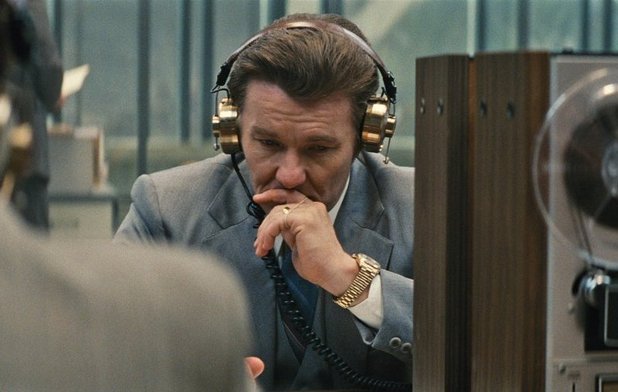
Along side Depp is Joel Edgerton as John Connolly, an old friend of Bulger who feels he owes him a favor. Benedict Cumberbatch plays Bulger's brother Billy who also knows Connolly and frequently associates with him. Actors Jesse Plemons and Rory Cochrane play Bulger's henchmen who show they are just as loyal to Bulger as is Connolly and Billy. There's also scenes with Peter Sarsgaard, Kevin Bacon, David Harbour and Adam Scott who work along side Connolly in the F.B.I. agency. The majority of these characters get a good dose of character development and each actor performs exceptionally well. The violence although not gruesome, is certainly brutal no doubt. The killings are mostly direct and to the point about what the job is and there are some that will make the viewer hope they don't ever have a run in with a character like Bulger. Not even a can of spinach would save somebody against Bulger; contempt is what he lives on.

Listening in on Bulger rumors
The cinematography shot by Masanobu Takayanagi has a skilled visual flare to it as well. Since this film has two methods of story telling, there are also two methods of camerawork. For the documentary style part of the narrative, Takayanagi films those scenes completely still and close up like an interview would. As for the rest of the execution, Takayanagi films the rest of the scenes like other films. Thankfully there are no shaky cam shots, or disorienting continuous rotating 360 shots. Every scene is well lit and is steady no matter where the camera goes. The film score composed by Tom Holkenborg, better known as Junkie XL also brings in some nice cues to the table. It was a little questionable at first because of how Holkenborg likes to mimic several of Hans Zimmer contemporary synthetic type cues but here Holkenborg actually provided a enjoyable listening experience that includes strings and piano that emotionally capture the trouble that goes on throughout this crime thriller. It's tragic and sounds great.

The only thing that sticks out as of needs for improvement was explaining how Jimmy Bulger got his motivations to become what he's known for. That's not much to say though with a talented supporting cast, gritty violence, effective camerawork, tragic sounding music and a defining performance from Johnny Depp that is quite opposite from the majority of his previous roles.

Points Earned --> 8:10

Friday, September 11, 2015

Saturday Night Fever (1977) Review:

As infrequently as some oldies tunes happen to pop up on the radio, there was a time when that's all it was believe it or not. During the 1970s, the wave of disco joints multiplied by the day. Besides the 1960s and 1970s promoting peace and love, it also became a time where dancing was the "in" thing to do. Everybody was doing it. It was a craze that took a nation by storm where all people wanted to do was party and dance. For movies, the 1970s were also a time of many successes that have created quite an impact on today's culture and society. One of the most widely popular films to be remembered from that era was Star Wars: Episode IV - A New Hope (1977). However for movies that capitalized on the dance wave at the time, the best known and respected film to represent such a time was this film. It does have some components that could've been left out or fixed but mostly it is an entertaining film of its time.

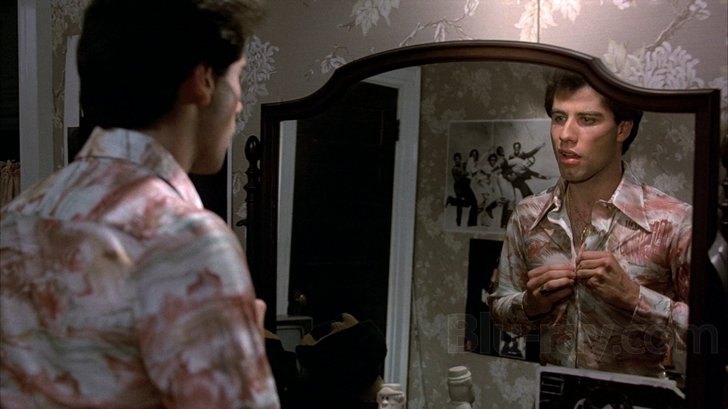
Hard to believe that's John Travolta
Written by Norman Wexler (Serpico (1973)) and directed by John Badham (in his first feature film), the story is about a late teen named Tony Manero (John Travolta) who lives in a world where the only thing that matters to him is the weekend. He's a nice kid at heart and works hard but just wants live his life in the present. During the day he works at a paint shop, later he hangs with his immature goof ball friends, gets badgered by an old flame named Annette (Donna Pescow) and then has the same dinner every night with his family of high expectations. What Manero looks forward to on the weekend are the disco dances. While attending a party one night he comes across a dancer who catches his eye named Stefanie (Karen Lynn Gorney). It's at that moment Manero wants her to be his dance partner for a competition. For all the prior subplots going on around Manero, they do serve the purpose of character development but they also fall to the wayside over time.

The reoccurring moral of the script is the power of choice. Everyone has a choice to be or do what he or she wants in life. Manero's family wants him to become a priest like his brother Frank (Martin Shakar). Annette gets told numerous times by Tony that she has to decide on whether she's going to act like a woman or a prostitute. Tony is also challenged on his beliefs by Stefanie and when his boss tells him to stop spending his money frivolously on the weekend. Stefanie even gets some of her own medicine thrown back at her. Tony friends are a gradual eye opener as well. Every single supporting/main character has a specific role to play when it comes to character development and it is handled properly. The problem is once the change in character occurs, the supporting threads and their respective characters disappear and aren't concluded in the most direct of ways. The only other component to the writing is some of the slang dialog used. Yes, the 1970s were a much different time. However, this still does not excuse the fact of using various racial slurs.

Other than this every other aspect to the film is enjoyable. The acting is competently performed. It is a bit jarring to see the difference in years when it comes to how much John Travolta changed. Also voice-actor Paul Pape has a role as one of Tony's goof ball friends. The acting and writing also effectively capture the mood and attitude of the era. As stated before, disco was a craze at the time and many people hopped on the bandwagon just because everybody was doing it. Plus with all the issues surrounding Tony, going to the disco was also a good representation of how disco was an escapist activity for a lot of people. For the people who took part, it was a moment in time where people would forget about their troubles and just enjoy the night. The cinematography shot by Ralf D. Bode fit well with the scenes too. Bode was able to acquire a number of odd angles and establishing shots that in some ways felt like the camera was prepping the audience just as much as the scene was.

"Everybody dance!"
The choreography handled by Lester Wilson was crafted nicely as well. A year before, Wilson worked on Sparkle (1976) which proved to be a success and it didn't change here. Wilson's ability to get the entire cast to work in synchronized motion is impressive. That and all the dance moves that Travolta and Gorney perform are well staged. It's unimaginable how much practice went into making sure those dance numbers were done the right way in one shot. That takes patience. The music for this film is practically scoreless with only a few tunes composed by David Shire. The rest was handled by English pop group The Bee Gees (Barry, Maurice & Robin Gibb). The movie itself would probably not be as memorable or popular if it weren't for the numerous songs heard throughout the background. Songs like "Stayin' Alive", "Night Fever", "How Deep Is Your Love" and "More Than a Woman" are just some of the songs that'll stick in the viewers mind. It's also interesting to watch the dancing with these songs because of the viewers’ knowledge of music, how sensual the emotions are in the performances.

Unfortunately for its time it suffers from racial slurs that are still not excusable and its subplots are well written until they aren't needed anymore leading to indirect conclusions. These flaws are thankfully made up for with the abundance of character development, appropriate acting, memorable music tunes and well-staged dance choreography. It is a time capsule that defined the 1970s.

Points Earned --> 7:10

Friday, September 4, 2015

Dark Water (2005) Review:

Ghost stories are a very common occurrence throughout history. Whether the actual phenomenon was portrayed in a good light or not, most people who believe they saw one get weirded out. Seeing something that looks like the image of a long gone person or animal is kind of strange. In literature, a ghost exists because of not being laid to rest appropriately, a curse or something along those lines. For director Hideo Nakata who has made several Japanese horror films, many producers seem to like remaking his films. In 1998, Nakata released Ringu (1998), which would later become The Ring (2002). During that year, Nakata released another original film of his called Honogurai mizu no soko kara (2002); this would eventually become this film. For what is presented here, it is moderately entertaining but it is nowhere near as being a great ghost feature. However even with that said, it does provide a brief enjoyable deviation from the usual horror tropes.

Jennifer Connelly
The story is about Dahlia (Jennifer Connelly), a mother going through a divorce with her husband Kyle (Dougray Scott) who are both trying to figure out who will have custody over their daughter Ceci (Ariel Gade). After a counseling session goes wrong between the parents, Dahlia moves with Ceci to a city further away from Kyle. There they settle in old apartment building owned by Mr. Murray (John C. Reilly) and managed handyman Mr. Veeck (Pete Postlethwaite). Upon picking their suite, Dahlia notices the ceiling to her bedroom is leaking water. Within a couple of days the leak becomes worse and Dahlia takes it upon herself to figure out what the problem is on the floor above. Unexpectedly, Dahlia comes into contact with a ghost that not only will make her situation more tense but also jeopardize her daughter's life. The overall narrative penned by Rafael Yglesias (which was most likely just lifted from Nakata's work) feels solid. However, looking deeper into the cracks reveals various continuity errors.

The acting and characters work effectively in their designated roles. Both Jennifer Connelly and Dougray Scott are convincing as a troubled couple but also show their love for their daughter as well. Seriously though, poor Dahlia - she goes through so much throughout the running time. On top of that after Dahlia moves to the new city, she's hit with a lawsuit by Kyle so she hires Jeff Platzer (Tim Roth) as her lawyer. Platzer probably shows her the most respect (other than Ceci). The duo of John C. Reilly and Pete Postlethwaite as the apartment managers demonstrates what happens when people don't take care of the property. The best actor of the bunch goes to Ariel Gade. She's the highlight of the feature just because how strong her character is at such an early age. How does one even deal with the events put onto them so well without cracking? It is also because of her innocent nature that she feels like the only one who doesn't have such a dim outlook on life. The ghost is played by Perla Haney-Jardine and although she's doesn't shine as much as Gade, she is creepy.

The continuity errors to the script belong to Haney-Jardine's ghost role. Whenever the ghost is around, water begins to get pitch black and gross. However at first, it seems it's only the water in the apartment. Yet when Ceci's at school, the ghost can make the water dark there too – how? This brings in the other question. Most ghosts are bound by which the place they thrived as a human being. So why is it that she can move to the school but yet is bound only by the apartment? Not making sense here. Another good question that isn't answered (non-continuity related) is where are all the tenants at Mr. Murray's complex? Practically nobody shows his or her face. Does anyone live there and if they do where are they? The creep factor is definitely alive in this film though. Besides the fact that the rating is PG-13, there are a number of good scenes that just involve establishing shots of various places in Dahlia's apartment suite. Plus with the fact that the whole apartment owned by Mr. Murray doesn't look the best, it just adds to the uneasiness of what is being portrayed. Thankfully, there are not a lot of jump scares to this feature.

That leakage....
The cinematography shot by Affonso Beato compliments a lot of the scenes dealing with the apartment and rain itself. Throughout the movie, it rains almost the whole time. It is rare that weather sets a tone for a movie but that's what occurs here. The rain immediately does that with its consistency and gloomy grey atmosphere. Another thing to take note of is the lighting used per scene. Much of the colors in each scene have a drained yellowish look to them as if they lack actual life. It's a nice touch. The film score composed by Angelo Badalamenti does its job too. Unlike his first effort in A Nightmare on Elm Street 3: Dream Warriors (1987), which consisted of a pure cheap sounding synth performance, this effort is far superior. Badalamenti has a much more organic sound and it uses minimal synth in the back for atmosphere. Actual piano, strings, harps and horns play the rest of the sound. There's also a main theme for the film and it is beautifully tragic highlighted by solo piano keys. A much better listening experience.

Its writing has some big plot holes that don't make sense but it doesn't drag the film down entirely. The characters are believable, the creepiness is there (without a ton a of jump scares), the camerawork matches the mood of the story and the music is hauntingly memorable.

Points Earned --> 6:10

Monday, August 31, 2015

Bride of Chucky (1998) Review:

Although he was late in the decade, the foul-mouthed serial killer Charles Lee Ray who transferred his soul into a "Good Guy Doll" still made a name for himself as a famous horror icon. After transferring his soul into the doll, Chucky (as he would later be addressed) gained quite a following for his disruptive antics and morbid enthusiasm. Upon his first appearance, Chucky had an imposing presence that made several viewers uncomfortable because of how creepy dolls are in general. However similar to other franchises, the scare factor and level of seriousness viewers began to accept was beginning to stretch too thin. By the time Child's Play 3 (1991) came out, fans and viewers a like became fed up with Chucky's goal of trying to transfer his soul into the body of Andy Barclay. For writer and creator Don Mancini, a small hiatus was in order after being pushed around to make sequel after sequel for his brainchild. A decade after the release of the original Child's Play (1988), Mancini returned and wrote for this feature that began Chucky's new trilogy.

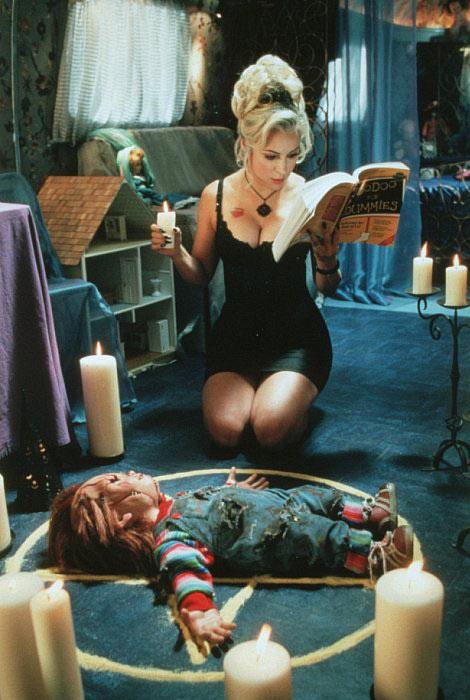
"Give me the power I beg of you......"
To some this was an improvement over Child's Play 3 (1991), while others were shocked the see the abrupt change. What Mancini had changed was the tone of the script. For the last three films Mancini wrote them as if they were literal; happening in the real world. The new intonation was that the story would be self aware in its execution but still continue from where the last film ended (roughly). An old lover of Charles named Tiffany (Jennifer Tilly) acquires the shredded remains of Chucky (Brad Dourif) and resurrects him. After being brought back, Chucky decides in order to finally get out of his body, he needs the amulet he had from the time of Child's Play (1988) located in his casket where he was buried. Paralleling these events is troubled couple Jade (Katherine Heigl) and Jesse (Nick Stabile) who are constantly harassed by Jade's uncle Chief Warren Kincaid (John Ritter) for Jesse supposedly being a bad influence.

As much as some viewers find the self-aware script jarringly different, having the series turn a comedic cheek to that of serious was a good move. Considering it became sillier as time went on, parodying it seems like an okay solution even with its flaws. For example the fact that it pays homage to its own films by clearly making a comment about it is funny for the fans to see. Even better, it references other horror icons directly and indirectly. It does bring up some clerical issues though. For example, other than Chucky how would another character know how Chucky killed people in the prior films? Also, is this now a universe where all the horror icons have been locked up or killed that their item that made them popular is now in storage? It doesn't make sense even if it is funny to see on screen. As for physical comedy, there are some ironic moments in the film involving Chucky's plastic body. Yet again, some bits are silly because of how physically impossible it works out.

One other component to the writing that may make the plot feel predictable is because of how familiar viewers are with Chucky's nature. If you know how Chucky works, well then things may be more transparent than expected. The acting is adequate for what is asked though. Brad Dourif again succeeds at voicing his plastic counterpart with just the right amount of comedic and quotable lines. Jennifer Tilly as Tiffany matches Dourif's chemistry nicely by being just as foul-mouthed and violent. Nick Stabile and Katherine Heigl as the troubled couple feel authentic and end up demonstrating the power of teamwork later on. John Ritter as the annoying uncle plays his part like it should be too. There's even an appearance of Lawrence Dane from Darkman II: The Return of Durant (1995) playing a detective. Since this is a comedy now, there is no scare factor unless the viewer doesn't like stitched up Chucky. The violence though is just as bloody as were compared to its other sequels. The kill scenes just keep getting more and more inventive by the jigsaw doll.

Jade & Jesse
The cinematography shot by Peter Pau was decent too. Pau as director of photography has had more experience in the action genre and his skills are highlighted when the few action scenes in this feature show up. For every other frame, the scenes are well lit and conceal the illusion of the living dolls. Also an important side note; as time has gone on, Kevin Yagher's production of puppet effects designers / puppeteer coordinators has really gotten the knack for lifelike movement. The original Chucky was pretty convincing but now it looks great and perfected. The film score by returning composer Graeme Revell was unique. For this entry, Revell creates a new theme for Chucky and keeps some old ones from his score of Child's Play 2 (1990). He also has a theme for Chucky and Tiffany, which consists of solo guitar and chanting girl choir. The rest of his score has a mix of the classic horror cues and action related arpeggios. The soundtrack containing songs sung by Rob Zombie and others is an okay addition but not necessary per say. It does make it feel quite 90s.

It still has its problems of unexplained loopholes, ridiculous concepts involving physical comedy and continuity errors but it’s a nice self-twist. The self-aware referencing script, the violence, the musical score and acting help make it watchable fluff.

Points Earned --> 6:10

Sunday, August 30, 2015

Watchmen (2009) Review:

With the creation of superheroes and comic books, the imagination of various artists and writers has endless boundaries. Once Hollywood proved to people and fans that adapting such works to film was doable, more and more studios began to hop on the gravy train looking for the most profitable opportunities to franchise. Whether it was mainstream or indie related, more and more comic book properties are being adapted to film due to the sheer craze that is consuming the movie business. For the majority of these cases however, very few productions involved adapt a graphic novel by the page. When it comes to this group of loyal fans, Watchmen (2009) is probably one of the few fans will say played it by the book (literally). Fresh off the critical and financial success of the Dawn of the Dead (2004) remake and 300 (2006), director Zack Snyder took on his second comic book adaptation (the first being 300 (2006)) and it performed just as well as Snyder's other projects.

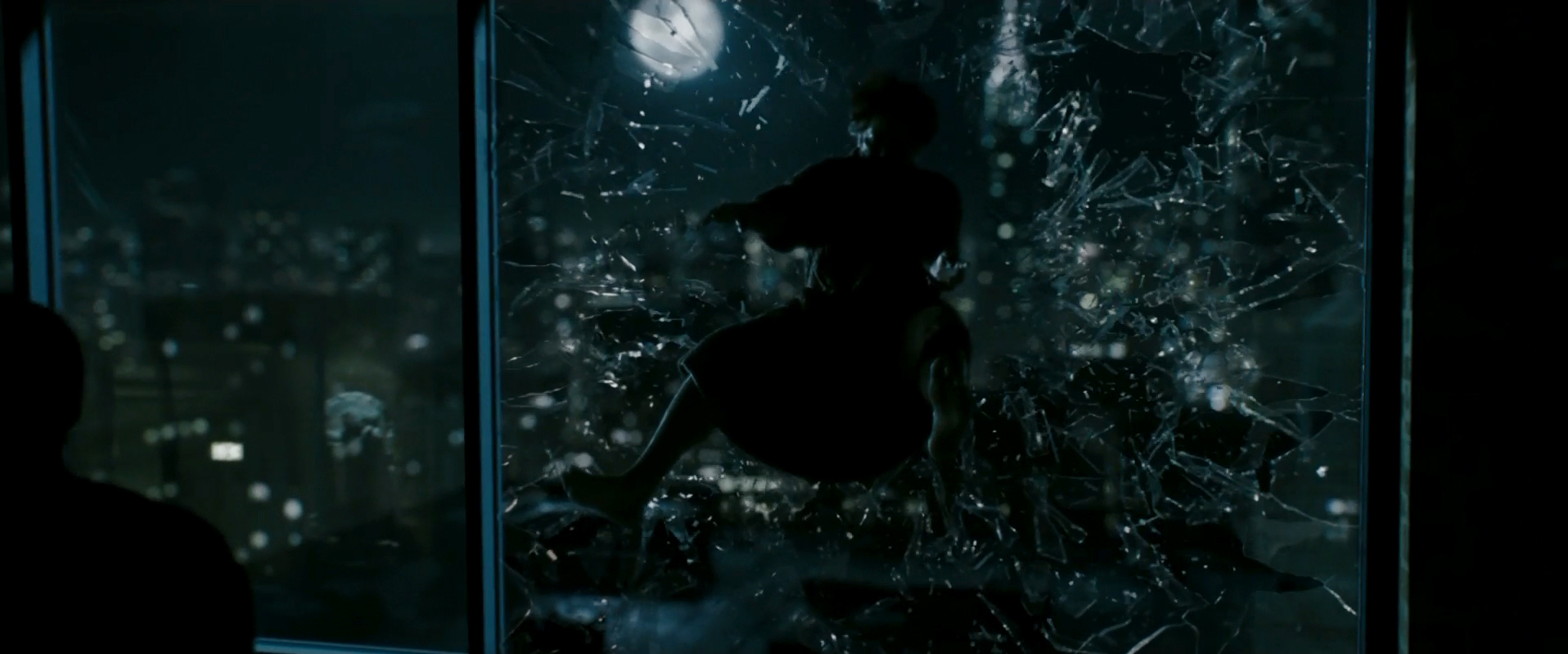
"I believe I can flyyyyyy...."
Lots of fans and critics were pleased with Snyder's visual direction and the writing handled by Alex Tse (his first theatrical credit) and David Hayter (X-Men (2000), The Scorpion King (2002) & X-Men 2 (2003)). There are a number of good parts but for the average viewer, this film is just as confusing as it is watchable. The setting is in an alternate universe in 1985 where Richard Nixon was voted president for a third term. All superheroes must remain hidden and the cold war between the US and the USSR has escalated to where a count down takes place for when everyone fires nukes at each other. It's definitely new because honestly where would the world be if Richard Nixon continued his presidency? The plot is a crime mystery about a superhero named The Comedian (Jeffrey Dean Morgan) is killed by unknown assailant. Upon discovering this, the angry ink-faced detective Rorschach (Jackie Earle Haley) makes his mission to find out what happened while talking with his partners Silk Spectre II (Malin Akerman), Dr. Manhattan (Billy Crudup), Adrian Veidt (Matthew Goode) and Nite Owl (Patrick Wilson).

Now, if this were just a crime thriller or a superhero Vs government debacle or a cold war fight, then the story structure to this would be a lot easier to follow. Unfortunately Hayter and Tse's writing tries to infuse all these giant plots together and it becomes quite difficult to follow for a number of reasons. A big problem is a constant shift in focus. There is nothing wrong with having multiple main characters as long as they are properly developed, and they are in this film. The issue is, the way each character is developed is so detracting from one another, and it begins to get confusing on what the main point of the scene was all about. Another flaw is the unequal tone in its storytelling. Frequently the way at which scenes and characters are shown dramatically swap between serious and comedy in almost surrealist like viewing as if the audience is supposed to laugh. Was this supposed to be a partially black comedy? Some of the sick humor is clear while other times not. The continuity related to time feels all over the place as well.

There are certain main characters that have a picture taken in 1940 and at that point they look like they're in their 30s. Jump to the current period and some of them look no different while others aged. How is it that some aged and others not? This can throw off viewers because they can't tell if they're watching the current or past time. It's not even that frustrating that the film is 3 hours long. It's just that with all this run time, perhaps something would feel in order? There are some areas that pick up for these errors. A big plus is the acting by all actors. The actor who looked like he had the most fun and who many people enjoyed was Jackie Earle Haley as Rorschach. The trench coat, fedora, the Rorschach ink blot mask and the gruff angry voice is makes the character so memorable. All the costume designs are unique in their own way as well. The special effects to Rorschach's mask and Dr. Manhattan look great too.

Rorschach
The action is another important key note. For most mainstream comic book movies that belong to logos like DC or Marvel, most are kept PG-13 for the sake of wider audience distribution and better ticket sales. By 2009 Marvel had a number of R rated films in their library like the Punisher, Blade and Man-Thing features. As for DC, this would be their first R rated superhero film and it is gloriously graphic. Maybe not bucket loads of blood are dropped but some scenes can make the viewer wince at just the thought of what is displayed. The cinematography by Larry Fong is decently crafted. Being that he worked with Snyder on 300 (2006) only seems familial and his work is well integrated in with the CGI. Sadly the film score composed by Tyler Bates and the soundtrack was disappointing. For one, Bates does not have a main theme for the protagonists so that's a bit dumbfounding to start off with. Any other tracks in between aren't really developed and mostly overshadowed by all the soundtrack songs that include various 1980s artists. Again, the music adds to that strange offbeat tone that shows its face time and again. Is it supposed to be hilarious?

It has well designed special effects, gory action set pieces, effective acting and good-looking camerawork. However, its good doesn't make up for the bad. The film score is minimally empty, the soundtrack library of songs and part of its writing don't mix well and create an uneven tone in overall seriousness. There are timeline continuity errors and the focus alternates too much with an overabundance of main plot lines.

Points Earned --> 5:10

Enemy of the State (1998) Review:

For certain aspects in life, there are specific things the average person has no control of. How other individuals interact with each other, how well a piece of operating equipment works or how technology advances itself forward are just a couple of examples. In the current world of today where computers are basically apart of everyone's lives, it's not that difficult for someone to find information on another person. All anyone has to do is go to any search engine whether it be Google, Yahoo, Bing, Ask etc. and they'll at least get 2 to 3 webpages about or are connected to them in some way. It's the scary truth, being on the internet is not always the safest place to be. Looking back on Enemy of the State (1998) it seems that director Tony Scott and writer David Marconi have produced a piece of cinema that is an underrated gem that feels more significant now than it ever was the year it was released.

Will Smith & Gene Hackman
The story is about an attorney/family man Robert Dean (Will Smith) being unknowingly jammed into a big government conspiracy about a rouge senator Thomas Reynolds (Jon Voight) wanting to pass a bill that'll begin invading the privacy of the US residents. What Dean has that he doesn’t know about is a videotape that a suspect hid in his bag that had visual evidence that Reynolds is behind the killing of congressman Hammersley (Jason Robards) who supported individual privacy. The idea of homeland security has always been a controversial topic since the concept was ever brought to fruition and using that as an undercurrent for the script's plot was a thought provoking move on Marconi's part. As stated before with technology being a much bigger proprietor for internet access, the ability to be researched is a lot easier than it was displayed in this movie. Dean ends up being hacked from all directions - his house & mobile phone, home and satellite. Now there's that, the internet, social media and a slew of other devices that make it easy to track someone.

Another part about the writing that is effective is how many times Marconi will keep the audience guessing. Every time there's a point where progress occurs, Marconi writes in an event that creates a new roadblock and a new solution plan has to be made. It's clever because most scripts are cut and dry with either one or (maybe) two remedies to a problem. This at least has three or four and its uncommon, which is good because it keeps the viewers guessing. The only component to the writing that doesn't make sense is how a supporting character was able to figure out where the FBI was located. Isn't the FBI supposed to be covert in their operations? It's a little weird that their main office doesn't seem to feel so secret. Other than that, almost every step of execution to this story is woven in such a way that'll have the viewer on the edge of their seat.

The acting is well done too. Will Smith as Robert Dean plays his character differently compared to other past roles. Throughout the majority of the running time Smith plays his character like an average family man; humble, respectful, caring and not cocky. Occasionally a small bit of the old-school Will Smith humor arises from the cracks but for the situation he's put into, sarcasm sometimes feels like it was needed. Tagging along side later on is Gene Hackman as Edward Lyle, an ex-NSA agent who knows the inner workings of the system and provides some frightening insight to how things run inside the government. With Hackman being a lot older, he plays it up as a grumpy man when he's hungry and although he's not the nicest sounding, he does care at certain instances. Behind these two are a ton of other cast members consisting of Jason Lee, Scott Caan, Jake Busey, Stuart Wilson, Regina King, Lisa Bonet, Gabriel Byrne, Jack Black, Jamie Kennedy, Larry King, Tom Sizemore and even Seth Green.

"Help me Optimus,...I made a boo-boo"
The cinematography provided by Daniel Mindel had a interesting look to it as well. Since this film involves surveillance of various individuals, the camera will have numerous angles to sit at. That means being hidden cameras in various objects, or among the buildings and street property. Then there's also the satellite tracking cameras that usually fly straight down to the location that's being focused on and then watching what's going on from a bird's eye view. Now obviously, the flying down from space to earth is CGI but after that it looks very real. Mindel later worked on other big budget films like Mission: Impossible III (2006), Star Trek (2009), its sequel and The Amazing Spider-Man 2 (2014). The music composed by Trevor Rabin and Harry Gregson-Williams appropriately has the right mix of synthetic and organic sounding orchestra. There are also two main themes, one for the film and another for Hackman's character. They are not that memorable but they do show up more than once and that's good. The action cues aren't as well developed but they do elevate the experience.

Besides one plot hole being a bit too noticeable, the rest of the film is fine. The large cast of actors are effective in their roles, the cinematography carries lots of bird's eye view shots, the music is appropriate and the writing has smart context in its narrative.

Points Earned --> 8:10

Friday, August 28, 2015

Minions (2015) Review:

Stories can be told in any direction and when it comes to movies, studios love to make franchises involving sequels and prequels. Despicable Me (2010) was a surprise hit that had intelligent writing, amiable main characters, plenty of comedy and heartwarming character development. When Despicable Me 2 (2013) came out, it not only continued its success financially but also critically by preserving the elements that worked in the initial installment. Of both films the character that became the official mascot of the series was the minion; the yellow, google eyed, muddle mouthed, squishy, denim overall wearing pills that followed Gru until the ends of the Earth for him to accomplish his mission to be the greatest villain mastermind. It is because they became so popular that a film revolving entirely around them was made. Thus this prequel serves as the backstory to how the minions got to the point of Despicable Me (2010). The question is, does it serve its purpose - kind of but not entirely.

Bob, Kevin & Stuart
The plot to this prequel is actually a bit convoluted. Since the beginning of time minions have roamed the earth looking for a bigger and badder antagonist to follow. After trying through multiple time periods and failing miserably, the minions finally go into isolation. Over time their life becomes stagnant and three minions named Kevin, Bob and Stuart (Pierre Coffin) decide to go out into the world and find their groupies an evil leader to follow. On their travels they see an add for VillianCon - an underground society where evil geniuses around the world come together to celebrate being bad. There the trio find Scarlett Overkill (Sandra Bullock), an outlandish hyper-stylized fem-fatale who has the rights of being the first female villain. For this feature, Brian Lynch (Puss in Boots (2011)& Hop (2011)) served as the screenwriter and seems appropriate since Puss in Boots (2011) was also a prequel film to that of Shrek (2001). However even with this credit given, there's a lot that isn't answered.

The voice acting performed by Pierre Coffin and Sandra Bullock are the highlights in the acting. There are other voice appearances throughout like Jon Hamm playing Scarlett's boyfriend, Michael Keaton as a rogue father of a crime family and Geoffrey Rush as the narrator of the story. Yet none of the other characters are that important because they do not appear in Despicable Me (2010) or Despicable Me 2 (2013); it's rather disappointing. Animation and direction is also a plus. Kyle Balda (Co-Director of The Lorax (2012)) took full reigns of the project and it is competent. The lead character animator credit belongs to Christophe Delisle who has also worked on The Lorax (2012) and Despicable Me 2 (2013). Delisle's animation is smooth, colorful and is comical when it needs to be. Another interesting thing to take note of is the gradual alterations that have been given to Kevin, Stuart and Bob. There's a difference in their designs seeing them from Despicable Me (2010) to now. Possibly the most notable change is that Bob isn't so wide, he's been thinned down some.

For writing other than the main plot, there are several parts that don't make a whole lot of sense. For one, are minions immortal? Besides surviving some of the most hostile environments, did anyone else notice that they haven't aged since they came onto the screen? They lived from the dinosaur age, medieval times to mid 20th century. There's not even a real explanation to where they came from. Another big question are historical records. If minions have existed for this long in time, just how exactly do people in later times not know who they are? Surely someone must have documented such indestructible and loyal creatures. Then there's the whole separate issue of the humans in this particular universe. Unfortunately for England, London was the choice for setting and some of what is displayed is overly exaggerated. The UK police have car chases while pouring hot cups of tea - alright. The whole country of England hands over their entire kingdom to anyone who wears the crown - ummm yeah. I don't think the humans from Despicable Me (2010) or Despicable Me 2 (2013) were this silly.

Scarlett Overkill
The human character reactions to what the minions say on screen is also half and half. Sometimes they look like they understand and other times not. This too goes for the audiences' reactions. This feature unfortunately suffers from taking a supporting character and making it a main character. Sometimes it's not a good idea, especially if you can't grasp their language. Remember The Star Wars Holiday Special (1978)? Yeah it's not as bad as that but same concept. Lucky for us the minion-ese language consists of various common words so it's not as tough as understanding wookies. The music was adequate for the film. Series composer Heitor Pereira returns and maintains the same feeling of the music although there is no main theme. Adding to that are a bunch of old school soundtrack songs from popular English rock bands during the late 1960s such as The Rolling Stones, The Beatles, The Monkeys and others. It's appropriate for the setting.

The voice-acting is fine, the animation looks better than ever and the music works. Honestly for a prequel it is not as well crafted as Despicable Me (2010) or its sequel. Even though it nicely ties in the events that took place before the minions met Gru, it leaves a lot of big questions in its place. Those minions are lucky they're so likable because otherwise it would not have been as enjoyable even at the most minimal level.

Points Earned --> 6:10

Thursday, August 27, 2015

Dumbo (1941) Review:

The story of Dumbo (1941) is one of those classic films that most children do not go without seeing at an early age. At the time Disney was having financial troubles. Although Fantasia (1940) and Pinocchio (1940) were critically acclaimed, both failed to bring in a profit for the animation giant. Interestingly enough the screening of Dumbo (1941) did the exact opposite and even managed to be made during an animators' strike during the current time. Like a lot of the other Disney films, the iconic elephant would become apart of the library of assorted characters to represent the Disney company. The only thing that sets Dumbo apart from other Disney mascots is just how many people and fans remember him more than others. He probably comes 2nd or 3rd to Mickey. For this to stick that much there must have been something in the film to make it hang around so long in the conscious of the viewers.

Mother & Son <3
That something is what goes into this story's writing penned by Joe Grant and Dick Huemer. The story is about a newborn elephant with ears larger than normal being brought into the world by mother elephant Mrs. Jumbo. Yet with his ears being abnormally big, the name Dumbo ends up being his new name by the local snot nosed gossip circus elephants. Upon one show, locals begin to make fun of Dumbo, which enrages mom causing her to be separated from him. Feeling sad and alone, Dumbo befriends Timothy Q. Mouse (Edward Brophy) who sympathizes and wants to help him. There are two main components that work in the script. The first is the mother/son relationship between Dumbo and his mother. The other part is the life lesson of never stop believing in oneself and to never let others bring you down. Dumbo in some ways parallels that to an early version of WALL·E (2008); where the main character does not have much or if any dialog. This kind of writing isn't always effective because it's harder to portray emotions on a verbal level but that's not a problem here.

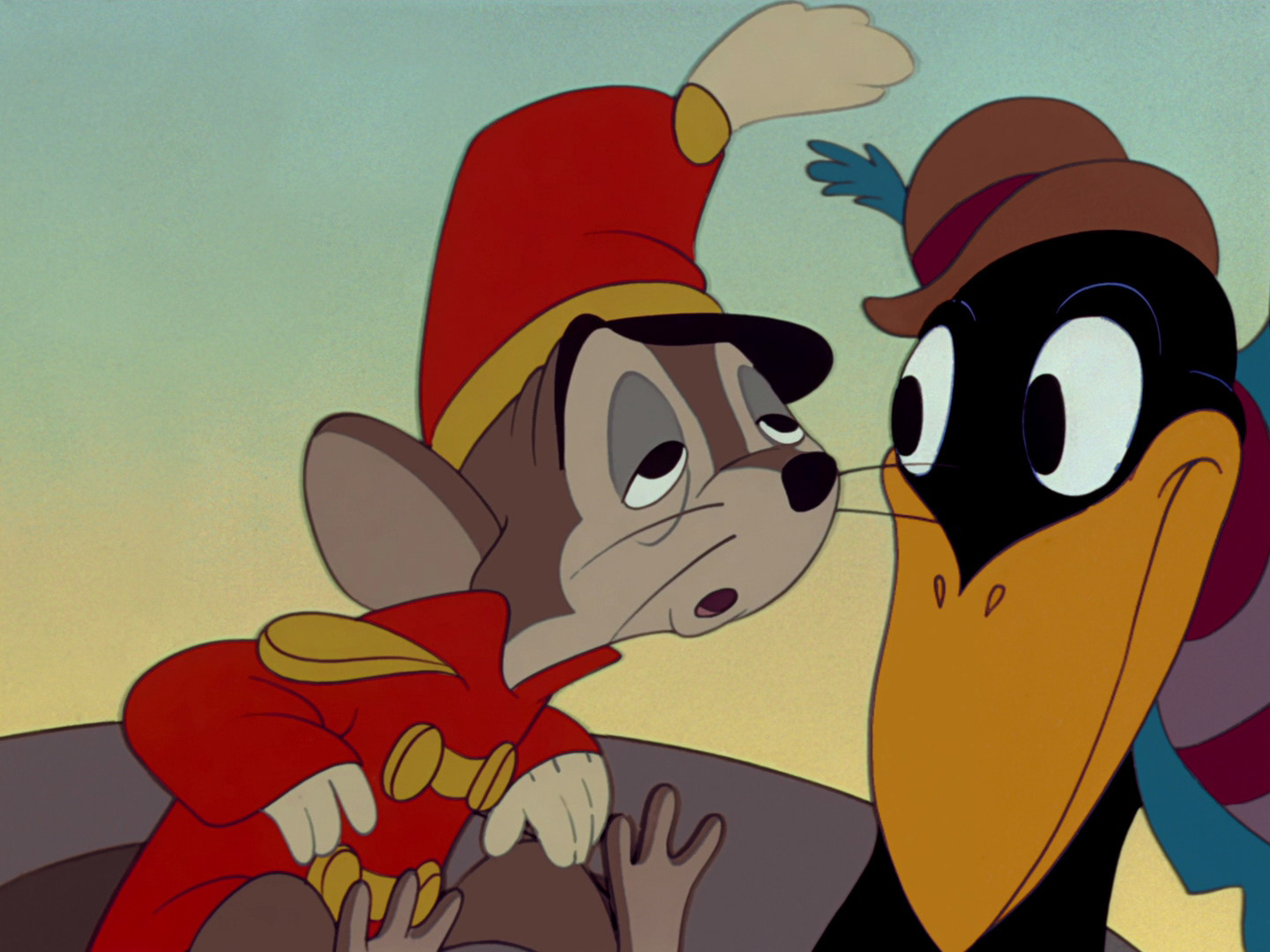
Dumbo is one the sweetest little characters a viewer could watch. There is literally nothing to dislike about him. He’s possibly even more innocent than Bambi (1942). Watching him interact with his mother is one of the sweetest moments in childhood history. It is this element that demonstrates how important a mother is in a child's life. As for Timothy Q. Mouse, he represents the self-preservation part about moving forward in life and not letting anyone stop you. If it were not for Timothy, who knows how long it would've taken Dumbo to get out of his slump of being mocked. Timothy is actually an underrated mouse icon and should be the second mouse to think of other than Mickey. However, even with these strong points there are some moments of question as to why they were even considered to be included. For these scenes, they involve the pink elephant sequence and racial representation.

During a moment when Dumbo has the hiccups he accidentally takes a drink out of bucket that contains booze and gets loopy, which then induces him and the audience into a trippy sequence about pink elephants. From a particular viewpoint the scene does make sense, which is distracting us so we're thrown off guard when the scene ends, but from another point of view there really is no other significance. It's just a scene that gets a bit weird over time and may give some kids nightmares. As for racial representation Dumbo and Timothy meet a group of crows that are drawn and talk like African Americans at the time (as media had thought). For both situations it's understood that more adults viewed cartoons at the time and the way African Americans were portrayed in cartoons was much different, but both don't excuse for how that turns out now. Yes, it is all apart of history but it is still insensitive. Children nowadays watch this and could get the wrong idea. If these parts were managed in a less insulting way there'd be more to give slack on.

Tim & Jim
For this movie there was no head of production. There were seven different directors for this feature; all of which handled different sequences. Nonetheless they all are directed as if it were one person. The animation headed by Art Babbitt was well crafted too. All the movement on each character and objects were fluid and smooth. For a Disney film like this, nothing but excellence is expected, otherwise it would  not be considered among the memorable films. The music composed by Oliver Wallace and Frank Churchill was an addition to happily hear. There are several tracks that are recognizable and are catchy to listen to. The main theme for Dumbo is heroic and brave sounding with that classic mid 1900s sound of horn and string. Other tracks like the odd "Pink Elephants" and jumpy Casey Jr. train tune are catchy and memorable too. It's not perfect but it is still an enjoyable piece of film work.

Unfortunately due to the time of its release, the film suffers from racial caricatures and adult content involving booze. It's not a huge anchor but it does feel insensitive. Thankfully the adorable main characters, effective writing, creative animation and memorable music help even things out.

Points Earned --> 7:10

Sunday, August 23, 2015

Van Helsing: The London Assignment (2004) Review:

The character of Abraham Van Helsing is quite common among horror enthusiasts. Being that he has been portrayed in several live-action films along side his arch foe Count Dracula; he was bound to be focused on at some point. As for animation, this is probably one of the very few he's been seen in. As for why this particular production was made, remains to be understood. In some ways it runs along the same lines as Hellboy Animated: Sword of Storms (2006) and Hellboy Animated: Blood and Iron (2007); they have continuity with their live-action counterparts but aren't clear in their target audience. There's enough to enjoy on this little feature for 30 minutes but as for setting up a universe for itself is a totally different problem.

Van Helsing & Carl
The plot starts with mysterious bloody off screen deaths of young women walking around the streets of London at the wrong hours of the night. Turns out that Dr. Jekyll (Dwight Schultz) and his alter ego Mr. Hyde (Robbie Coltrane) are up to no good. During the day Dr. Jekyll plays doctor to an ill and elderly Queen Victoria (Tara Strong) and secretly loves her. However in order to cure the Queen of her sickness, the likes of Mr. Hyde is needed to harvest the youth of other women. Enter Van Helsing (Hugh Jackman) and his partner Carl (David Wenham) to search and find out all that has happened. For what it's worth, this half an hour feature gets to the point quickly. It literally feels like a Saturday morning cartoon. In some ways this is good and others not. The pro of it being 30 minutes is that the plot, written by Garfield Reeves-Stevens and Judith Reeves-Stevens is clean cut and gets to the point. The con to this is that the introduction to Van Helsing and his partner come out of nowhere. Plus, the side character of Carl feels even less familiar because he just feels like some nobody.

Direction was headed by Sharon Bridgeman (her first time) who normally works in the animation department and has been apart of projects like Shark Tale (2004) and How to Train Your Dragon (2010). With those kinds of projects in mind, Bridgeman probably had a good idea of what she wanted to have in this short. Combine that with Jeff Starling as the visual development artist and there is something unique to see. The overall animation is all right for the most part. There are some areas that look somewhat choppy but that's mostly on the scenes that do not involve as much movement. When it comes to action the animation becomes much better. This is not only in fluidity but also in 3D rendering effects. For these key scenes the blending isn't the strongest, but it is that uneasy blending that makes it interesting to see because it is 2D on top of 3D. Most of the time this really wouldn't be a thing to praise but it's intriguing enough to look at so there must be something to benefit from it. It's not distracting at all.

Along with the animation, the actual action sequences entertain. Helsing has his weapons and can maneuver around with ease. There's a nicely paced scene that involves a chase between Helsing and Hyde on an old subway (which also includes that 3D rendering mentioned before). That looked like fun. Surprisingly for action, there are also some pretty graphic images. If this were a live-action film it would've been rated R. The way the women are killed by Hyde are not clean and there is blood shown. See how it parallels the Hellboy animated films? Who exactly is this animated film made for again? Obviously not all animated films are made for kids but if the live-action sequel has a rating of PG-13 what's going on here then? Why is Universal Studios not budging their nose in on this production but can do it for the story that comes after this? Let's be consistent guys.

Someone woke up cranky this morning
The voice acting is well casted. Hugh Jackman has his moments of some funny one liners as Helsing and has acceptable chemistry with his lesser skilled companion Carl who also has moments of quirkiness. Tara Strong as Queen Victoria appropriately plays the role like any actress would. Dwight Schultz as Dr. Jekyll is an excellent choice considering Schultz has a lot of experience in voice work and has voiced numerous characters ages old and new. Robbie Coltrane as Mr. Hyde was another suitable casting decision. Taking into account the actual size of Coltrane seems like the only legitimate actor to take on Hyde due to his brute strength and deep voice. Even John DiMaggio has a small role although I'm curious if DiMaggio could've topped Coltrane as Mr. Hyde. The music composed by John Van Tongeren was okay but anonymous. It had all the sounds of orchestra but lacked a main theme or any cues that were memorable.

It's music and writing is a little above average only because of the amount of time given for this whole feature being a half-hour. There isn't much for background to the main characters and the violence is questionable when it comes to audience viewing. However, the digital renderings mixed with animation is unique, the voice-over work is good and the action is fun.

Points Earned --> 6:10

Total Recall (2012) Review:

Hollywood is criticized countlessly for rebooting various popular films from the past in the forms of remakes. Unless the project is given to people with the right skill set, many remakes end up paling in comparison to the original material they spawned from. A big cause of these foul-ups is that it's a remake alone. Many fans feel there is nothing to re-invent about what was made prior. Another issue is how sensitive the rating system has become. With more and more studios believing that PG-13 rating is the best way to get a mass crowd of viewers, less and less fans become interested. During the last half of the 20th century, many films were made with R ratings just because. However, more PG-13 ratings are given and that mindset is still taken into account when it comes to redoing certain properties. Unfortunately, this lesson hasn't been entirely learned yet. For director Paul Verhoeven a lot of his late 1980 and early 1990 films have not been given enough leeway.

Colin Farrell & Jessica Biel
Although in some ways the original Total Recall (1990) has not aged nicely, its narrative, hard R rating and Schwarzenegger's memorable acting made it a sci-fi classic. Skip 22 years later and you have this remake, which like many studios claimed was "introducing it to new audiences". It is watchable but is probably only worthwhile once. The story is fairly similar to that of Verhoeven's version. Douglas Quaid (Colin Farrell) is an average guy married to his wife Lori (Kate Beckinsale) who works at a factory with Harry (Bokeem Woodbine) where they make synthetics (robot cops). Yet every night, Quaid keeps having dreams where he's trying to escape with some girl named Melina (Jessica Biel) and he feels like he knows her. In the background, there's a "civil war" occurring between Cohaagen (Bryan Cranston), the man behind the Synthetics and Matthias (Bill Nighy) a man labeled as the "leader of rebels". Among all this, there is a giant elevator that transports people from one side of the earth to the other passing through the earth's core and it's called "The Fall". It is this that people believe the phrase "The fall enslaves us all".

For writing, which was penned by Kurt Wimmer (Salt (2010)) and Mark Bomback (Unstoppable (2010)) takes the mind-bending screenplay from the original and waters it down to where the story comes across as really generic. Just how does the fall enslave everybody? There barely is any depiction of what the fall does to the people who don't approve of it. Here there's not much of a reason given and most audiences will continue watching the film than try and figure out the motivation. Another subplot Wimmer and Bomback couldn't effectively translate was whether after Quaid visited rekall, if he was in a dream or not. There is a hint of it later on but it is so weak in comparison to Verhoeven's version, which kept its viewers guessing every step of the way. This version has no transition from when Quaid gets his memory implant. The only part of the writing that is flattering are the various references. Remember the "two weeks" disguise - which's there. Remember the three breasted female - she's there, mind you that doesn't even make sense because there is no mention of mutants in this world.

Although not many standout, all main cast members act believable between each other. The actor who looked like he had the most fun went to Bryan Cranston as Cohaagen. Colin Farrell and Jessica Biel pass as a couple and Farrell has his moments along with Kate Beckinsale. Bokeem Woodbine as Quaid's friend was okay but felt predictable. The only actor who is completely useless in his role is Bill Nighy as the infamous rebel "leader". The only thing Matthias does is give a one line quote of insight to Quaid and that's it. Nighy is not even allowed to let his hammier side of acting show, which is unfortunate. The action entertains but only initially. The physical fight scenes between Quaid and other characters have energy; that part is worth it. What gets tiresome on the other hand are all the sci-fi action scenes that involve car chases, synthetics and other worldly technology. Like a structured story should be written, every action-related scene should get bigger than the last but for these, it becomes preposterous. That's not to say they become mind numbing like a Michael Bay film but they suffer from obvious CGI overload.

"Did you see me from Breaking Bad?"
The special effects are well put together no doubt, it all looks real and physically tangible singularly. It just becomes too much sometimes when everything is together all at once. The cinematography by Paul Cameron (Collateral (2004)) doesn't always help either. For the outside scenes it is hard to tell what is real and what isn't. There's no problem having wide panning shots to give the audience a better idea of scope. However, it helps to also shoot scenes with techniques like those while including parts of the set that are real so each scene doesn't feel so CGI-ish. The other fault Cameron keeps making are continuously having lens-flares in various shots, whether it be indoors or out. It's rather distracting when one is trying to focus on what is happening. Harry Gregson-Williams composed the music, which consists of hybrid orchestra. For this score, Williams does have a main theme for the film but it lacks any kind of memorable cue that'll make someone think of the film. It is literally a two-note cue involving horns and deep synth base.

It's a watchable film but only for a one-time stand. It has acceptable special effects, hand-to-hand action, okay acting, music and flattering references to the original. Yet this doesn't make up for the occasional CGI overload, generically written plot, weakly written dream subplot and continuous lens flares in its cinematography.

Points Earned --> 5:10

Friday, August 21, 2015

Sinister 2 (2015) Review:

For many horror films, once the possibility of a franchise solidifies itself among bankable names, it takes many blunders for it to lose traction. Yet, quantity usually triumphs over quality and thus leaving many franchises to quickly run out of steam due to lack of interest and just trying to make a quick cash-in. For Sinister (2012), which was written and directed by up-and-coming Scott Derrickson created quite a fanbase for the villain of Bughuul (Nicholas King). Even with the last half of the film's execution being almost transparent in predictability and protagonists that weren't the easiest to sympathize with, its first half was exceptionally well crafted in its premise and its mysterious clues that was left behind. It had something but wasn't fully realized. Unfortunately, this fault was most likely due to Derrickson taking on too many tasks. Being writer/director is not always the easiest thing to do. So for this sequel, Derrickson plays just a writer and it seemed that it was a better choice.

"I'm okay,..."
Teaming up again with Derrickson as co-writer is C Robert Cargill who also worked on Sinister (2012). Together they not only fixed some of the problems that plagued the first film, but added more material as well and in less of a running time. After the events of Sinister (2012) and being discharged from the force, Ex-Deputy So & So (James Ransone) continues to make it his mission to keep families from inhabiting the houses that the murderous killings took place. However, since he's one man and possibly the only one to understand what's going on, doesn't mean he gets to every spot in time. Enter Courtney Collins (Shannyn Sossamon) a divorced mother and her two sons Dylan (Robert Daniel Sloan) and Zach (Dartanian Sloan) who are trying to stay secluded from their abusive husband/father's radar (Lea Coco). Where are they - taking refuge in a house where next door one of Bughuul's sacrifices took place. The direction by Ciarán Foy (Citadel (2012)) and the writing help greatly in making this viewing a much more significant watch.

The backstory trinkets of information given out come from Dr. Stomberg (Tate Ellington) who fills in as a replacement for Professor Jonas (Vincent D'Onofrio) while giving a verbal explanation to why he was not featured. Along with him are a bunch of Bughuul's loyal kid followers headed by a boy named Milo (Lucas Jade Zumann) who elaborate on how Bughuul chooses the families he has/wants destroyed. Another plus is the likable characters featured in this story. Even from Sinister (2012), Deputy So & So that James Ransone plays is a better good-natured character than Ellison Oswalt ever was; channeling his "inner Dr. Loomis" sort of speak. The struggling one mother family is an added bonus with Shannyn Sossamon and the Sloan brothers pitching performances that are much more interesting to watch. It is kind of surprising though when Lea Coco plays a more frightening antagonist than Bughuul himself. Coco's ability to change personality at the snap of a finger may take viewers off guard. That's not to say Nicholas King as Bughuul isn't effective. Bughuul is still an uncomfortable villain and with more information on his background and personality, he's more than just a spook now.

Unfortunately even for these mended elements, the scares are practically nonexistent throughout. Like many horror films, the "sting" is included in several scenes. It's damaging when there's promise and something so cliche like that is still resorted too as a means of scares. The only things that are positively cringeworthy are the kill films that are viewed on a nightly basis and the violence. Not every scene is bloody but they are all brutal and morbid. There's also a question of knowledge and continuity here. One key moment that is specifically noticeable is when Courtney and sons are taken back by ex-husband Clint without telling Deputy So & So where they are. Yet, So & So found their house without anyone telling him the address. There was no mention of a tracking device or using satellite technology to locate them via cell phone,...so how'd he know? It's not stated.

Bughuul's home video theater
As for flaws go, this is about it. The cinematography to this sequel looks much better than the work in Sinister (2012). For this production, Amy Vincent (Footloose (2011) and Eve's Bayou (1997)) was the director of photography. Unlike Chris Norr's work from the original, which only captured a couple of different rooms within the Oswalt house and was very dimly lit. Here, Vincent captures a lot of the Collins' house, outside/around and in the building neighboring the house. Top that off with appropriate lighting and there really isn't much to complain about. The music was a welcome addition too. Christopher Young sadly did not compose the score to this feature, but instead by Tomandandy, a duo of composers who are best known for their work on The Strangers (2008). Although Young's credit is sorely missed, Tomandandy preserve Bughuul's eerie main theme and cultivate new and other creepy tracks that are distinct in their own way. The music still consists of warped bass notes, out of tune piano keys and thankfully not much of extra soundtrack noises this time.

It still has its continuity errors and is practically scareless, yet it manages to resurface itself above the original by having writing that gives more background information and personality to its villain and a more agreeable set of protagonists. The cinematography is also an improvement while sustaining the disturbing footage and foreboding film score.

Points Earned --> 7:10

Thursday, August 20, 2015

Transporter 2 (2005) Review:

For various sequels to original films, they all usually have the same trend in common. That trend is the law of diminishing returns. There are also groups of very few series that have follow-up films that surpass its first entry. Then there are the later installments that work differently than their predecessor, but just match their parent. With this sometimes it works, while other times depending on how good the first was doesn't help it to begin with. For Jason Statham's Transporter (2002), it was an entertaining fluffy popcorn action film that had its moments of ingenuity but was for the most part fairly predictable and cliche for a lot of its running time when it came to character development and plot. Another weak aspect was the backstory to what the villain's motivations were. Thankfully, even for these flaws they did not outweigh the better parts of the film's execution.

Kate Nuata & Jason Statham
Surprisingly even with much of the cast and crew being more of a French production with its release, the film gained a sequel. Continuing to write the sequel is Luc Besson and Robert Mark Kamen (creators of the first movie). As an entire movie, it feels like a better film but in fact, it feels roughly the same as the first. Jason Statham returns as Frank Martin, the ex-military guy for drive-hire (aka a Transporter). However instead being given a special assignment, Martin's in a bit of slump in his career at the moment. Currently, he's doing daily pickup jobs for a parents' son Jack Billings (Hunter Clary). The parents, Audrey (Amber Valletta) and Jeff Billings (Matthew Modine) are on bad terms and are trying to mend their differences, but it's slow moving. One regular day when picking up Jack, Martin's car is hijacked by a trained killer named Lola (Kate Nauta) who works for a hired mercenary named Gianni Chellini (Alessandro Gassman).

Turns out that Chellini is testing a viral solution that if injected becomes highly contagious just by breathing it in and the only cure is with him alone. For writing, the screenplay suffers almost the same flaws from that of The Transporter (2002). For one, the whole viral bacterial disease subplot has been used time and time again. What evil antagonist hasn't tried this method yet? The film's most noticeable flaws however lie in its connections to the first film and various assumptions that are made for the audience. Connection wise, other than François Berléand gladly returning as Inspector Tarconi from the first film, there is no other mention to what happened after the events of the original film. The storyline ended properly but it seemed as if Frank Martin acquired a new girlfriend. If not, there should've been at least a mention for the audience. Assumption wise, the screenplay makes various short cuts so that once a conflict is over, everything is hunky dory. When in fact, other than focusing on the main characters, nothing else is concluded when it comes to several other characters. That's rather important.

Again though, these mistakes are happily made up for with everything else. One thing that is better in this particular screenplay than the prior one is that it does not include the typical "female falls for protagonist" subplot. Another is the direction headed by Louis Leterrier (Co-Director of the original), which instead of having Martin doing his job, he's forced into doing one he doesn't feel is right. That's much different than breaking your own rules like of the first film. It's also not as contradictory either. For action, the sequences that take place are more elaborately stylized and it works well at being fun to watch. The Transporter (2002) had a great scene involving being slicked up in oil and being hard to catch. There's a small reference to that here but there's also a scene that involves using a fire hose. Can you imagine the strength and speed needed to use it the way Statham would? That takes skill. All actors do nicely in their role as well. Nobody felt out of place or miscast. Even veteran actor Keith David has a small role.

Alessandro Gassman & Mitchell Amundsen's camerawork
The cinematography shot by Mitchell Amundsen was well handled. Although he has more credits for being a second unit and camera operator, Amundsen demonstrates he is capable of being the head director of photography. There are plenty of shots that capture all angles of the setting. Whether it is with scenes that involve movement or stationary work, the camera is steady and allows its audience to clearly see what is being portrayed on screen. Composing the music for this entry was Alexandre Azaria and although it is not as jazzy or slick sounding as Stanley Clarke's rendition, Azaria created a reoccurring main theme for Martin. Plus Azaria also includes a mix of organic orchestra, synths and deep piano keys. Those particular cues are not always memorable but they are different on a listening experience level.

Its plot still suffers from cliched writing but in other areas. Also the connections between this and the original are untouched. Other than that the choreographed action scenes, steady camerawork, music, direction and acting is all acceptable. No better and no worse than the first.

Points Earned --> 6:10

Saturday, August 15, 2015

Straight Outta Compton (2015) Review:

Biography adapted films are sometimes risky depending on the topic. The biggest risk is making sure that all events related to whomever the biography is about are true. For this to work there are a couple of factors that need to be considered. First is the time period. Depending on the time period, certain events and facts may be difficult to research. Second are the people being portrayed. For individuals that have never been  heard of before, the only way for someone to know how to portray them is by studying records of their behavior and then interpret it themselves. However, for more recent times it has been a lot easier for such access to various information. Then again, there is no greater person to help with this kind of project than the person themselves. Take it from Ice Cube and Dr. Dre who produce this movie about themselves, when they went from the bottom straight to the top in the rap group Ruthless & N.W.A.

"I got somethin' to say...."
There really is no better way to make a film about yourself other than directly being involved with it. Then add F. Gary Gray as director with writers Jonathan Herman (his first writing credit) and Andrea Berloff (World Trade Center (2006)) and you have a recipe for successful storytelling. It's quite a feat considering only one writer had a credential that showed promise. F. Gary Gray was a nice choice due to his work in other films and his best known film to date being Friday (1995), which also starred Ice Cube. For a biopic on a group of artists, it has a natural tendency to educate audiences (especially the ignorant ones) about why Ruthless & N.W.A. acted the way they did and why they did it. The main plot is about how Dr. Dre, Ice Cube, DJ Yella, MC Ren and Eazy-E rise, fall and recover from their fame after making a name for themselves. Specifically, the music they would create related to the people being oppressed by the police officials in Compton California.

This section of writing is what really the educational part of the story is. As displayed throughout the film, for those who were not aware of the situation going on in California, many considered Ruthless & N.W.A. pimps that glamorized and emphasized the negatives in life. But as clearly stated by one character, "Our art is a reflection of our reality". It does not get any more real than that. Along this being its strongest element, it is also its weakest because that particular social undercurrent is not focused on enough. The rest of writing analyzes the rest of the characters from startup and separation of paths. This is fine and develops its characters, but in some ways it feels like it slights the main point. That's not to say the actors that play the characters aren't noteworthy though. Playing Ice Cube is his son O'Shea Jackson Jr. who can not only act but (thankfully) shares his father’s looks as well. Along side Jackson Jr. is Corey Hawkins (as Dr. Dre), Jason Mitchell (as Eazy-E), Neil Brown Jr. (DJ Yella), and Aldis Hodge (MC Ren). All of which have great chemistry with each other and all act with true emotion.

The only other actor who has almost the same amount of screen time with them is Paul Giamatti as Jerry Heller, Ruthless & N.W.A.'s first producer. Giamatti as Heller is convincing in his role and does play a significant part in the groups history. The only thing that doesn't look right is Giamatti's horrendous looking wig. It just looks too fake to be his. Couldn't there have been another wig that looked more realistic? And just for fun there are a bunch of other references either to past events or nods to other celebrities. There's (not real) appearances of Suge Knight (R. Marcos Taylor) head of Death Row Records, Tupac (Marcc Rose), Snoop Dog (Keith Stanfield), mentions of Boyz n the Hood (1991) etc. For those who remember those moments and enjoy revisiting the past, the nostalgia will be memorable.

You may have the acting chops Giamatti,...but not the hair
Matthew Libatique is credited as the director of photography for this production. For all of Libatique's camerawork, there's great lighting, and an exceptional demonstration of showing the transitions that went through the artists lives from beginning to the end of the movie. For the scope that the camera captures, ranges. There's a mix of wide panning shots but only to show the scale at which events were occurring. There's also shaky-cam effects, which although aren't welcome most of the time, end up doing okay for the moments that call for them. This usually involves frantic scenes but that's it. The music, of which this biopic is based on definitely has the beats. Although the soundtrack music is mostly lip-synched to the actors, it feels authentic. Joseph Tranpanese composed the film score although there were not a lot of scenes that needed instrumental music. Trapanese just fills in for the sentimental and tense moments. It’s the usual cues but all anonymous and that's good since it's a biopic on rap music.

Aside from the writing's initial social undercurrent that is unfortunately let go of over time and Paul Giamatti's awful looking wig, it is a well made film. The actors have authentic chemistry with each other, the music has catchy beats, the camerawork is well lit and a lot of its writing paints an educational picture about the ups and downs of the fame life.

Points Earned --> 8:10

Thursday, August 13, 2015

Highlander (1986) Review:

For the genre of adventure films, there's multiple ways to make action sequences depending on weapon type. The most common of ammunition are guns and objects of physical contact such as swords, hands, legs and other improvised weapons of choice. Among those, swords are probably the second most used item. The act of clashing two sharp metal blades together is a method of contact that is barely used today in contemporary battle. Most movies that used violent blade action during the 1980s were horror and various Asian influenced films. Occasionally there would be a movie here or there that defied the usual trope like Raiders of the Lost Ark (1981), but most followed what was “in” during the time. However for this movie, it was probably one of the few to portray this kind of swordsmanship in an entirely different culture. Of the films released around this time, how many films actually displayed the Scottish culture on film? Probably not a whole heck of a lot.

MacLeod & Ramirez
Directed by Russell Mulcahy (as his first American made film) and written by Gregory Widen, Peter Bellwood and Larry Ferguson (who at the time didn't have many other credits to their names) put together a wondrous story with enchanting direction. The story is about an immortal Scottish Warrior (AKA a Highlander) known as Connor MacLeod (Christopher Lambert) who is in a constant state of alert watching out for other immortal warriors who look to decapitate him. Turns out, each immortal is looking to be the last in order to achieve a prize, but this is only attained once the last immortal is standing. The warrior who seeks MacLeod's head the most is The Kurgan (Clancy Brown), a brutal fighter who is beyond negotiable and has no conscience. The only way MacLeod will be ready to defeat The Kurgan is by getting trained by Juan Ramirez (Sean Connery), an eccentric and colorfully dressed swordsman. This alone is an interesting concept and it feels original.

The acting is believable and works on its viewers. Christopher Lambert has a great mix of one liners that are funny, emotional and clever. Though it is bit strange that his youth resembles that of a Thomas Jane persona. Clancy Brown as the Kurgan was a great choice. Although he is known more for his voice work nowadays, his physical acting chops are just as strong. Plus, his hulking size and costume design adds to his menacing demeanor along with his recognizably deep voice. Sean Connery as Ramirez is acceptable in his role too. Casting him seems like an odd choice for the role since his accent clearly doesn't change but nonetheless he plays a likable mentor for MacLeod. There's also a subplot about MacLeod's identity during the current time with reporter Brenda J. Wyatt (Roxanne Hart) on his tale. When it comes to character development, Hart's role is the weakest link. She plays a love interest and the build up to how it gets there feels forced unfortunately. The mythology of the story is another ball of wax.

The storytelling is encapsulating but there are noticeable loopholes. Two big flaws are the explanations given for the warriors being immortal told by Ramirez. It is unknown to how they became immortal yet they know why they must fight each other until one is left to win a prize. Well,...okay so you know why you're immortal but can't explain how you became immortal? Who told Ramirez to begin with? If he wasn't told directly from the source, then how is the word going around and how come MacLeod wasn't told? Another is how does each immortal know when they are the last of the group? Two could have a showdown and think who's ever last has won the prize but there may be someone halfway around the world that's waiting for his chance. It's rather illogical unless all immortal warriors are born with some kind of immortal tracking device (and that's not said in the movie either). So this still begs the question; however even with all these questions, most viewers will let it slide because of how likable the characters are.

Nice costume Clancy Brown
For action, the sword fights are not as nimble or agile as other sequences seen in slicker films, but they do entertain all the same. Medieval sword action isn't as commonly seen on film anymore so it is different to watch. The special effects, which usually involve rotoscoping animations look creative as well. Since this film took place in a time when computers were just beginning to be used, a lot of the effects look practical and that's commendable. Gerry Fisher as director of photography is probably best known for his work in this production. There are magnificent panning shots of the Scottish landscape and inner city streets that MacLeod goes through. Plus, the transitions between past and present times are nicely stitched together. Finally the music composed by Michael Kamen was memorable. There's a recognizable main theme for MacLeod that sounds heroic and has a sense of bravado. This is all produced with the help of strong string progressions and battle cry like percussion beats mixing with the calling of various horns. An uncommon heroic sound.

Aside from the overall mythology to the backstory being contradictory in most places, the storytelling is enticing to see play out with its likable characters headed by Christopher Lambert, Clancy Brown and Sean Connery. The action, old school special effects, beautiful cinematography and music assist in making it not your typical action fantasy film.

Points Earned --> 7:10