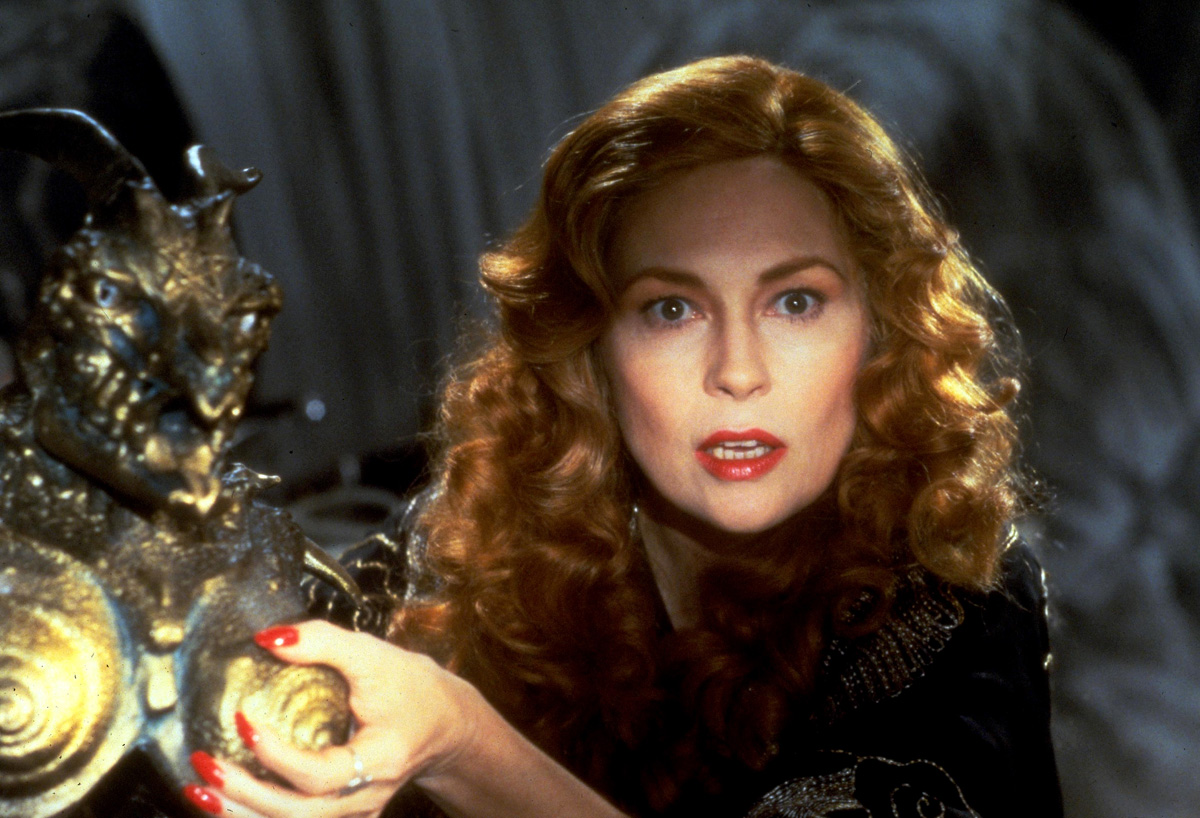
Sunday, February 24, 2019

Clash of the Titans (2010) Review:

Remakes in general have a pretty big hill to overcome. Whether producers, actors and studios alike think they're doing the fans a service, it is still very likely approval will be low. A remake of an original work can't have tributes alone to satisfy viewers. But this is also the problem, a remake has to do something different from the original but also not completely alter everything, or it will alienate its base. The only way a remake can truly have success is if the original was either not that good to begin with or it manages to step up its game. Most of the time, these kinds of opportunities are far and few between. For this remake, competing with the original Clash of the Titans (1981) was already a tough call. With so many aspects of the original enjoyed by many, this film had to meet some high expectations. And while it wasn't as well received, it did manage to still produce some popcorn fluff. Just not in all the right places.
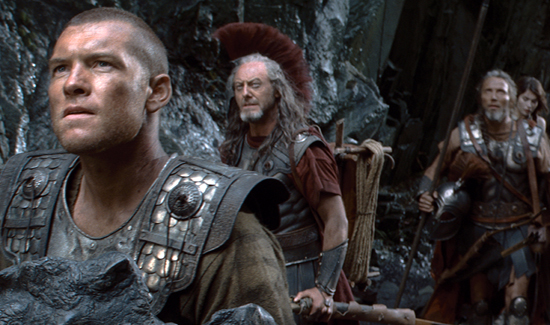
Sam Worthington
With Travis Beacham (who would later work on Pacific Rim (2013)), Phil Hay and Matt Manfredi (Æon Flux (2005)) as writers to this film, it is apparent that they tried to make it similar to the original. When a man named Perseus (Sam Worthington) witnesses his family's death to a god, he sets it his mission to fight back. This motivation is only reinforced when the city of Argos, a rebellious city is threatened by Zeus (Liam Neeson) to be destroyed. With Hades (Ralph Fiennes) being granted permission to let the kraken loose on the city thanks to the queen (Polly Walker), Perseus and Argos' strongest men seek the answer on defeating it. Directed by Louis Leterrier, a guy with many action films tied to his name like Transporter (2002) and Transporter 2 (2005), certainly has what is needed for a film that needs lively energy. The biggest issue though is the script and Sam Worthington as the lead.

While Worthington can grimace, yell and move athletically, his emotional range needs some work. Being that the script relies more on the loss of his family and less about romance, there lacks an emotional balance in the story. There's barely a time where Perseus even cracks a smile or wise remark. As a result, the lead feels less charismatic and more just a pawn in the story. With the writers' screenplay failing to incorporate more of this, it feels as though they forgot the heart of the story. Yet somehow they did remember to include charming and more favorable dialog for the supporting actors like Mads Mikkelsen, Liam Cunningham, Hans Matheson, Ashraf Barhom, Mouloud Achour and Nicholas Hoult who play Argos' top warriors. So, not sure how that works. Even Ian Whyte who plays some mysterious humanoid scorpion creature is more interesting to watch.

Aside from this, the writers do include some other references to the original like Jason Flemyng who plays the cursed Calibos. Even Bubo the mechanical Owl appears for a cameo. Action sequences are by far the strongest this film has to offer. Whether the fighters are fending off other human attackers, human sized creatures or giant monstrosities, the action is lively and engaging. The best set piece is when Perseus and company come across super-sized scorpions. Even the battle between Perseus and Medusa (Natalia Vodianova) is fairly entertaining even though it won't ever top the original. The weakest was probably the one between Perseus and Calibos. All this is most likely due to Louis Leterrier's experience working with action set pieces. Believe it or not though the graphic content is turned down. Although that's probably just to attract a wider audience.
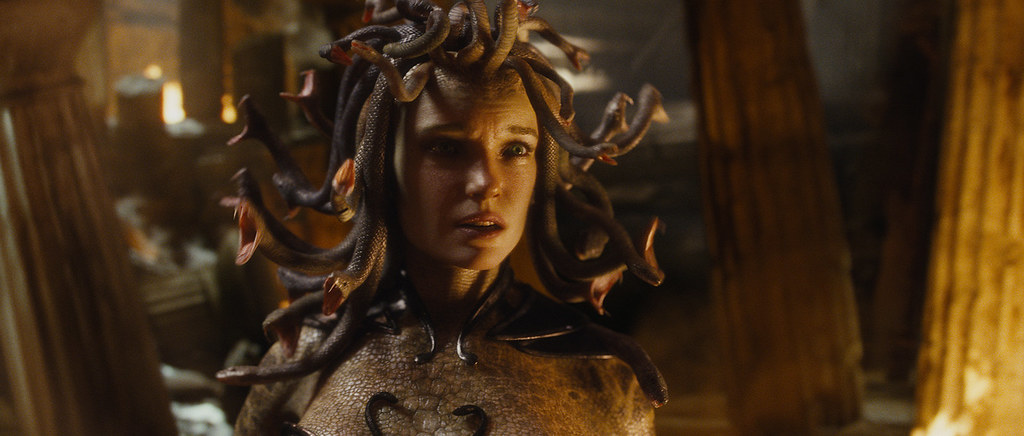
"Does this CGI really make me look bad?"
Visuals to the film are an unfortunate mixed bag. While the imagery, makeup effects and creature designs are creative, their CGI counterparts tend to suffer. Although watching movies can be used as an escapist activity, to watch actors walking around and interacting with various settings that are CGI ruins the whole experience. There's barely a place that feels like it is physically tangible. The cinematography by Peter Menzies Jr. (The 13th Warrior (1999) and Lara Croft: Tomb Raider (2001)) was adequate, it was just the CGI scenes that felt the least credible. Producing the music was composer Ramin Djawadi, who had worked on Blade: Trinity (2004) and Iron Man (2008). Relying heavily on strings and electric guitar, Djawadi makes an interesting interpreter for the film. Sadly, it has very little resemblance to that of the upbeat and adventurous sounding score from the original.

The supporting components to this remake are probably the best thing it has to give. From the supporting cast, to the music, cinematography and action. Yet the fault in the foundation are the CGI effects, a less than charismatic lead and rather unemotional screenplay revolving around the lead. It's fun but not for frequent revisiting.

Points Earned --> 6:10
Monday, February 18, 2019

Funny Girl (1968) Review:

Movie genres can be combined to make any kind of hybrid production. This can lead to different levels in how the story is told and how audiences may react or take the movie. Musicals in general can incorporate any genre and make it into an interesting showing. It may be more unlikely that a horror film could be turned into a musical, but it's not impossible. It takes the right balance of everything to make sure that whatever is trying to be depicted gets across correctly to the audience. However, it can be confusing when the title and genre of film suggest one thing, and later on show nothing of the sort. That seems to be the problem with this movie; or so it seems.

Related image
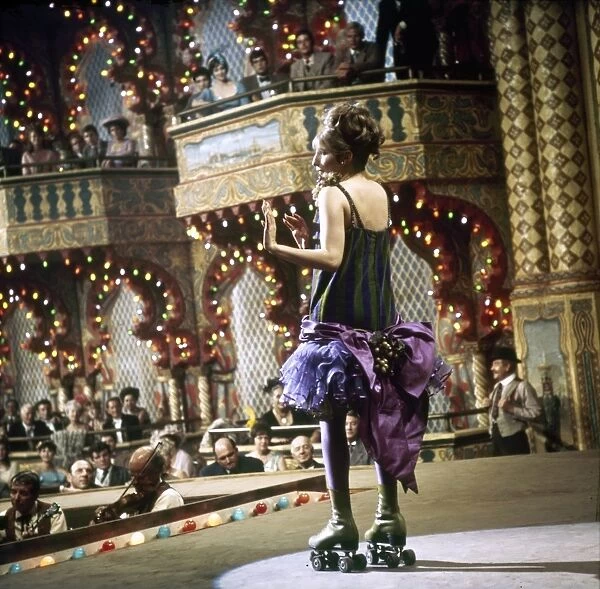
"Ummm hi, I don't have stage fright,....promise"
Featuring the debut of Barbra Streisand, a vocal powerhouse at the time, plays real life comedienne Fanny Brice. The plot follows her start of showbiz, her rise to fame and her relationship with Nick Arnstein (Omar Sharif). The script, written by Isobel Lennart, as her last credit, has no issue with showing Brice's career progression whatsoever. With credits to other films like It Happened in Brooklyn (1947), Lennart must have had some kind of experience to produce a good screenplay. The problem however is in the title and execution. Was this William Wyler's issue as director? Hard to say, with having films like Carrie (1952) and Ben-Hur (1959) attached to his resume, who knows.

Somehow though, the tone of the script and the performances from the cast do not match on a regular basis. This film falls into the category of a comedy, drama and musical. Yet there's mostly drama and music. For a title with the word "funny" in it, there aren't many laughs to be had except for some sporadic ones. Adding to that is the 2.5 hour run time. While the production design is well constructed and elaborate, there are a bunch of overly padded scenes that seem to take longer than usual. This does not however discredit the actors involved in the film. Although the cast in this film is small, the amount of extras used in the background is horrendously large (but all for good reason).

Streisand and Omar Sharif have plenty of chemistry to share with each other. The emotions displayed on screen feel properly acted and emoted well. Sharif who played in Lawrence of Arabia (1962) definitely has the chops to be a suave husband for the love interest. There's also Walter Pidgeon who plays Florenz Ziegfeld, who ends up moving Brice into the spotlight. And while these actors work, the script fails to show a struggle for almost none of the showing. While at first it seemed as though no one wanted to have Fanny Brice in their shows, once she met Nick, her success never stopped. That, and when things didn't seem to work out Brice made decisions that contradicted her motives. The actions do not really make sense when someone enjoys that much success and it doesn't make them truly likable either.

Related image
Omar Sharif as Nick Arnstein
For visuals and music though, this feature had it in the bag. Harry Stradling Sr. was the man behind the camerawork. With experience in other films like Over the Moon (1939) and Gypsy (1962), it's no wonder the shots filmed look so large in scale. With musical writers like Jule Styne ("Don't Rain on My Parade") and Walter Scharf, composer to Rock-a-Bye Baby (1958), the musical pieces are enjoyable to listen to. That and having Barbara Streisand's solid vocals makes the performances all the more authentic. Unfortunately, because the execution to the story is so tonally confused, the music does not have the same emotional impact as it should.

Everything about the production is well done. From the camerawork, to the musical compositions, to the production design and the actors’ performances. Yet, the script gets so lost in telling a story with very little conflict that it doesn't feel like there's much to get behind. Not to mention the padded timing and very few scenes being funny either.

Points Earned --> 5:10

Police Academy 4: Citizens on Patrol (1987) Review:

It's really something when a franchise begins its second trilogy. While many critics had found only the first Police Academy (1984) a mixed bag, the later sequels earned even less stellar opinions. Yet somehow, the series continued to push onward. While Police Academy 2: Their First Assignment (1985) was more or less retreading the same ground, Police Academy 3: Back in Training (1986) stepped back up to the plate for some fun. The cause of this was more of having the original cast learning new skills, which reminisced more of the first film. Here, the story is now putting them in the trainer shoes. All because of an idea their ever so absent minded commander had one day out of the blue.

Image result for police academy 4
"Excuse me miss, you remind me of Kim Cattrall"
Written by Gene Quintano, who also penned the prior entry, was the sole writer for this film. The story begins with Commandant Lassard (George Gaynes) having the brilliant thought of making relations better between the police and public by having a new program involving both. The program is called Citizens on Patrol (COP - how clever), and it would allow citizens to actively partake in making sure crime isn't committed. Seeing it as a lousy decision, Captain Harris (G.W. Bailey) returns with Proctor (Lance Kinsey) to fill in for Lassard as he makes his way to London to promote the concept. Meanwhile, it's up to Mahoney (Steve Guttenberg), Hightower (Bubba Smith), Jones (Michael Winslow), Tackleberry (David Graf), Hooks (Marion Ramsey), Sweetchuck (Tim Kazurinsky) and assorted others to make sure COP succeeds.

So the plot itself is really not very different. If anything the premise feels all too familiar because it's more or less a soft version of the first movie, which encouraged regular citizens to participate in the police academy. Here though, citizens do not become police officers but instead act more as like a subdivision of the department. The only new feeling is that now the original cast members are the ones doing the training, but that's where it ends. Jim Drake as the new director was okay, but there were scenes that felt too padded. What does work in the script's favor are the homecoming of familiar faces and jokes. Having G.W. Bailey come back for another entry was great because he was after all the first antagonist in the series. Plus, seeing him get acquainted with Steve Guttenberg's character brings back fun antics.

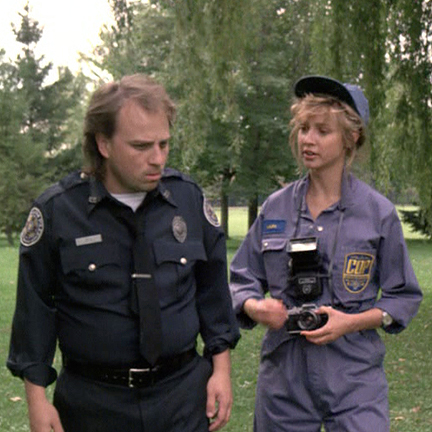
Although not all the jokes induce laughter, there are some better than average moments. One being actress Billie Bird who plays Mrs. Feldman, a charismatic old woman who enjoys the thrill of being a police officer. She produces some good laughs but she's literally one of very few new recruits in the COP program that stand out. The only other character that is a new addition and develops another character is Laura (Corinne Bohrer). While uneasy at first she develops a soft spot for the reformed gang member Zed (Bobcat Goldthwait). Aside from this though, no one else is really has development. There is however an appearance from a young Sharon Stone and a debut performance from David Spade.

Related image
Zed & Laura
For cinematography, Robert Saad shot for the film. While he provided additional photography for the first film, he really took over in the last sequel, which was shot differently. The same could be said here. There are scenes that are filmed in the city, but Saad also captured shots from the sky and it's impressive. Figuratively and literally, Saad has visually taken the series to a new height. Music has enjoyably remained the same, with another score composed by Robert Folk. The main title theme is always jolly and the rest of scenes work where they should. Now, all that is needed since the first film are the scores released for all the sequels that came out.

If you've been enjoying the films so far even after all the character swaps, this sequel should still provide some good laughs. The cinematography is still shot well, the music remains entertaining and the reunion of Mahoney and Capt. Harris bring back so good jokes. However, the plot feels very similar to the first, very few new characters receive development and the jokes don't always work.

Points Earned --> 6:10

Jeepers Creepers 2 (2003) Review:

While success did not come right away for Victor Salva early in his career, he was able to land in the spotlight eventually. Jeepers Creepers (2001) may have not been the most ingenious horror film, but it did have certain aspects to it that made it stand out from the usual traps horror films fell in to. The story was unique, the characters weren't the usual bunch and the music had its moments to shine too. And after that movie proved itself profitable, it's obvious as to why a sequel was made. Surprisingly, while it isn't much better, it still remains to watchable. The faults are now just in different places. With Victor Salva directing again, it's understandable as to why the film feels the same in quality.

Image result for jeepers creepers 2
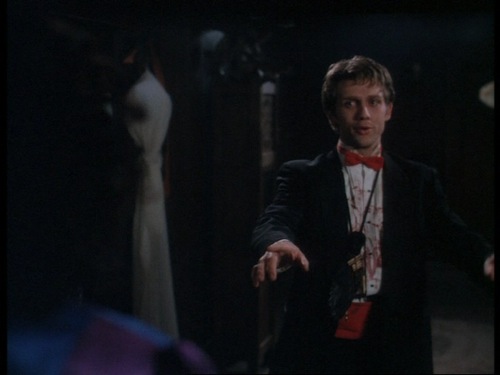
"Hey man, do you think we are safe in a bus?"
The script for this feature was also written by Salva who smartly keeps the continuity close by having the events of this story happening shortly after the first film. Not bad, considering most follow ups to horror films either reset the story completely or retro actively undo everything that happened in the prior film. Here a group of high school students are headed home after a game, only to soon find out their lives are in the cross hairs of the creeper (Jonathan Breck). Meanwhile, a vengeful father (Ray Wise) is on the hunt for the creeper after he was too late in saving his youngest son who was snatched away. These two plot threads end up converging on one another, which create an interesting brawl as things develop.

The whole setting of having students trapped in a school bus is not commonly used. That and the efforts Ray Wise's character goes through to hunt the creeper shows dedication. He's also probably the most likable character too even though he doesn't emote much. Unfortunately, the rest of the cast aren't that likable, which was an issue the first movie suffered from too. While the actors who play the high school students act the parts, they just don't seem to have the charm in order for the audience to get behind. There's only one character, Minxie (Nicki Aycox), who manages to learn the history of the first film through dream sequences. Of course that goes unexplained. She even gets to see Justin Long for a cameo and exposition dump; how convenient.

That particular aspect of the film doesn't completely ruin the experience though. Jonathan Breck as the creeper still makes a fine antagonist for the franchise. While this time, he was given a little more free range to play his part with personality. While the creeper is special in his own way, this time he'll make gestures which are very Freddy Krueger-esque. It's not a vast change, but it does give the character a more comedic personality which may not really fit. Aside from this though the horror is still there with a number of gruesome moments. Salva also cranks up the action into the picture too with Ray Wise's trigger happy role that he plays. It actually mixes quite well.

Related image
Ray Wise as tough dood
For the rest of the visuals, the cinematography is handled well. Shot again by Don E. FauntLeRoy, the camerawork is steady and mixes well with its surroundings. Even the CGI and live-action practical effects look good to this day. What would have been more interesting to see was the creeper's new lair from the last film. Being that it was only briefly shown and what he does there, that's something that should be explored. The musical score also saw the return of Bennett Salvay. Being that the feature mixes more action with its horror, Salvay also beefs up his score as well as making it sound even more robust to match the action sequences. Not bad at all.

This is a sequel that maintains its level of quality compared to its predecessor. That's a good and bad thing. While the script still shoehorns in certain plot elements and still has very few likable main leads, the viewing experience is still fun. The gore has more action in it, with an appropriate score, credible cinematography and a script that still keeps fairly good continuity.

Points Earned --> 6:10
Sunday, January 20, 2019

Dudley Do-Right (1999) Review:

During his rise to stardom, Brendan Fraser had become quite the leading man when it came to films in the family and adventure genres. After getting his big break with Disney in Jay Ward's live-action George of the Jungle (1997) and landed in the smash hit movie reboot The Mummy (1999), he had the reputation as a solid bankable star. Which naturally led him back to participating in a film quite similar to that of George of the Jungle (1997). Stepping back into the cartoon live-action genre, Fraser landed the role of Dudley Do-Right (1999), another Jay Ward based cartoon. Sadly, this one didn't have the same appeal. While it does have its moments there are several problems too.

Brendan Fraser & Sarah Jessica Parker
The Dudley Do-Right (1969) cartoon was a short lived show that didn't make it past 1 season and was very much similar in plot to that of Popeye. For this feature, it was kept the same where Dudley Do-Right (Brendan Fraser) the protagonist has been working to do his best to outsmart Snidely Whiplash (Alfred Molina), his childhood (now grown up) arch enemy. Together these two old foes square off for the affections of Nell Fenwick (Sarah Jessica Parker) who can't seem to make up her mind as to who is the better individual. As if it was hard to tell. The adaption was written and directed by Hugh Wilson, a veteran of many comedies in the past like Police Academy (1984) and Rhustler's Rhapsody (1985). The difference is, those were original works.

Here Wilson seems to struggle between what exactly is necessary and what isn't for a number of components. Right from the start, the movie begins with a Jay Ward Short under the "Fractured Fairy Tales" banner. Unlike George of the Jungle (1997) and even The Adventures of Rocky & Bullwinkle, which began as cartoons and led into the live action feature. Here the cartoon short is comical, but completely unrelated to the feature. What is the point? But that's not the only thing that drags, the pacing tends to feel overly drawn out for needless reasons too. There's a number of scenes where dance numbers take center stage over carrying the plot through. They are well choreographed, but that doesn't take away the pointlessness of having it.

There's also weak character development among the main characters. Nell really doesn't change and neither does Snidely. Really it's just Dudley who is shown this from a hobo played by Eric Idle. And while there are certain aspects to the supporting characters that can be important, most don't move the plot. There's also appearances from Robert Prosky as Nell's father. Alex Rocco plays the Chief of a Native American tribe and Jack Kehler plays one of Snidely's right hand henchmen. Lastly there's Corey Burton who oddly enough sounds like Keith Scott's impression of the narrator from George of the Jungle (1997) and The Adventures of Rocky & Bullwinkle (2000). All in all, the actors act okay. It's just the script that stilts them in making their characters any more likable.

Don't I look DASHING?!
Cinematography on the other hand was well shot by Donald E. Thorin, cameraman of Lock Up (1989), Tango & Cash (1989) and Ace Ventura: When Nature Calls (1995). Again, while some scenes were not crucial to have in the picture, they were all competently filmed with a wide angle lens. As for music, Steve Dorff served as composer to the film. And while an official soundtrack nor score was released, the music matches the scenes at hand and the TV show theme is revisited. Out of the three cartoon movies mentioned, The Adventures of Rocky & Bullwinkle (2000) was the only film to get its own score released. So weird.

This cartoon live-action adaptation isn't as bad as the score says it is, but it is not that great either. There are some funny moments, the actors try, the camerawork is well done and the music fits. Yet there are several over padded scenes, little character development and unneeded characters.

Points Earned --> 5:10

Psycho II (1983) Review:

Movies that end up becoming a smash hit at theaters are usually quick to crank out a sequel. It only takes a few years, tops or at minimum, one. However, it's when sequels get made years later that can make it a challenge. Alfred Hitchcock's Psycho (1960) of Robert Bloch's book was an innovative horror film for its time. It not only popularized the idea of "slasher" flicks, but created one of the most disturbing characters in film history. At the time, a sequel wasn't probably thought of being a thing. But with the 1980s being the decade of such genre films, the notion had resurfaced and a continuation of the original story was made. What's even crazier is just how well the story is written and executed on all accounts. Perhaps a little too well for its own good. It certainly was a sequel well worth waiting more than two decades for though.

Meg Tilly & Anthony Perkins
More than two decades have passed and finally, Norman Bates (Anthony Perkins) has been granted freedom and sanity after seeking help from psychiatrist Dr. Bill Raymond (Robert Loggia). On the other side, Lila Loomis, formerly Lila Crane (Vera Miles) is not happy with Mr. Bates release and wants to get him back in custody. Meanwhile, Bates heads back to his mother's house and tries to reintegrate himself into society by working at a diner. There he meets Mary (Meg Tilly), a young lady who's been dumped by her boyfriend needs a place to stay. Offering her a place, Bates begins receiving strange notes signed by his mother, thus freaking him out. Written by Tom Holland, future director of Fright Night (1985), Child's Play (1988) and Thinner (1996), the script does quite the job at bringing its audience back to the Bates state of mind. On top of that, with Richard Franklin directing this feature, seeing he had worked on other horror films like Patrick (1978) and Road Games (1981), his credits were valid.

Throughout the run time, there are lots of moments that can easily make the viewing experience engaging. From how Bates is getting notes from his dead mother, to how people end up dying around him when he knows he isn't doing it, or so he thinks. It's definitely something viewers will not be expecting because it's difficult to tell just what exactly is happening. This is to the benefit of the film, but also it's only flaw. While the screenplay has some interest twists, it can also lose the viewer easily as well without having a clear resolution. The cast though still perform well with everything they were given. Anthony Perkins as Norman Bates while brings back the character with ease, he adds another layer of humanity as he struggles between the right and wrong reality. Helping Bates in that struggle is Meg Tilly's character Mary. Being that female heroines had become a staple for horror films, Tilly's role is somewhat the antithesis of that and it works well. Seeing Vera Miles return as Marion Crane's sister was great to see too, one could understand why she would be frustrated with Bates' release.

Robert Loggia as Bates’ Psychiatrist is also believable seeing that he understands very easily what goes on around him. There's also appearances from Dennis Franz who plays a sleaze ball temporary owner to Norman's motel until he returned. It's Franz's character who helps show just how much Norman tries to keep his head on straight. Franz also had a role in Robert Altman's Popeye (1980). Hugh Gillin plays John Hunt, the sheriff of the town who looks like he does his best to maintain law and order. And there's Mrs. Emma Spool (Claudia Bryar) who is also the owner of the diner Bates begins working at. She's probably the only character who knew who Norman’s history, and immediately wanted to give him a second chance. That's rare considering how most people react to such dark histories.

Vera Miles
The visuals to this feature was crafted well too. While the black and white look of the first film helped in simplifying the experience, this sequel's camerawork was just as prominent. Handled by Dean Cundey, the cinematography very much follows the same style as John L. Russell's style from Psycho (1960). The only noticeable differences was that the movie was in color and occasionally some dutch angles were used. Cundey also shot for films like Halloween (1978) and The Thing (1982). Composing the film score to this feature was the legendary Jerry Goldsmith. Although some feel hiring anybody but Bernard Herrmann was a mistake, Goldsmith not only honors Herrmann's shower string theme, but also expands the music. Norman Bates now has his own motif, one that emphasizes just how unbalanced he is. It is very well constructed and performed on the piano, especially the expanded score.

In all honesty, this sequel is very much an even match to its predecessor. The only flaw it has is that the script, while well written, can be a bit to fully understand the first time around. But aside from that, the cast all perform great, the visuals and music are iconic in their own way too.

Points Earned --> 8:10

Thursday, January 3, 2019

Bruce Almighty (2003) Review:


Believing in a higher power isn't always people like to think. To some it sounds corny, others it seems useless, while others actually feel it does them a world of good. No matter what religion you have or don't have, life has a way of working itself out. How people deal with this though depends on the personality. Some feel they're doomed to suffer bad luck constantly, while others think if they pray, it'll change their directional course. When in fact, there's more to take away from this kind of situation and what better way to explore this with a little Jim Carrey team up with Tom Shadyac. Surprisingly unlike his other features, Shadyac produces a feature a slight bit different in tone, however it still works in favor for the audience. It actually is quite thought provoking.

Catherine Bell
Bruce Nolan (Jim Carrey), a news reporter looking to do more than just cover fluff pieces is
frustrated with how things are going. While his girlfriend Grace Connelly (Jennifer Aniston) thinks things are adequate, she doesn't see that Nolan's adversary Evan Baxter (Steve Carrell) keeps getting more and more promotions. Finally having enough, Bruce comes in contact with the one and only God (Morgan Freeman) and gives him a taste of his power to help take care of business ; since Bruce thinks God isn't doing anything right. Written by Steve Koren (Seinfeld) and Mark O'Keefe (The Weird Al Show), the script to this feature brings on a narrative that's funny and may actually have the viewer realize something about themselves when the end credits roll. That's pretty good for a Jim Carrey film.

Seeing Bruce Nolan go through the expected emotions of attaining god-like powers is funny. When gaining that kind of ability, of course one will take matters into their own hands and right their own wrongs first. But of course having such incredible powers, comes great responsibility as cliche as that sounds. But it's true and the writers help put that into perspective not only for Nolan but the viewers themselves. There's only one major plot hole that came about that didn't make much sense. When God gives Nolan his powers, he says no to do two things. First, not to tell anyone and two, that he cannot affect free will. Yet somehow, Nolan can make his dog do things for him. So is it just human free will he can't control? If not, then he lied because a dog is a living being too, just not as sophisticated as a human.

The actors are no doubt comical in their roles. Jim Carrey makes plenty of funnies throughout using his usual brand of humor. While Jennifer Aniston is nowhere on the comedic level as Carrey, she has some very deadpan moments that help ground the situations that ensue. The same could also be said for Morgan Freeman who stares down Carrey's character with truth and honesty in every word that he says. Even Carrell who has a much smaller role, gets his moments to do some crazy things. There's also appearances from Philip Baker Hall as Nolan's boss, Catherine Bell as a co-anchor of the news company Nolan works for and Lisa Ann Walter as Grace's sister, who also talks some sense to Nolan. Considering this is coming from director Tom Shadyac, who made Ace Ventura: Pet Detective (1994), it's a surprise change in execution.

"I'm waiting,...."
When it came to visuals, things were pretty good for 2003. The tricks used to make things look believable do not look put together last second. Things like added hand digits or walking on water all looks very well done. However, one thing element that doesn't look anything special is the cinematography. Which is odd because it was shot by Dean Semler, the cinematographer to The Road Warrior (1981), City Slickers (1991), The Three Musketeers (1994), We Were Soldiers (2002) and later on Maleficent (2014). The shots of the city and other streets are just boring and lack anything that stands out. However the film score provided by John Debney did a wonderful job. The music is light and energetic, just like the main lead and the antics that come about. Not anything shy of what he's done before.

While there's one noticeable plot hole and the cinematography isn't anything to be impressed with, the rest is a fun feature. The actors all give entertaining performances, the comedy is funny and the writing behind it not only gives some good laughs, but also has a message about taking on life and what do to about it.


Points Earned --> 7:10

Sunday, November 4, 2018

Return of Swamp Thing (1989) Review:

The 1980s was a decade of much change and innovation for several industries. While the first Superman (1978) was not a part of that era, it did lead to the other three sequels to come after it. It also lead to the spin off Supergirl (1984) film, and even the first Swamp Thing (1982) feature. While many of those outings were moderate to unsuccessful, Swamp Thing (1982) managed to remain a mildly entertaining hit. But like other sequels to come after their predecessors, they were met with much dissatisfaction. Yet, while this sequel has its faults, it also has a bunch good signs as well. Considering it was directed by Jim Wynorski, a man who has supervised many schlock fest features like Chopping Mall (1986), Sorority House Massacre II (1990) and Busty Cops (2004), it's surprising that it was made as well it is.

"Not sure I should be seeing you since,....I'm a plant"
Written by Neil Cuthbert and Grant Morris, the story sees the return of not only Alec Holland, Swamp Thing (Dick Durock), but also his nemesis, Dr. Arcane (Louis Jourdan) in human form. Dr. Arcane is back and looking for a way to remain youthful through a special serum. The serum is a mix between human and animal genes, but Arcane feels the best DNA would be from Swamp Thing and his step daughter Abby (Heather Locklear). When it comes to the narrative, it really is a disappointment. Several plot points feel similar to that of the original film. Instead of Dr. Arcane seeking unlimited power from Swamp Thing, he now wants unlimited youth. It just feels like a weak motivation for a villain who was able to get a second chance at exacting revenge on the person who defeated him initially. Dr. Arcane is fixated on Swamp Thing.

There's also similar supporting characters that mirror the first film. An example is a henchman named Gunn (Joey Sagal) who reports to Dr. Arcane. He is in a way a copy of Ferret (David Hess) from the original movie. Heather Locklear ends up being just another romance figure for Swamp Thing, which he already had from the first film. There's no need to repeat these tropes. What hurts the movie most though, is the level of camp that it's cranked up to. It's not super over the top, but all the characters except Swamp Thing seem to act as though they know they're in a movie. Where in the original, the story felt grounded in a way that was believable. Not even Louis Jourdan bothers to keep it restrained. Here he just blatantly comes out and proclaims how evil he is. I guess that's what you get when one of the writers would later pen The Adventures of Pluto Nash (2002).

However, there is one positive. Cuthbert and Morris did manage to sneak in a reason for Dr. Arcane's return to normal. If that was left out, that would have also been to the film's discredit. And although the camp level is turned up, the actors still do a good job. Dick Durock as Swamp Thing gives the character more charm than before and smiles more too. Although it is weird that apparently the vocal dub isn't Durock's voice but some unknown actor. While Jourdan is much more openly evil, he too remains the same character. Locklear as Arcane's step daughter is okay, yet her falling for Swamp Thing because she loves plants is a bit silly. There's also appearances from Sarah Douglas as one of Dr. Arcane's scientists. Funny how she also played Ursa from Superman II (1980).  And there's also Ace Mask who plays another scientist of Dr. Arcane.

Sarah Douglas & Louis Jourdan
For visuals, the practical effects look like they improved. Unlike the original film, the creature effects here are not as rubbery looking. This time they have moving parts and wet areas. The most impressive creature was the leech man. But that doesn't exclude Swamp Thing's design, which has gone from a few pieces of foliage to a literal walking mossy, heavily overgrown root bound mash. It looks way better than the first suit used and Dick Durock comes across more muscular as well. The cinematography shot by Zoran Hochstätter looked good. The swamp marsh is just believable as it was before. As for music, the underrated Chuck Cirino did a great job composing the score. Not only did he create a memorable theme for Swamp Thing, but his synths actually help create an authentic atmosphere for the film. Kudos!

The writing has one upside and that is, it explains Arcane's return. Everything else though is a missed opportunity with the level of camp raised, weak villain motives, similar plot and characters. Yet, even with this, the actors are okay, the practical effects look upgraded, the cinematography is nice and the music is even better than before.

Points Earned --> 5:10

Thursday, November 1, 2018

Sniper: Ultimate Kill (2017) Review:

Sometimes it takes long periods of development to perfect a story. Sniper (1993) starring Tom Berenger, was a mildly successful film. Enough success propelled the story of the main character for a couple more stories. Only to be picked up and rested on the shoulders of a younger generation by introducing Chad Michael Collins. That was when Sniper: Reloaded (2011) came to the scene, and with some minor help from Billy Zane, the franchise got a fresh kick start. Since then, the sequels to come after have remained decent but missed chances to really further develop its characters more. But at last, fans have seem to have gotten what they wanted. With much emphasized desire, the franchise has been able to once again rise up and show that there's still life in this aging series of films.

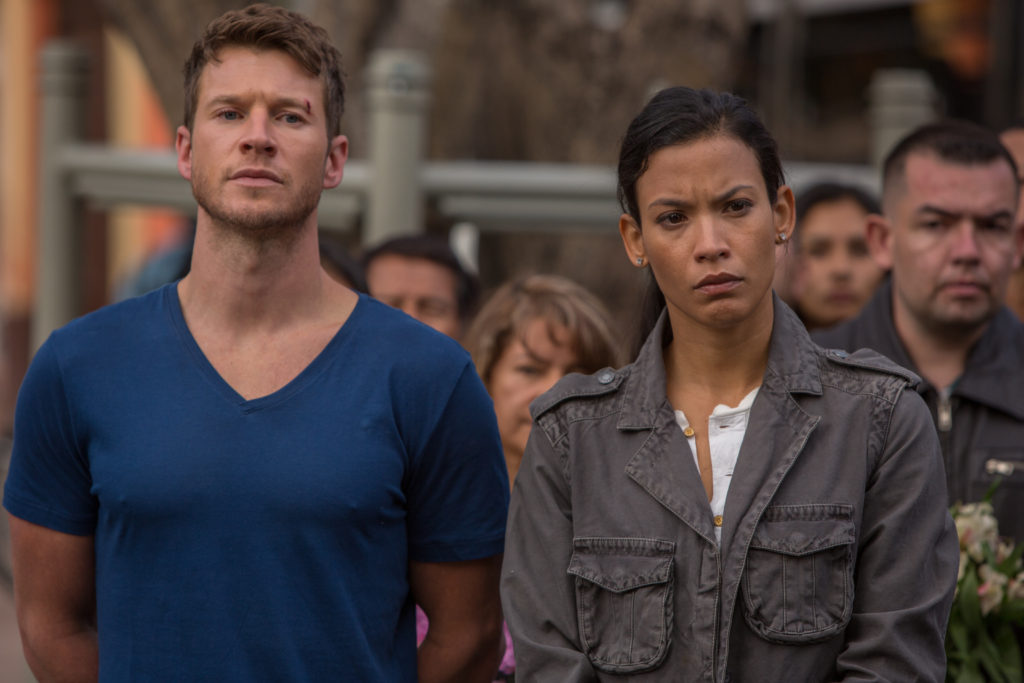
Chad Michael Collins & Danay Garcia
Starting off with a funeral for one of Brandon Beckett's friends who committed suicide, Beckett Jr. begins to have second thoughts. Shortly after, Richard Miller returns with orders for him to take down a drug lord by the name of Morales (Juan Sebastián Calero) in Bogota Colombia. Heading the operation down there is Thomas Beckett, along with newcomer Kate Estrada (Danay Garcia) who has been on Morales' tail for the last few years. After an unsuccessful strike on Morales' home, Estrada and Beckett Jr. discover there's a sniper after them played by Felipe Calero who's got a trick up his sleeve. For this entry, director Claudio Fäh returns to head this entry. Being that he helped in initiating the revival of the series once before, it suites that he circles back around. As for writing, things have gotten better too.

Chris Hauty also comes back from the previous film to pen the story here and it has improved. Aside revisiting old characters, Hauty's script was able to tackle several things this time. Right from the beginning, Brandon Beckett begins to rethink his career with the thought of developing post traumatic stress disorder. This is an issue that was addressed in the original Sniper (1993) with Richard Miller understanding how to cope with it. Then there's the focus on technology and how it has advanced, which is what Beckett Jr. and his crew are tasked with. No more are the times when a bullet was just a bullet like the first movie, things have gotten more complicated. However, the best supporting parts of the movie are the quips Beckett Sr. and Miller have with each other. Whether it be a split screen or in the same location.

While Hauty's script continues to miss the opportunity to explain past characters absences, this feels less of an importance now. The Colonel (Dennis Haysbert) and Bidwell (Dominic Mafham) are nowhere to be found or mentioned. Yet this is made up for by the chemistry between the actors. Seeing Chad Michael Collins, Tom Berenger and Billy Zane all on the same screen, FINALLY, is practically a dream come true for any devoted follower of the franchise. Especially since the last time the two veterans shared the screen was way back in the first movie. The latin cast are a great addition too. Danay Garcia gives her character a lot of fortitude and energy, while Felipe Calero as the hired sniper and Juan Sebastián Calero as the drug lord come across quite dangerous to say the least. All well done, even for the supporting characters played by Joe Lando, Jaime Correa, and Lucho Velasco.

"On my honor, I will follow Master GUNS"
The finishing touches to the film mostly worked well too. Ross W. Clarkson was the credited cinematographer to this feature it is shot wonderfully. With majority of the scenery coming from Bogota Colombia, the scenes are even more cinematic looking than that of any other prior sequel. Although only a short period of time will the plot have sniper action happening in the rural terrain, the rest is still entertaining. Clarkson also worked on other projects like Undisputed 2: Last Man Standing (2006), Undisputed 3: Redemption (2010) and Ninja: Shadow of a Tear (2013). As for music, Frederik Wiedmann composed the music once more although somehow he wasn't credit on IMDb. His work may be a tad weak compared to everything else since he doesn't try to create a theme for any character, even though he's been on board now for a while. Oh well.

The music for the film doesn't have a signature and the script still loses its grasp on past characters, but this is almost nothing worth being disappointed over. The script in this feature handles much more material as opposed to past sequels. The camerawork is great to look at, along with having Tom Berenger and Billy Zane finally reunite once again is the greatest feat of them all.

Points Earned --> 8:10

The Island of Dr. Moreau (1996) Review:

Using big name actors to sell a movie isn't a bad concept. However, using them just because it supposed to sell a bad movie is another thing. It's even worse though when it goes beyond even those intentions. For director Richard Stanley, he was at a point where he was making his way up, and was getting close to the place he wanted to be. His hopes were to create a film based on H.G. Wells Island of Dr. Moreau novel and make it into something that would be totally his, while giving the story a new twist. Unfortunately for him and everyone else on board the movie, nothing worked out the way it supposed to. Stanley was fired not long after filming began, mainly because of the lead stars Marlon Brando and Val Kilmer. However that was just one of the disruptive moments in the process.

Related image
Fairuza Balk & David Thewlis
Amazingly, as bad as things were, the film crew managed to put together a film that isn't too discombobulated. Yet this doesn't mean it's a good movie either. Instead, much of the story comes off lazy, unfocused and board. With Stanley fired, John Frankenheimer was brought in to take over. This didn't help though. While partially working with Stanley's script, Ron Hutchinson (Blue Ice (1992)) was also brought in for rewrites. This furthered the confusion and it shows. While becoming stranded out in the ocean, Edward Douglas (David Thewlis) is picked up by Montgomery (Val Kilmer) and brought to the island of Dr. Moreau (Marlon Brando). What Douglas doesn't know is that Dr. Moreau has been doing twisted experiments, mixing human and animal genes to create new monstrosities.

Premise wise, it sounds uniquely horrifying, but that's where it ends. The execution of the plot is very similar to that of something like Planet of the Apes (1968). Dr. Moreau is the one who keeps the order on the island and has a device that remotely controls his creations. Though hiding behind something to control everyone else can prove to be ill advised. What really doesn't help the plot is the whole purpose behind it. Dr. Moreau explains the testing that he's doing, but he doesn't go into detail on how it'll benefit anyone outside his reach. He was outcast to that island because his actions were so controversial. As for characters, there's really very little to get behind. David Thewlis as Edward Douglas is a sympathetic character but there's not a lot of focus on him. Instead much of the attention is given to Marlon Brando and Val Kilmer.

Being that Dr. Moreau is played by Brando, it could be understood as to why he would have more screen time, but Kilmer's character is just bizarre. He explains how he got in contact with Dr. Moreau but that's it. The rest of Kilmer's performance is all over the place. It's difficult to tell whether he was acting or being lazy. Brando, although a credible actor, does seem disengaged at times. He does give a sense of mystery to the doctor, but it's only for a short while. This is the unfortunate bit, being that the marketing went on about having Val Kilmer and Marlon Brando being the faces of the movie, when there was more to it. Plus, David Thewlis' role had more significance. There are other actors viewers may recognize like Fairuza Balk, Temuera Morrison, Ron Perlman and Nelson de la Rosa.

Related image
"Hmmmm what do you think Mini-me?"
The real positive things that can be said for this creature feature were the visual aspects. The makeup effects crafted by master Stan Winston was spot on. Making the combination between human and land animal type features can be tricky, but Winston made it look easy. Sort of like a 180 degree turn from his work on Leviathan (1989), which involved human and marine life mixing. The cinematography shot by William A. Fraker was decent. With filming locations coming from Queensland Australia, the jungle terrain looks legitimate. Fraker also worked on 1941 (1979), Tombstone (1993) and Waking Up in Reno (2002). Lastly, the music composed by Gary Chang was an intriguing element. The tracks heard are reminiscent to that of his score from Sniper (1993), but thankfully, he gives this film its own theme. Not to mention, it got its own release which is rare for him.

Sadly, the premise, makeup effects, cinematography and music cannot save the wildly unfocused performances by the cast. It may feature heavy hitter names, but they don't save the feature after all the trouble it went through. The plot execution isn't even that unique.

Points Earned --> 4:10

Friday, October 5, 2018

The Fear: Resurrection (1999) Review:

It's a strange phenomenon when obscure films are released and somehow they end up getting sequels. How dothese kinds of events happen in the time of the 1990s? When The Fear (1995) came out, it wasn't a smash hit nor did it even gain marginally favorable reviews. It was a horror film that had a unique concept but lacked any kind of vision to help make it feel largely different from that of others in the same genre. The one aspect to the film that still remains a highlight was the antagonist named Morty; the wooden mannequin. Somehow, somewhere, someone found this movie to be groundbreaking and demanded a sequel be made. Not sure how this was accomplished with the absence of social media and internet reviews. But whatever. It's not like it was worth it. This followup is by no means any improvement to the original.

Gordon Currie
As like the original, the plot is very similar. A group of adults venture into a house for a weekend getaway during the Halloween season. The leader of the group, Mike (Gordon Currie) is seeking to rid himself of post traumatic stress. When he was young, he witnessed his mother's death after his father (Garvin Cross) axed her and kidnapped him. Now he's taking his soon to be wife Peg (Stacy Grant), her brother Chris (MYC Agnew), Mitch (Phillip Rhys), Jennifer (Emmanuelle Vaugier), LisaAnne (Kelly Benson), Ned (Brendan Beiser) and Trish (Rachel Hayward) all to his grandma Mams (Betsy Palmer). There, they plan on all facing their fears with the help of Crow (Byron Chief-Moon) and his friend Morty (John Paul Fedele). Written by Kevin Richards, the script doesn't try anything new with this plot.

There is barely a drive in this plot. The execution by Chris Angel as director has the same setup to that of the first film. All the characters come together for a ceremony to embrace their fears only to have Morty let loose on them. The fears the group have don't even vary from that of its predecessor. What is the point in rehashing the same material? Richard's script doesn't make sense from the beginning either. Mike's father kills his mother and yet when it's displayed on screen, it looks as though Mike's mother stumbled across a stranger who killed her. What was Mike's father doing out in the wilderness? How did Mike escape his rampaging father? None of that is explored or explained. Not even an exposition dump as some people say. What's even worse is how oblivious some characters are.

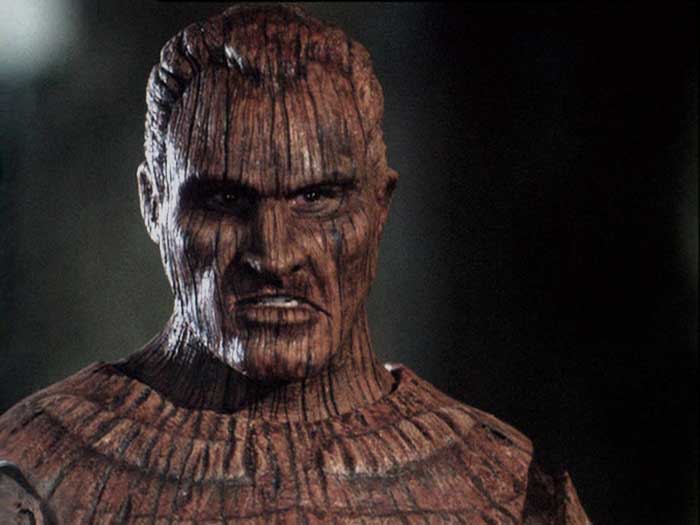
An example of this is when Crow explicitly says that a certain mystical item needs to be around Morty for it to keep the evil inside it at bay. However when the object is removed without him knowing, he doesn't realize until much later. Really? We can't be this neglectful. Yet even with these problems, there are a couple of noteworthy things. For 1999 and from what the film looked like it had budget wise, the physical and special effects don't look too bad. The Morty prop and suit worn by Fedele is about the same in visual texture as was the old suit from the first film. Although it's a tad redder in color. Sometimes it even looks like when the prop is still, someone is actually sitting in makeup. The special effects for this film are used more for Morty's physical transformations. Whether that be morphing his hands or entire body.

"I look convincing right Mike?..........right?"
The cinematography to this picture though was rather unimpressive. Taking place in a similar setting to that of the original, nothing feels different about it. Shot by Brian Pearson, the camerawork is okay but just isn't enough to truly make the experience engaging. Mike, the protagonist also suffers from dizzy spells, where the screen will become wavy but that's about the only added feature. Pearson also worked on projects like Final Destination 5 (2011) and Insidious: Chapter 3 (2015). Then there's Robert O. Ragland who composed the score to this franchise (I can't believe I typed that) once more. And it's alright for what it's worth. It's has some deep thumping bass notes at points and can add some suspense to certain scenes. After all he did work on the original movie and Grizzly (1976).

Music and visual effects are really the only highlights. Why not see Morty do cool things right? However, the actors, the characters they play, the script itself and the camerawork are bland and more or less copies of what the original film had already done. It's just an updated rehash of the original.

Points Earned --> 4:10

Wednesday, September 26, 2018

Supergirl (1984) Review:

After studios witnessed how successful super hero films could be with the release of Superman (1978), Superman II (1980) and Superman III (1983), the ball was beginning to roll for other properties. While Swamp Thing (1982) had proven to be adequate, Warner Bros. wanted to bring another hero from the planet krypton to the big screen. Being that Kara, Superman's cousin was the only other well known person, it was decided to move along with her own story. Mind you this is where the possibility of a shared universe was in its infancy. This was years before anything MCU or DCEU related. Unfortunately for Supergirl, her initial outing wasn't the success producers wanted. When finishing the feature, it can be seen as to why this happened. It was a bold step, but perhaps, a little too bold for its own good.

Helen Slater as Supergirl
The plot is about a powerful orb known as the omegahedron that Zaltar (Peter O'Toole) loses to Earth. The orb itself powers the place Supergirl (Helen Slater) and Zaltar live in. Thus Supergirl goes after it, only to have to blend in with society. Meanwhile, Selena (Faye Dunaway), an evil witch, her assistant Bianca (Brenda Vaccaro) and on-off boyfriend Nigel (Peter Cook) discover the omegahedron and seek world domination with it. This in itself is pretty outlandish already, but that's what was written by David Odell. Surprisingly that's really the only thing to this movie that isn't done well and the end product suffers greatly because of it. There's just so many questions going on with it, it's a lot to take in without hesitating first. Odell was also known for writing The Dark Crystal (1982) and Masters of the Universe (1987).

To start off, all actors seem to very invested in their roles. No matter how over the top some may come across, they are making their character their own. Faye Dunaway and Brenda Vaccaro play off of each other very well even though they portray themselves as the most casual villains ever. Helen Slater portrays our heroine well too. She's naive, kind, pretty and puts her best food forward. Peter O'Toole as Zaltar gives some insight into the omegahedron as well as the phantom zone. Peter Cook as Nigel is an interesting character as well, since he's familiar with the dark arts, as is Selena. All of which these actors have been in various movie credits that are well known. Even Marc McClure as Jimmy Olsen appears, which proves this film was supposed to be the start of a shared universe. So who ripped off who again?

However, as to what the characters do is another thing. Right when Selena finds the omegahedron she is able to make it do things for her (occasionally). Half of the time she knows how to work it, while other times not so much. It doesn't make any sense. She's never had the orb before so where's the logic? Even Nigel has understandings of the dark arts but only introduces a powerful artifact at the very end out of nowhere. Okay I guess. Not to mention the fact that Selena's motivations are clearly out of her range. World domination? One step at a time lady. Her plan behind this is to woo a guy name Ethan (Hart Bochner), who will then help her in completing her mission. Not sure how. Let's also not forget that he mistakenly falls for Supergirl. It's rushed and utterly silly.

"I look soooo evil.....yesssss"
This kind of jagged story structure leads to the pacing of it all. It's okay in various spots, but other moments it just lags for periods at a time. Jeannot Szwarc, the director of this film and Jaws 2 (1978) should know better than this. Believe it or not, the visual effects of the film are decent for 1984 standards. Most of which still hold up now. The weakest area belongs to the flying sequences which is understandable. Alan Hume as the cinematographer helped with that too. Being that he had worked on other movies like Star Wars: Episode VI - Return of the Jedi (1983) and Octopussy (1983), it shows he knew what had to be done. Musical score was also impressive thanks to Jerry Goldsmith. While it may not be as recognizable as John Williams music from Superman (1978), Goldsmith gives the lead her own theme and the sound is overall very upbeat.

While the actors try really hard to make things entertaining, the cinematography is competently shot and the music well composed, it is ultimately not enough. The script has too many flaws, the plot is too reliant on one thing and the pacing is uneven. It's not a horrible outing, but it's not the best either.

Points Earned --> 5:10


Sunday, September 23, 2018

Out for Justice (1991) Review:

While Steven Seagal was sort of late to the whole action macho role explosion trend that occurred during the 1980s, his debut was very successful. With other films like Above the Law (1988), Hard to Kill (1990) and Marked for Death (1990), Seagal wasn't stopping. As much negative critiques that he got, he was still able to produce a sizable following in box office tickets. However Seagal's films did have a bunch of things in common; they were productions that were either just above or at par when it came to viewing. Was it the worst thing put to the film? No. Was it a decent action fest? Not really either. It was just adequate. Not surprisingly, the trend continued further with this movie. After viewing this feature, there are things that work here but other times, it seems like things are just boring. So let's dive in shall we?

"Hey Gino, you really think this is enough protection?"
In the crime ridden streets of New York City, the alleys are monitored by the local law enforcement and also the Italian mob. For Gino (Steven Seagal), he has the luxury of being allied with both. Gino works for the police, and the mob respect him too. However there's one guy who isn't fond of him and that's Richie (William Forsythe). One day, after Richie guns down Gino's partner, Gino makes it his mission to take care of Richie once and for all when he finds him. In order to find out Richie's whereabouts and why he shot his partner, Gino begins a city wide search for anyone who knows. The problem is, nobody seems to have the information he wants. Written by R. Lance Hill, the screenplay isn't deep nor does it create any shocking twists. That doesn't mean the characters don't have back story though. There is a history between Gino and Richie.

The bigger issue though, is that Hill's writing produces very little intrigue among anything else. Viewers won't care about what happens to any of the characters except the main two because all other subplots are left up in the air. Gino's going through a divorce and his wife Vicky (Jo Champa) wants him to be around for their kid more often. But that goes nowhere, so it doesn't matter apparently. Hill was also the writer to The Evil that Men Do (1984) and Road House (1989). The director to this feature was John Flynn, known for movies like The Outfit (1973), Rolling Thunder (1977), Lock Up (1989) and Brainscan (1994). As to just how exactly this production did not manage to be more than just average is unclear, since both these individuals have fairly well-known credits to their names.

Aside from the script, the other flaws in this showing was unfortunately a few components. Surprisingly Steven Seagal is not that engaging in his role. Most of the time he goes around asking where Richie is and flipping his lid when no one gives him an answer. And by that, he just harasses many supposed suspects. He walks around in a sleeveless black shirt and wearing a beret flashing around his badge. Not exactly a by the books kind of cop and it looks really unrealistic. Who does that in real life? Only vigilantes do that sort of thing. The only bit of entertainment that Seagal provides are his quick action skills. Some of the violence is bloody but not by a lot. Much of the time it's just shoot outs and occasional fist fights. Nothing more than that. Not even an explosion. That's the truth. Even Jerry Orbach is more believable than Seagal.

William Forsythe
As for William Forsythe, he's the exact opposite of Seagal. Whenever Forsythe is on screen, his presence is known. Although he's definitely chewing a lot of the scenery, he gives a much more memorable performance than his co-star. At least there it feels like he's putting in the effort as to Seagal's rather underwhelming charisma. The camerawork provided by Ric Waite wasn't anything to be impressed with either. Much of the scenes have unappealing street settings, grungy looking interior sets and limited lighting in various shots. Considering he also worked on 48 Hrs. (1982), Footloose (1984) and Cobra (1986), it's disappointing. Then there's the music composed by David Michael Frank. Being that he had made music for other early Seagal features, perhaps his creativeness was lessening. Thankfully that same year he would make his best score for Showdown in Little Tokyo (1991).

The bare bones plot, William Forsythe's performance and the action is what really stands out in this Seagal movie. Sadly Seagal isn't one of those positive things. Not only does he sound bored, but so does the cinematography and music. The pacing feels slow at times and the much of it is just Seagal asking questions and after that knocking skulls.

Points Earned --> 5:10

Saturday, August 4, 2018

Jumanji (1995) Review:

The 1990s was a decade of a lot of experimentation. With the advent of CGI coming to the forefront, studios couldn't help but try to implement it into every production they had. Aside from James Cameron who was more or less the facilitator in this push, there was another director who was getting his experience with these kinds of special effects. Joe Johnston by the mid 1990s had a couple popular movies under his belt and was working his way to becoming a rather credible director. Having his name listed with movies like Honey, I Shrunk the Kids (1989), The Rocketeer (1991) and served in the visual effects department for Raiders of the Lost Ark (1981), Johnston certainly had good stuff on his resume. So when this movie came along he was well ready for it, but for audiences, that was a risky bet. However that does not mean this movie isn't worth it.

"Let's play a game shall we?"
Based on a book written by Chris Van Allsburg, the same writer to The Polar Express, had quite the intriguing concept. What would happen if there was a board game that played itself and whatever moves were made were determined by the board? Sounds pretty crazy. Yet Johnston and his team of screenwriters were able to produce not only that, but a story about a boy who learned how to grow up by not running away from his problems. Alan Parrish at a young age is the son of a wealthy shoe factory owner but feels neglected. He and his only friend Sarah find a board game by the name of Jumanji and decide to play it. Of which Alan is sucked into the game until 26 years later when Judy (Kirsten Dunst) and Peter Shepherd (Bradley Pierce) rediscover the game and start what begun those years ago.

There they meet adult Alan Parrish (Robin Williams) and Sarah (Bonnie Hunt) who join them in finishing the game. From there, things only escalate beyond the point of no return. A new turn produces more collateral damage to property and all other sorts of things. The same could be said for how these characters end up after the game is finished. Audiences will realize that the story of Alan largely plays a significant role in the progress of his home town and how it will affect other people. This also creates a good portion of emotional moments for the character and Robin Williams is also able to sell that well. The same can be said for Dunst, Hunt and Pierce who all add to the events that occur. All four of them also have great chemistry together, providing laughs and scares. Writers Jonathan Hensleigh, Greg Taylor, and Jim Strain all did a decent job building this story.

The visuals to this story however are occasionally a mixed bag. If anything, the game mechanics to this interactive extravaganza is ridiculous. No matter what, so much goes wrong even if it seems like things couldn't get that bad. As an adult, it's completely fine to watch. However for younger audiences, this movie may be too intense and can be a little too much for a comedy adventure. Being sucked into a board game isn't all the cool sounding when you're stretched and distorted. And that's where the effects come into play. Being that it was still at the point where CGI hadn't been fully perfected there are still a number of areas that look untouched. Some objects are too light in color as opposed to their surroundings. They just don't mesh well and it makes them stand out even more. There are practical effects too, which look a little better but even they look slightly unrealistic.

The Jumanji board game
The most convincing of these visuals though was the cinematography by Thomas E. Ackerman and the set design. Having worked on Beetlejuice (1988) and later George of the Jungle (1997), Ackerman surely knows how to make adequate looking shots. Most of the film takes place in Alan Parrish's house and considering how out of control things become, not long after Alan's house doesn't resemble a house anymore. It gets that bad, that quick. Lastly the musical score composed by James Horner was nothing short of greatness. Believe it or not there is a signature theme for the game itself involving minor key music box notes and beating drums. Also the cues played for Alan Parrish are rather emotional too. It may not be his most profound or emotionally moving score but it still rings memorable chords.

For a family adventure film, there are some moments that prove to be a little too intense for young eyes and the special effects haven't aged that well. Yet with credible performances by the main actors, high tension, and respectable music, this board game movie shows that game based movies can be fun, even if they aren't based on a video game.

Points Earned --> 7:10

Monday, July 23, 2018

Thursday (1998) Review:

Drug dealers and gangs are two things that typically go hand in hand. Usually one relies on the other, or at least that's how it's portrayed in various films and shows. Whether or not they're sympathetic is another question entirely, but in general they all have one goal in mind and that's to make money. It's never been known to be a clean or a nice business to be a part of and yet plenty of people par take in it all the time because how loaded they get from it. But what happens when someone finally wakes up and realizes that this life is no longer for them? Well this is what happens to someone who at first looks like an ordinary man, only to soon understand it can be very difficult to escape one's past. That is the story that takes place here and it is certainly one interesting film to watch solely for the purpose of execution.

Hi,....Frank Castle isn't home right now, please come back in 2004
As a narrative, it's strongest point is displaying just how insane someone's problems can get. Not long after the film begins, the plot begins to tail spin and continues to do so until the end. To see a story do that is astonishing because it's amazing how long it lasted. Married man and architect Casey (Thomas Jane) is living his life with his wife Christine (Paula Marshall) as normal as can be until an old friend drops by. The acquaintance is Nick (Aaron Eckhart), a former partner of Casey's past in California. What Casey's wife doesn't know is that he and Nick were drug dealer's in California. And when Casey recognizes a certain briefcase, he knows Nick has brought his "work" with him. To his misfortune from there on, Casey is bombarded by several associates of Nick while his wife is out on business related travel.

Written and directed by Skip Woods, the script's lesson on how sometimes leaving the past behind you isn't as easy as one would think is a significant one. On top of that, seeing how skillful Nick and his pack are at being criminals is shocking too. To evade the authorities for so long seems almost impossible, but they somehow do it. However, the fact that Casey hides his former profession from his wife does not make him entirely a sympathetic character. There are some redeemable traits like him not hurting anyone he comes across but considering he still lies is not a good idea either. Woods also includes a scene where Casey is forcibly raped by Dallas (Paulina Porizkova), a cohort of Nick's. Like in other movies that have depicted this, these kinds of scenes are not necessary to show. They add nothing for the viewer except making them uncomfortable.

Thankfully Skip Woods didn't bother to make this a trend and include it in all of the later projects he contributed to like Hitman (2007), X-Men Origins: Wolverine (2009), The A-Team (2010) and A Good Day to Die Hard (2013). Another thing that was left unresolved was Casey's oh so important project that he was working on before Nick arrived. It is mentioned a bunch of times throughout that he's trying to make something that even his wife isn't aware of, yet it is never revealed what it even is or if it affects the plot. Oh well. To their credit though the cast act well in their roles. As much as Casey isn't a role model protagonist, Thomas Jane does his best to give him some charm. The same goes for Eckhart who's constantly grinning. Even Porizkova as Dallas is quite convincing. There's also appearances from Michael Jeter and CSI: Investigation's Gary Dourdan.

Nick and Dallas
Camerawork for this picture wasn't all that noteworthy however. Covered by Denis Lenoir, the cinematography throughout this feature is for the most part standard and but nothing out of the ordinary either. Much of the shots feature the house Casey lives in, which isn't all that big to begin with. It's just your regular suburban two story house with bland colors and the typical set of rooms. Lenoir also worked on films like Control (2004) and So Undercover (2012). Lastly the music for this movie was provided by an artist by the name of Luna. The music itself is a mix between soundscape type music, rock and goofy comedy music. Being that this is a black comedy of sorts, they all fit in their places but they do not give the film itself a signature to it. It's just a hodgepodge of various kinds of music that work within its context.

There are parts to this film that do not add substance to the plot and it is difficult to truly feel any kind of empathy towards the main character. Yet with an unusual premise, credible actors and appropriate music, this black comedy will manage to hold its audiences' attention at least for one viewing.

Points Earned --> 6:10