Friday, May 29, 2020

Shoot 'Em Up (2007) Review:

Sometimes lightning only strikes once, but when it does, it is quite a thing to see. The same thing goes for films,...sometimes films are made and they blow away audiences. Yet the creator behind the project doesn’t go any further than that to make more entertainment. Take William Wesley, the director of Scarecrows (1988) as an example. The film went through a lot to be made and while it didn't have the greatest critical reception at the time, it has garnered quite the following. Yet with that, Wesley hasn't made another movie since 2001. The same could be said for this movie, which didn't do that well at the box office. However, it's another feature with a devoted following for how it was executed.

15 Explosive Facts About Shoot 'Em Up – IFC
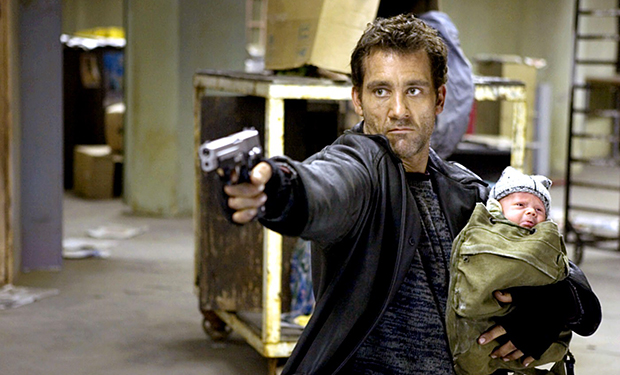
Mr. Smith & the baby
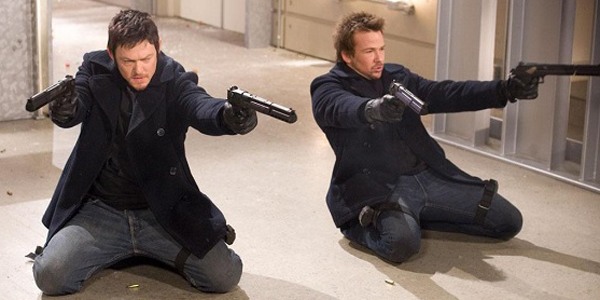
Directed and written by Michael Davis as the last film he's headed since, this literal "shoot 'em up" film is just that, but it's not brain dead. The plot is about an unknown man who goes by the name of Mr. Smith (Clive Owen) who gets entangled in what seems to be a regular hit job. As time carries on though, he begins to find out there's more to it than just that, since the main target is a baby. With the help of a hooker named Donna Quintano (Monica Bellucci), both race to find the truth and escape the smart but callous Hertz (Paul Giamatti). Meanwhile another man is also after the baby, a lone man (Greg Bryk) who quite honestly could be mistaken for Jason Clarke. For the majority of this cat and mouse chase, things are very much on the move.

The story itself is something to admire because of the plot behind it all slowly unravels revealing what's actually going on. It's a clever way of writing because it requires little exposition dumps. It's more just, as it goes, more information comes to light. This keeps the audience's attention and makes the execution smoother. What also helps are just how intriguing the characters are, no matter how few of them receive character depth. Clive Owen as the unknown Mr. Smith is one skilled marksman and expresses his dissatisfaction for a lot of things, while crunching on carrots. Paul Giamatti as Hertz is one sick villain who has the intellect but quite the womanizer, along with being a poor father and husband.

Monica Bellucci as Donna Quintano may not be the classiest heroine audiences may see, but she does have the right intentions. Bellucci was also in The Matrix Reloaded (2003), The Matrix Revolutions (2003) and The Passion of the Christ (2004). There's also appearances from Daniel Pilon, Julian Richings and Stephen McHattie who was in 300 (2006) and Watchmen (2009). The action is also well done. Considering Michael Davis wanted the movie to be gun centric, that's pretty much what the action involves and it's done in several creative ways. The only issue that arises with these sequences are the effects and plausibility. The validity of some scenes are just not that realistic. If done in real life, the likelihood of it being done would be once because they're such fatal stunts.
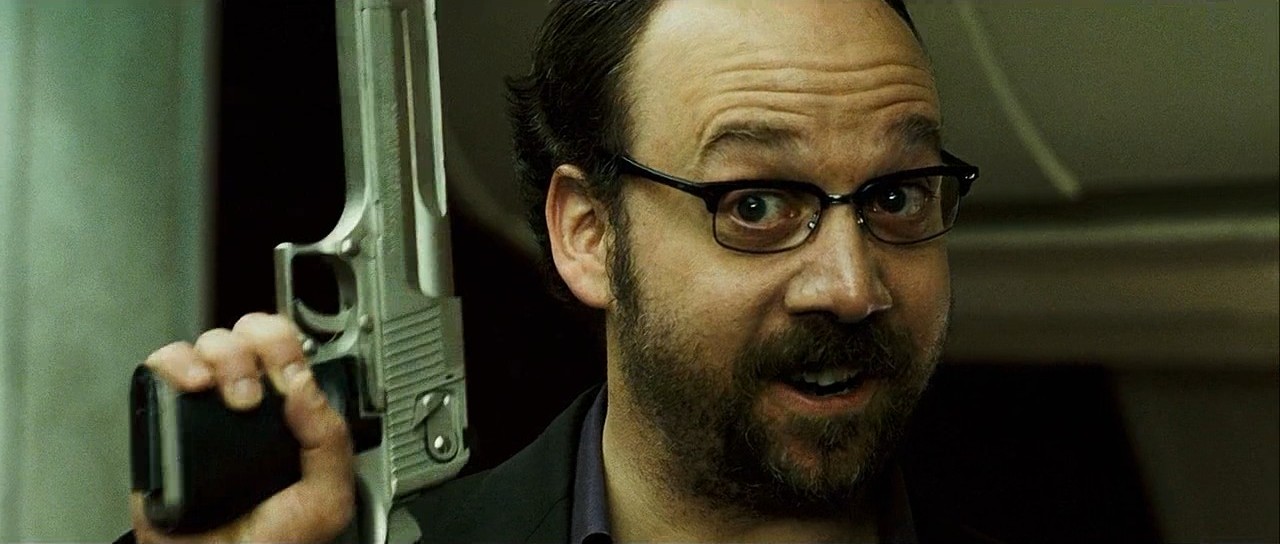
Do we really suck, or is this guy really that good?” : An ...
"I'm Paul Giamatti,...and I love being crazy"

Majority of the time, the blood shots look real, but every now and then there are scenes that look badly rendered for the year 2007. Most noticeable is a skydiving scene. However, the cinematography was crafted competently. With Peter Pau behind the camera, the shots are very fluid. Pau also worked on several John Woo / Chow Yun-Fat projects and even Bride of Chucky (1998). Sadly, he also has Jean-Claude Van Damme's bummer film Double Team (1997) on his resume too. Music was a delightful listening experience thanks to composer Paul Haslinger. While the score is usually a mix of guitars, synth beats and strings, the music lends itself well to the style and tone of the film. Haslinger feels like he took inspiration from Clint Mansell's score to Smokin' Aces, another stylized hit job film.

Aside from the possibility of the action happening in real life and sometimes the effects looking dated in small areas, the rest of this shooter film is an entertaining one. The story is an interesting watch, the cinematography and music jive together, with a cool Clive Owen performance leading the way.

Points Earnd --> 7:10

Sunday, May 24, 2020

Deepstar Six (1989) Review:

The year of 1989 was a strange time. For some reason, the craze was all about underwater horror creature features. As to why that was a thing, it’s hard to say if anyone actually has the answer. It just so happened that's how things fell in place. Right from the very beginning as a matter of fact, in the month of January. The film to start off the conga line of similarities was this movie. Unfortunately, when it was released many were not impressed and the reviews were quite poor. However, upon revisiting it, it's a little difficult to see why it deserved all the disdain. It is by no means perfect, but it's also not horrible either. Now if this was the last film to be released, I think the bad reviews could be tied to fatigue of the genre,...but this literally started the whole thing.

McCoy, Peeples, Pickett & Blacque
The story takes place in the far depths of the ocean, where a group of colleagues are finishing out their months long shift installing nuclear warheads. Lead by Van Gelder (Marius Weyers) and Laidlaw (Taurean Blacque), the two have their team lay the groundwork over one rift on the ocean floor before finishing. Unfortunately for them, they awake something dangerous lurking below. Written by Lewis Abernathy and Geof Miller, the problem with this feature is the premise in general and the clichés that come with it. As soon as viewers are introduced to the main cast of actors, it is easily identifiable as to who will survive and who won't. It's troubling when a decent production and cast is bogged down with predictable execution.

The film was directed by Sean S. Cunningham, the same director who started the Friday the 13th (1980) franchise. Geof Miller would later write with Lewis Abernathy directing House IV (1992). Co-starring with Weyers and Blacque are Joyce Collins (Nancy Everhard) and McBride (Greg Evigan) as a close couple who have grown on each other since they began their assignment. Scarpelli (Nia Peeples) and Richardson (Matt McCoy) are also a casual couple. The rest of the cast is rounded out by Snyder (Miguel Ferrer), Diane Norris (Cindy Pickett), Burciaga (Elya Baskin), Hodges (Thom Bray) and Osborne (Ronn Carroll). Thankfully the characters are interesting to watch and do have distinguishable personalities to boot.

The horror aspect to this film was fairly credible too. While the cast is not filled with A list actors, that doesn't mean you can't have fun with the rest of the film. The special effects depicted here are very much practical. With Greg Nicotero credited as creature supervisor, the sea monster itself is very much a sight to see. Not only that but there are miniatures used as well for various scenes, which is all the more credible. The gore itself also very much visible. The amount of bloodshed here is more than Sean S. Cunningham's first film. Even the underwater scenes look very much real, even though they were probably shot on a dry-wet set.

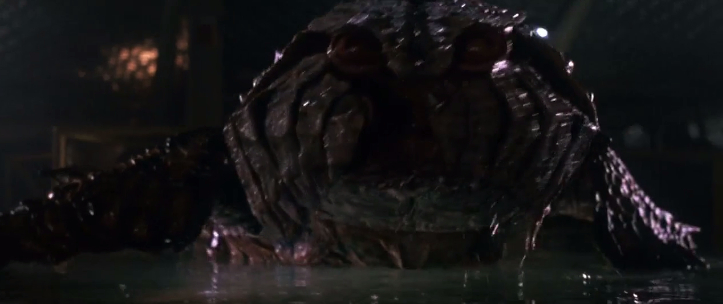
"Open wideeeee"
The cinematography also helps with the look of the movie. Shot by Mac Ahlberg, the same director of photography for Hell Night (1981), Re-Animator (1985), House (1985), House II: The Second Story (1987), Robot Jox (1989) and even Oscar (1991), the camera movements are fluid and capture much of the surroundings our story takes place in. Whether it be underwater or in the containment vessel. Lastly, the film score composed by Harry Manfredini was quite a joy to listen to. Usually, Manfredini's score are a lot cheaper in sound, but this time he sounds like he has a full orchestra at his disposal and it sounds wonderful. The film comes with its own motif and everything.

Sadly, the overall plot and execution of the story is very much been there, done that. It's very cliché. Surprisingly, this doesn't stop the film from being entertaining. The actors make their characters interesting. The camerawork and special effects look very believable. And the music by Manfredini stands out from many other works in the past.

Points Earned --> 7:10

Saturday, May 23, 2020

Death Machine (1994) Review:

To be able to get oneself on the map towards discovery can take a long time. Getting acknowledgement by age 30 though seems pretty impressive. Especially for Stephen Norrington, who would be best known for directing Marvel's first successful theatrical film, Blade (1998). Prior to this though, his first directorial debut came in the form of a different action/horror film, which was this one. In some ways, viewers will understand the tone of this film, as it was more his project entirely as opposed to the ones he would direct later. This film has Norrington's style written all over it. And for what it's worth, for his first venture it's done okay for the most part. Viewers just need to be aware of couple things.

Pouget, Sharian & McDougall
Written and directed Norrington, the story takes place in the near future where an armament corporation named CHAANK is looking to perfect its latest weapon, which the public has not approved. The developer behind the project is Jack Dante (Brad Dourif), a psychotic and deranged employee of the company. Meanwhile Hayden Cale (Ely Pouget) is the new CEO of the company hoping to turn the company around. At the same time, a group of rebels infiltrates the building to get back at CHAANK's unapproved behavior. However, after Cale goes after Dante for his termination, Dante unleashes his robot called the Warbeast to wreak havoc. Thus the film's title, everyone is up against the "Death Machine".

While the script isn't very deep, there are some aspects that make it memorable in its own way. For one, the characters are unique; maybe not the most memorable, but they are fun to watch. Joining Pouget and Dourif are William Hootkins and Richard Brake as other corporate executives. Making up the trio of rebels infiltrating the corporate building are Andreas Wisniewski, John Sharian and Martin McDougall. More surprising is that Hootkins also played in Hardware (1990), which had a similar premise. Brake would go onto play the Night King in HBO's Game of Thrones. Sharian would go on to play a role in The Machinist (2004) and Wisniewski was in Die Hard (1988) before this film. The script also has the characters throw out a bunch of pop culture references, which is fun.

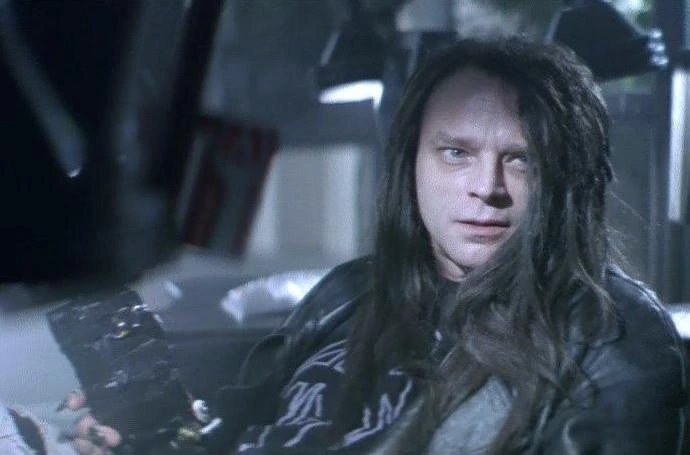
Unfortunately, there are parts to the story that don't work. One being the plot in general. The idea of an evil corporation developing weapons that nobody wants has been done several times before. The idea of having a rampaging robot killer on the loose is very similar to that of Hardware (1990) and there's even elements of Roland Emmerich's Universal Soldier (1992). That and the getup Brad Dourif wears looks pretty ridiculous, almost like pre-Tommy Wiseau, bad wig an all. But this doesn't take away the spectacle of the film. The action in this film is very energetic and the special effects are decent for the budget this film had, headed by Peter Hutchinson. Even the gore is up there. Some of the deaths are pretty gruesome.

"Did you know I'm really a good guy?"
For overall visuals though, that was disappointing. While cinematographer John de Borman was competent in the way the camera was handled, the coloring to the picture is very drab. There's too much dark colors like gray and black making the look of the overall production uninspired. It's just not as interesting as it could be. The same could be said for the musical score composed by Crispin Merrell. While the score isn't hard on the ears, it's not the most dynamic in its presentation. The sound relies more on atmosphere than it does actual theme based tunes. While occasionally there are hints of synths, pipe organ and percussion that sounds like Brad Fiedel was involved, it doesn't get more complex than that.

It is certainly not an average film, because it shows significant effort went into it. But what doesn't work is its dull plot, music and camerawork. Thankfully, the action, gore and characters help make the film marginal fluff entertainment.

Points Earned --> 6:10

Sunday, May 17, 2020

Robots (2005) Review:

Robots have always captured the attention of viewers. Whether they have a glossy rounded finish or if they're jagged and rusty. It seems that interacting with these mechanical beings has always been a way for humans to feel connected to something other than themselves. While self-aware artificial intelligence is not totally ingrained in the global society, it is getting there. But what if there was a place where all of this existed already? Leave it to Blue Sky Studios to develop something like this, which feels like it went largely forgotten. Considering this was in their early stage of developing animated films and their only other franchise starter was Ice Age (2002), that's pretty good. This movie actually makes the thought of a robot world very fun and exciting if it were to actually be a real thing somewhere in another universe.

Rodney and Friends
The story is about average robot named Rodney Copperbottom (Ewan McGregor), a young enthusiastic inventor hoping to make a difference in his world, after seeing his mother and father work very hard. His inspiration comes from a popular celebrity by the name of Bigweld (Mel Brooks) who's positivity stemmed from helping other robots. Written by David Lindsay-Abaire, Lowell Ganz and Babaloo Mandel, the script to this feature has a number of valid points to make when it comes to following your dreams. No matter the struggle, a goal is a goal, which should be the main focus. Sometimes sacrifices need to be made to help others. These are morals not only learned but reaffirmed as well by Rodney's parents (Stanley Tucci and Dianne Wiest).

Along his travels, Rodney also meets other robots Fender (Robin Williams) and Piper (Amanda Bynes) who live with Aunt Fanny (Jennifer Coolidge). It's here where more of the comedy ensues, which is fine. However, there are moments that probably have certain undertones people wouldn't exactly appreciate now. Examples like cross dressing or characterizing that cross dressing as "ugly". That and the occasional body humor, like flatulence. It's okay, but in some ways it's that kind of juvenile humor that seems unnecessary. Aside from those particular aspects, directors Chris Wedge and Carlos Saldanha were competent in their roles. Really, the whole moral to the story is what they get props for, because they kept that as the main focus.

The rest of the characters in this film are fun to watch too. Working behind the scenes to provide all robots only new parts is Ratchet (Greg Kinnear) and his mother Madame Gasket (Jim Broadbent). Both of them have good chemistry with each other as they look to take over Bigweld's company. There's also Cappy (Halle Berry) who is an assistant to Ratchet, but has a fairly predictable character arc. There's also voice appearances from Paul Giamatti, Natasha Lyonne, Dan Hedaya, James Earl Jones, Al Roker, Jay Leno, Stephen Tobolowsky, Terry Bradshaw and Drew Carey in some small roles. And the reason why these characters are fun to watch is because everyone who participated gave good performances.

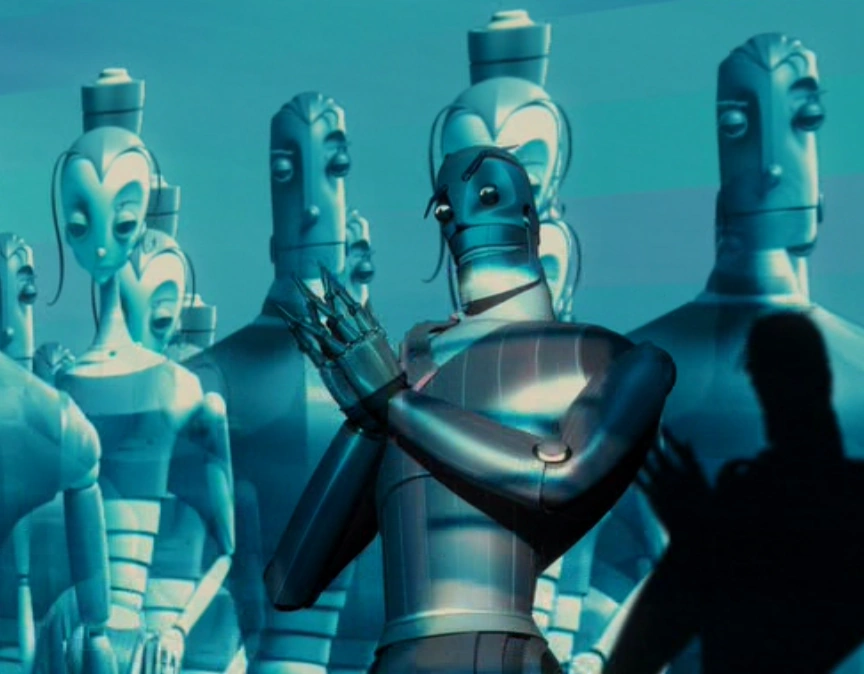
Ratchet,....yes,...very evil
From a visual standpoint, the animation was well done for its time. If it was made now, it's more likely than not that certain things would have more details to them, but overall it still holds up. What's more impressive is how creative the studio was in making the robots universe. There are so many contraptions and mechanical gizmos that make it seem like their world is so much more entertaining than our current one. For music, composer John Powell scores the film with much appreciate energy. After working on other films like Antz (1998), The Road to El Dorado (2000) and Shrek (2001), Powell has proven his knack for scoring animated films. The music Powell creates is a great mix of jazzy and classic orchestral compositions.

Parts of the writing may be somewhat insensitive for today's time, but it's a very low count. The animation, while could be improved today, largely still holds up with fun characters, energetic music and a great overall story.

Points Earned --> 7:10

Saturday, May 16, 2020

Futureworld (1976) Review:

Usually when a sequel is made without the inclusion of the creator of the original, is where things go downhill. Michael Crichton's film debut with Westworld (1973) was a unique sci-fi / horror film that made its viewers think about what if technology goes awry. Strangely enough, a sequel was made to that, but Crichton wasn't even involved. He wasn't even credited for any of the characters used in his original film! However for this followup, things seemed to stay intact, which is surprising. The more interesting thing about this, is how the story played out here compared to the other. The problem is, it's kind of expected, especially after seeing the trailer to this. But does that make it bad? Well,...it depends on what makes the bigger point.

Peter Fonda & Blythe Danner
Worked on by a totally different crew, the story continues from the events of Westworld (1973) as the new and improved Delos. This time Delos is being claimed as "Fail Safe" from its new head of the company Duffy (Arthur Hill). But someone is not convinced and that person is Chuck Browning (Peter Fonda) a news reporter who covered the disastrous nightmare that Delos had from the original film. Joining him is Tracy Ballard (Blythe Danner), another reporter who was looking to take point on the story Browning was given. Together they are invited by Duffy to tour the new Delos system and see all that has been changed. While being there and with Browning's suspicions, they begin digging deeper to find if the company is doing something they shouldn't.

Written by Mayo Simon and George Schenck who had worked on separate projects before this actually manage to maintain fairly good continuity with the original Westworld (1973). While Peter Fonda's character was not in the first film, he is properly introduced and given a history as to how he's connected to the past plot. Yet there are two aspects of the film that don't make a whole lot of sense. The first one being the return of the infamous gunslinger played by Yul Brynner. The reason why he appears is not clear as to why and he has no dialog, which comes off feeling more like a gimmick. The other error in writing belongs to the antagonist of the plot. It's an interesting direction to take, but the motivation doesn't exactly explain itself in detail.

It's strange how the thing that attracted people to Delos were the worlds they could visit. Wasn't it just amazing alone they could build robots? It seems like director Richard T. Heffron who mainly worked on made for TV movies didn't have a strong vision on the story's direction. There's also a subplot about the robots maybe having the possibility to develop feelings but it doesn't go beyond speculation. The example used in this story is about Harry (Stuart Margolin), a veteran worker from the original Delos who befriends an out of service robot named Clark (James M. Connor). The acting in general is acceptable. All the cast members who participate are as believable as they can be. Action is one of the things that didn't turn out okay,...it's just very lame. Nothing out of the ordinary.

Clark,...the man of steel
As for visuals, the set design looked great. Throughout the film, it is a definite that all the props and sets used were physically there. And for some of them, credit is due as to how creative some of the futuristic things are, like boxing and chess. They even revisit the old abandoned Westworld set of Delos, which is pretty eerie. Cinematography was handled by returning cameraman Gene Polito and also Howard Schwartz. Both do a decent job keeping the look of the film similar to that of Westworld (1973). Then there's the music from returning composer Fred Karlin. What made Karlin's music memorable from the original was his use of prepared piano. That's not here but he does rely on deep pulsing synthesizers and has a main theme for the sequel which is nice. It's a fair match.

This sequel misses the mark when it comes to making the antagonist one that makes sense. The use of Yul Brynner is wasted and the action is rather dull compared to the first. However, the actors still perform well, the set design is still appreciated along good continuity and appropriate music.

Points Earned --> 6:10

Saturday, May 2, 2020

The Chronicles of Riddick (2004) Review:

Before Vin Diesel came on the scene with his cult franchise The Fast and the Furious (2001), he was also known as Richard B. Riddick. While the character itself doesn't have as many films as Diesel's other tent pole franchise, Pitch Black (2000) was quite the unique film. Not only did it have a sense of mystery surrounding its main cast, but also pit them against a very hard deadline of escaping a dangerous planet. Following up to that initial success is this sequel, which almost turns in a full 180. Unfortunately, the showing here is less than stellar for how the story was executed this time. That's sad since some people were also from the original film.

"Guys,....I could really use Paul Walker right now..."
Solely writing and directing this feature was David Twohy, the same director of Pitch Black (2000). Knowing this, it seems additional writers Ken and Jim Wheat were needed again as they helped co-write Pitch Black (2000). The title itself doesn't really make sense either. The "chronicles"? What chronicles? This film is just one long overly drawn out story, with little to no record of what Riddick has been up to. Taking place five years after Pitch Black (2000), Riddick finds himself reuniting with Imam (Keith David) to find his home planet being invaded by a race known as the Necromongers. Simultaneously, he learns that Jack now called Kyra (Alexa Davalos), who he saved with Imam in Pitch Black (2000), is being held in a prison on another planet.

If viewers thought the convenience of landing on planet exactly when it was going to eclipse in Pitch Black (2000) was too contrived, then this will be far worse. It just so happens the subplot related to Kyra crosses paths with the Necromonger plot thread. What are the odds? On top of that, there's even more subplots going on about Riddick being the so-called “chosen one” who will overthrow the Necromongers told by an elemental played by Judi Dench. There's also two characters among the Necromongers, Vaako (Karl Urban) and Dame Vaako (Thandie Newton) who plan to commit treason on their leader Lord Marshal (Colm Feore). Why all the different storylines? Was it truly needed for this?

What made Pitch Black (2000) so entertaining was its single story line. Nothing involving "the chosen one" tropes or political treason among ranks. If there's one thing Twohy did get right, it was keeping the continuity to the first film. That was done well. Seeing Keith David return and on his home planet was cool. There was even an explanation as to why Jack had a name change. That's all good! It just all the added plot threads that weigh down the pacing and entertainment value to the main story of focus. It's fine if the idea was to expand Riddick's universe and lore, but it's too much too soon. That doesn't mean the actors aren't credible though. Even Nick Chinlund has an appearance as a snarky mercenary.

Thandie Newton & Karl Urban
From a visual standpoint, it's half and half. The action sequences are fun to watch. Vin Diesel has proven himself to be an action star as well as Alexa Davalos, Karl Urban and Colm Feore. Sadly, it's the camerawork handled by Hugh Johnson that doesn't come off very appealing. Much of the time, Johnson relies on a lot of Dutch angles and shaky cam, which gets very annoying when trying to watch. Music again, is also another component that could have been better. With composer Graeme Revell returning for round two, one would think he'd make up for his rather dull score from the last film. No luck, Revell continues to make his music as bland and anonymous as possible. A real let down.

Sequels tend to not perform as well as their predecessor, but they don't tend to fall too hard. This one did just that though. While the action, acting and continuity is kept in-tact, which is shocking compared to most sequels. The plot is overly complicated with poor cinematography and uninspired music.

Points Earned --> 5:10

Sunday, April 26, 2020

Silverado (1985) Review:

By the 1980s, the genre of Westerns had pretty much died off. Unfortunately, due to the enormous failure that was Michael Cimino's Heaven's Gate (1980), Hollywood not only reconsidered giving total control to directors of the projects, but also closed the curtain on big budget Westerns in general. They were seen as time consuming, costly and returned little revenue. Despite this, the genre went on but continued to see little financial success. Such goes for this film which not only had its set reused for other films that came later, but also manage to gain critical acclaim for how it was handled then. This is baffling even more when considering who took part and how the story was executed. It's really surprising the genre didn't bounce back with films like this.

Glover, Costner, Glenn & Kline
The plot is about a group of rag tag strangers who end up crossing paths and manage to develop a good working relationship with each other. All who end up passing through the city of Silverado. Written by Mark Kasdan, with co-writer and director Lawrence Kasdan heading the project, this western is one that not only has a fun story but also features a number of familiar faces from back in the day. Emmett (Scott Glenn) and Jake (Kevin Costner) are brothers in hopes of making it to California. Emmett's a sharp gunslinger, as is his brother. However, Jake is much more reckless. On their journey, they meet Paden (Kevin Kline), a traveler recently robbed from another group he once was close with.

Then there's Mal (Danny Glover), a wanderer looking for place he can be accepted for who he is. His sister Rae (Lynn Whitfield) is a popular lady among the saloons and is good friends with Slick (Jeff Goldblum), a wealthy gambler. Also found in Silverado is also one of Paden's old associates; Cobb (Brian Dennehy) and Tyree (Jeff Fahey). All of these supporting characters come to a head as the story comes to a conclusion. The only aspect of the script that should've been twisted differently were backstories to certain characters who more often than not are put in difficult situations. Understandably so, some are unavoidable due to the time it takes place, but these kinds of scenarios do not always have to happen.

Supporting the cast are other well-known actors like John Cleese, Linda Hunt, Joe Seneca and Brion James. For anyone unfamiliar, Lawrence Kasdan was also known for writing Body Heat (1981), The Big Chill (1983), Star Wars: Episode V - The Empire Strikes Back (1980), Raiders of the Lost Ark (1981) and Star Wars: Episode VI - Return of the Jedi (1983). The action was staged well for this feature. Considering this is a western, it is expected to have the local bar fights, fist fights, gun fights and horseback riding. All of which are executed like everyone involved has been doing it all their lives. There's even a sequence involving a stampede, which no doubt is dangerous if not controlled properly.

"You know,....I knew a guy named John Rambo...."
The cinematography was shot competently too. Behind the camera for this feature was John Bailey. Capturing wide landscapes along with matte paintings helped greatly in giving the film that classic western outback look. Prior to this Bailey also worked on Premonition (1972), American Gigolo (1980), Cat People (1982), and The Big Chill (1983). Lastly, the music composed by Bruce Broughton was very well done. Having a revisited motif for the feature made it all the more the memorable. Using classic orchestra and tambourine, the sound of it matches the tone and setting of the story completely. Thankfully for Broughton, after the initial release, Intrada released an expanded score which makes the experience that much more enjoyable.

Aside from one subplot being rather common place for many westerns, the rest is an enjoyable trip back to the past. All elements like music, camerawork, acting and action all help make the feel of it as authentic as possible.

Points Earned --> 8:10

Saturday, April 18, 2020

Agnes of God (1985) Review:

Mysteries arise because there's a lack of understanding as to how something happened. Depending on the situation, the mystery may be present due to the absence of witnesses. Or if people were around, the logical understanding behind what happened may not make sense. However, things can get even more baffling when it comes to faith based mysteries. The reason for this being that some may not feel there are logical answers to such phenomena. This unfortunately, becomes hard to make a case during court trials, paperwork and other such legal processes. That leads us to this particular film which deals with such a unique scenario that does not have an easily discernible answer.

Anne Bancroft
The story originally written for stage plays, is about novice nun Agnes (Meg Tilly) who is found with a dead newborn in her convent. The head of the convent, Mother Miriam Ruth (Anne Bancroft) is assigned psychiatrist Dr. Martha Livingston (Jane Fonda) to understand how such an event could have happened. Along the way, Livingston begins to learn more and more about what happened and just how much she relates to the setting around her. The screenplay was adapted by the same person who the wrote the play, John Pielmeier. Together, he and director Norman Jewison make a film that not only raises good questions, but really makes the audience think.

What makes the story so interesting to watch is seeing the clashing ideologies between Dr. Livingston and Mother Ruth. One is a trained psychiatrist, who looks to logic for answers. Solid, irrefutable evidence that allows one to solve such a strange anomaly. The other is a believer of God and feels sometimes things are not so easily explainable. Pitted between the two is sister Agnes, who remembers certain things, while other times doesn't remember the whole story. What's even more important is that while there is closure, there are moments left up to the audiences' interpretation. Giving the story another level of depth when it comes how things actually happened and why. The only part that doesn't really add up is just how the pivotal discovery was handled in such a short window of time.

The cast to this film is a mix of American and Canadian actors. All of which have credible acting skills. Jane Fonda and Anne Bancroft both act very well in this feature. Their characters have an interesting dynamic considering their histories. Fonda is known for her roles in Barefoot in the Park (1967) and Coming Home (1978). While Bancroft is known for her roles in The Graduate (1967) and The Elephant Man (1980). Meg Tilly as Agnes also gives a captivating performance as the main focus of the investigation. She not only is a tragic character, but a troubled one. At the time Tilly's best known role was in Psycho II (1983). There's also appearances from Gratien Gélinas, Guy Hoffmann and Deborah Grover.

"So....you ever been to the Bates Motel?"
Visually speaking, the film has lots to offer. While the movie is by no means in the horror genre, there are some horrific scenes that involve blood that nobody should go through. Aside from this though, the shots whether it be internal or external are filmed well. Behind the camera was Sven Nykvist, who would also go on to help film Chaplin (1992). As for music, the sound was brought in by French composer Georges Delerue. Seeing that many films that involve religion tend to lend more vocals, Delerue ops to evenly blend this with romanticized orchestra. The tone is tragic and beautiful simultaneously and deserves a listen.

There's very little to find confusing about the story told here. Aside from one bit related to timing, the premise is a solid one that not only questions believers, but non-believers. Thanks to strong acting, emotional music and skilled cinematography, this film will keep its viewers watching with intrigue.

Points Earned --> 8:10

Thursday, April 9, 2020

Scarecrows (1988) Review:

Films that are competently crafted and executed well sometimes don't get the recognition they want right away. Like other cult films that have grown in popularity over the years, this film is no exception falling into that exact same bucket. Majority of the time, very few people think of scarecrows as an actual intimidating thing. With their static nature and distorted bodies filled with straw, it's no real shock that anyone or anything would find them realistic. For cripes sake, the animals know the difference between these stuffed imitation humans versus actual living beings. Then again, most people don't make a very convincing scarecrow to boot. However, this film will make you think otherwise if you come across any scarecrow that looks like the ones shown here. And this is all kudos to a very special crew.

Victoria Christian, Kristina Sanborn & David Campbell
The plot is about group of criminals Corbin (Ted Vernon), Curry (Michael David Simms), Jack (Richard Vidan), Roxanne (Kristina Sanborn) and Bert (B.J. Turner) escaping with a large sum of money. With them are two air pilot hostages Al (David Campbell) and his daughter Kellie (Victoria Christian). To their dismay, Bert goes rogue making off with the money himself mid-flight and lands in what appears to be a deserted farm. Quickly catching up behind him, Bert's team have the hostages land the aircraft and search for him. Little do any of these characters know that the area they landed in has something much more sinister going on. Among the quiet fields are dreadful and human like scarecrows, of which they soon learn is more to them than what they think there is.

Directed by William Wesley, with a script co-written by Wesley and Richard Jefferies, this little horror film shows what can be accomplished with much minimalism as possible. First off, the premise. What an idea. Very rarely do stories actually make their villains the main characters but also sort of make a viewer feel for them (sort of). With a cast of less than ten actors, the story is kept tight with its focus and will keep the viewer at attention with all of its mysterious setups. If anything, the only things the screenplay suffers from is what feels to abrupt character motivation changes and an interesting backstory. Having a mysterious story is the right way to go, but when there are points to be made clear and they aren't, it begs the question what were the points? However, these flaws are far from a huge problem in the overall execution. In some ways, a viewer can forgive this just because of how well the story plays out.

The actors all have interesting scenes together whether it be in their respective groups or if it's protagonists vs antagonists. Surprisingly, many of these crew members to the film did not continue on after this. Ted Vernon, Richard Vidan and David Campbell continue to act in various projects. Michael David Simms would later be in X2: X-Men United (2003) and Eight Below (2006). However, Kristina Sanborn and Victoria Christian both dropped out of acting shortly after. As for B.J. Turner, he passed away a few years later. As a little gift though, Don Herbert from the Mr. Wizard show has a small role as a radio newscaster. Richard Jefferies has gone onto write for movies like The Vagrant (1992) and Cold Creek Manor (2003). What's more surprising is that William Wesley only directed one other movie which was Route 666 (2001). With making such a great debut, it's unfortunate he hasn't gone onto bigger projects.

"Don't mind me,....just hanging out...."
As for visuals the movie has got what a horror fan could want. The makeup and practical effects are fantastic. With help from the late J.B. Jones (Shoot to Kill (1988), The Crow (1994)) and Norman Cabrera (Spawn (1997), Hellboy (2004)), the scarecrows on scene are legitimately creepy. This is also thanks to Peter Deming as the credited cinematographer. Much of Deming's shots linger on the scarecrows to show just how insidious they really are. Deming would also shoot for Evil Dead II (1987) and The Cabin in the Woods (2011). Lastly, music was another great aspect thanks to the late Terry Plumeri. Featuring a small orchestra of strings, bass clarinet and piano, the themes used in this score are very effective in bringing on the uneasy tone. There are no stings in this score whatsoever and it is quite the listening experience. Too bad he is no longer with us.

Backstory and the unwinding of the history is not done very well but that is nothing compared to the rest of the film. The premise is solid, with a focused script, credible actors, great looking special effects, camerawork and music. This is one horror film to watch if viewers are looking for something pleasantly unsettling in a fun way.

Points Earned --> 7:10

Sunday, April 5, 2020

Staying Alive (1983) Review:

John Travolta's breakout role in Saturday Night Fever (1977) was a highlight not only for himself but for the decade it came from. During the 1970s, discos were very much the place to be during that time. And while the film itself had much of that to feature, the story of a regular young adult looking to make the most of their time enjoying life had interesting points to make. The story not only felt real but also understandable. Anyone trying to work from the ground up can relate to the struggle of making ends meet and trying to make something of yourself. That's what Tony Manero's story was all about that Travolta played. Weirdly enough, this sequel commits to furthering that story but only half way. It really doesn't make complete sense of everything which is unfortunate, but it is certainly not a terrible sequel.

Rhodes & Travolta
Directed by Sylvester Stallone, with a script co-written by him and Norman Wexler (from the first film), the story follows Tony Manero to Manhattan where he seeks to continue his passion for dancing on Broadway with support from his new main squeeze Jackie (Cynthia Rhodes). Although after one night seeing Jackie in rehearsal he comes across Laura (Finola Hughes) the lead dancer and decides to come on to her. Unfortunately, this leads to complications between his current relationship with Jackie and his passion for dancing. Aside from that, the narrative is kind of light. Unlike the first film which had lots of characters to play off of and add layers to Manero's life, now it feels almost empty. Not sure exactly what happened during the writing process but the film feels awfully long for such a short story.

It seems almost as though Stallone got too caught up in the production and visuals to bother actually helping to write a sequel that further developed the main character. First off, the only character to return from the first film outside of Tony is his mom played by Julie Bovasso. What happened to Stephanie (Karen Lynn Gorney), Annette (Donna Pescow) or any other part of his family? Part of the reason why the first film worked so well was that family dynamic and how they interacted with each other. Instead much of time is dedicated to confusing character motivations between Tony and Laura, or Tony and Jackie. These interactions don't make a lot of sense because all in all there's a lot of pivoting which makes the viewer disoriented in what the character's actually want.

This sadly leads to uneven character development, which is hard to watch since there are so few cast members this time that are of focus. However, this doesn't mean the actors involved are not credible. John Travolta still plays Tony like he did in the last film, still a goofball but quite talented when he's puts his mind to it. Cynthia Rhodes as Jackie is a kind person who deserves the most for herself. Even Finola Hughes is a good actress, but it's her character’s motivations which throw much of the story off. Rhodes would later star in Dirty Dancing (1987) and Hughes would go on to play in General Hospital. There's even a few shots of Kurtwood Smith poking around directing dancers on a stage, but he doesn't say anything.

"Hello, my name is Laura...."
Choreography however is probably the most perfected aspect about this film. More than likely this was Stallone's focus as well. No matter if it's the dance numbers on the stage with several extras or just one on one between main characters, the dance skills filmed are undeniable. Travolta not only maintains his skill but bulked up for it as well. Kudos to Dennon and Sayhber Rawles for their work as they would later help choreograph for Bugsy (1991). Cinematography also went well with that taken care of by Nick McLean. McLean would also shoot for City Heat (1984) and Short Circuit (1986). Even music was okay, while The Bee Gees were a main highlight before, the main singer to much of the songs is Frank Stallone (not surprised). Since this film was from the 80s, it's better than featuring disco music anyway as that fad was gone.

It's not as bad as critics called it, but it definitely lacks the kind of narrative that made the original so interesting to watch. Here, it's just the same character being sillier than before and trying to make it big, but nothing deeper than that. Stallone's directing and writing isn't the best. However, acting, camerawork and music are all fine.

Points Earned --> 5:10


Tuesday, March 31, 2020

Pumpkinhead III: Ashes to Ashes (2006) Review:

While upon its release Ray Winston's directorial debut with Pumpkinhead (1988) didn't gather the praise it may have wanted, it has managed to maintain its cult status. Despite that, studios are always looking to make a quick buck and manage to further nothing that made the original so memorable. Jeff Burr's Pumpkinhead II: Blood Wings (1994) was by no means a good film but there were things about it that made it funny to watch. There were all kinds of wrong with how the studio messed around with the final product. From a creative standpoint though, the story tried to do something different with the vengeance demon, which deserves kudos. Unfortunately, it was its continuity that was hard to figure out. Here though, this sequel is the opposite.

Ioana Ginghina
Taking place in a small community (presumably from the first film), a bunch of town locals discover that their mortician, Doc Fraser (Doug Bradley) has been doing malpractice on fellow family members. The person to first realize this is Molly Sue (Tess Panzer) and finds Haggis (Lynne Verrall) the witch who has the power to summon Pumpkinhead for vengeance. Meanwhile her partner Oliver (Emanuel Parvu) begins his own investigation and meets Bunt Wallace (Douglas Roberts) who continues to have hallucinations of Ed Harley (Lance Henriksen). Written by John & Barbara Werner, the plot behind this feature is truly a dud. Viewers will be very much familiar with this setup as it is a direct copy from the original film.

Unlike Pumpkinhead II: Blood Wings (1994), which tried a different narrative, nothing's changed here. The only interesting aspect to this sequel is that viewers will be given the clear indication that this indeed takes place after Pumpkinhead (1988). The fact that the writers included Haggis, Bunt and Ed Harley again was appreciative, but that's where it ends. The use of these characters is far and few between as to how they should've been addressed. Instead, fans see goofy acting among many thespians who just truly show that this is a TV film. Actors like Lisa McAllister, Tess Panzer and Ioana Ginghina are just boring. The only unknown actor who stands out more is Emanuel Parvu, although his voice doesn't match his look.

Jake West’s skill as a director wasn't that impressive either. His filmography has been more relegated to documentaries. He's only directed a few films like Razor Blade Smile (1998), Evil Aliens (2005) and most recently Doghouse (2009). As for the recognizable stars, not even they're truly safe. Doug Bradley and Lance Henriksen are both credible actors, but here they feel awfully unenthusiastic. If anything, Lynne Verrall and Douglas Roberts try harder. The violence and special effects for this feature were barely passable as well. The prosthetic Pumpkinhead is okay in some places but other times not as much. At least the first sequel had the decency to stick to practical effects. When you see a CGI Pumpkinhead, that's when you know it's bad.

"Ummm,....I thought you were taller?"
Gore is pretty much in the same bag. Not a lot of it is shown and when it is, it's not the best. Cinematography wasn't excusable either. Erik Wilson as the cinematographer was average with what he was given. Much of the shots are dimly lit and from an interior standpoint, the scenes look even cheaper. Only do the outer sets actually look okay. Wilson also worked on a film called The 13th Sign (2000) and would surprisingly go on to Paddington (2014). Lastly, one of the few redeeming qualities to this entry was the music composed by Rob Lord. While not having a ton of recognizable credits to his name, Lord at least managed to make the music sound sort of like the original although not exactly. A movie he worked on before was Slipstream (2005).

Trying for a second time, this second sequel matches the first but for other reasons. While the screenwriters resurrect old characters from the first film, it isn't much because the plot is all too familiar. The music is the only additional plus. Everything else from effects, acting and camerawork is iffy at best.

Points Earned --> 4:10

Saturday, March 21, 2020

Rambo: First Blood Part II (1985) Review:

When Sylvester Stallone first entered the scene as John Rambo, viewers may not have been expecting such an explosive turn out in the character he played. Aside from Rocky Balboa, Stallone didn't have many tent pole characters he could create a franchise off of. By 1985, Stallone was already up to Rocky IV (1985), and there was only First Blood (1982). Thankfully Stallone's first outing as Rambo secured him enough to start another line up of films. And while the first film was able to make a clear point about life as a war veteran and the hardships that came with it, Stallone had way more control over the story in this sequel. This is also because Rambo was not supposed to live after the first film.

Julia Nickson as Co
After the events of First Blood (1982), Colonel Trautman (Richard Crenna) picks up John Rambo (Sylvester Stallone) again for a new assignment. Wanting to determine whether there are any surviving POWs left in a Vietnamese camp, Rambo is assigned by Major Marshall Murdock (Charles Napier) to spy and take photographs (only) if any POWs exist. But things don't go as planned when Rambo discovers POWs do exist with the help of an inside informant named Co (Julia Nickson), who's also looking to flee the country. The screenplay says it was written by Stallone and James Cameron believe it or not. Although, much of what Cameron drafted originally was later changed by Stallone. The usual tropes Stallone includes in his scripts can sort of be picked out here too.

Instead of further exploring John Rambo's tortured psyche, Stallone's approach for this entry was looking more at people in his situation and the political drama that happens behind the scenes. The only individuals Rambo trusts are Co & Trautman. Unfortunately, Co's history with Rambo isn't so clear, the plot is basically a reverse of the Rambo's. He came home from war in First Blood (1982). Now he's returning to war in the sequel. Much of the story works because of the social commentary on whose really in control of international affairs, such as adding Steven Berkoff to the cast as Colonel Podovsky. But the other side characters like Co, or Ericson (Martin Kove) don't add a whole lot because of how little development they receive. The fates of their characters are quite obvious.

For how those characters are handled, it could also be in part to how the director worked with Stallone. Then again, George P. Cosmatos would also later go on to direct Cobra (1986), Leviathan (1989) and Tombstone (1993), arguably his best work to most. What Cosmatos was certainly capable of directing were the action set pieces. Throughout this film, again mainly due to Stallone's rewrites, the action is cranked up far higher than it was in the last film. There's a ton more explosions, gunfire, stabbings and arrows being shot. If there's one thing that was missed from the first film it was the survival aspects Rambo used for himself while all alone. If anything, that should have been used more, even though there were some aspects of it shown like the utilization of natural backgrounds for camouflage.

"I never wanted your party invite!"
The cinematography also changed hands for this sequel. Replacing Andrew Laszlo from the initial film is Jack Cardiff, another cameraman from the classic era of filmmaking. Unlike the first movie where Laszlo was filming areas of the western hemisphere, Cardiff was to make the film feel much more eastern. Making sure that the scenery looked as foreign as possible to the domestic viewer. Cardiff also filmed on Stephen King's Cat's Eye (1985). Lastly for music, Jerry Goldsmith returns to score the film and he too amps up his work. Originally, his first score to First Blood (1982) did not highlight the motif of John Rambo as much. That's a one eighty turn for this entry; where Goldsmith makes sure Rambo's theme is played in as many places as possible and it sounds great.

Part II is a decent sequel to the original even though it drops the whole PTSD angle for more carnage and political commentary. However, it's still great entertainment as it pits the main character at unbelievable odds as much as the outcome seems highly improbable. The cinematography and music only further make it that much fun.

Points Earned --> 7:10

Sunday, February 9, 2020

Gretel & Hansel (2020) Review:

Re-imaging of classic tales are not uncommon practices, especially in the film making industry. Whether it be based on a pre-existing literary work or if it was completely original, Hollywood is bound to have someone remake or reboot a film that resonated with viewers. The story of Hansel and Gretel are very much a well-known story from the brothers Grim. Having all kinds of their stories adapted to different movies like Cinderella, Rapunzel or Little Red Riding Hood, the brothers Grim were able to make a number of their fairy tales stick with their readers. Up until this point though, much of the movies that depicted Hansel & Gretel were not as true to the written work. Here though, this feature seems to make it it's mission. It probably could have used a tad more tweaking.

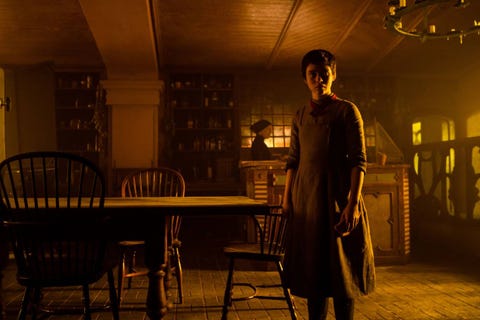
Sophia Lillis
The story follows the basic backbone of the classic tale. In order to survive what seems to be a famine, two siblings by the name of Gretel (Sophia Lillis) and Hansel (Samuel Leakey) head out into the dark forest where they encounter a suspicious kind lady (Alice Krige) who takes them in. Written by Rob Hayes (East Meets Barry West (2009)) and directed by Anthony Perkins' son Osgood (Oz) Perkins, the executions to this adaptation has a number effective things, but still has some hurdles to overcome. The struggle that viewers might have with this film is trying to understanding the time setting. While it looks very much like viewers are being transported to the olden days, there are things that make it feel out of place. Such as Hansel's hat; it's a baseball cap. Not sure that sport was around for people to know.

There's also an aspect to the story that involves supernatural elements for certain characters. However, this isn't fully rounded out as the screenplay does not give context to its viewers. And overall, the film just isn't scary. While having a PG-13 rating usually is a bad sign, that's not even it. It's just won't make its audience scared, as the story itself is not enough to win desensitized horror fanatics. However, this does not mean the film doesn't have merit. While the film isn't scary, it definitely is creepy. Assuming Osgood Perkins inherited some of his father's horror genes, it seems the direction had the right intentions behind it. There really aren't any lively colors, which help further drive home just how bleak the setting is for the protagonists. While Osgood Perkins hasn't direct many films so far, he has had his fair share of work in other places.

The actors cast for this film also do a great job. Both Sophia Lillis & Samuel Leakey are believable as siblings and viewers should be able to care for them. Lillis was also a part of It (2017) and It: Chapter 2 (2019). However, the actress who has a more interesting presence goes to Alice Krige as the suspicious old lady the siblings happen to stumble upon. Sporting a full black cloak and speaking in a very soft tone. Krige makes sure people pay attention and it should definitely give people goosebumps. Not to mention the fact that Krige has participated in other films involving unsettling situations like Ghost Story (1981), Sleepwalkers (1992) and most notably as the borg queen from Star Trek: First Contact (1996). There's also brief appearances from some younger actors like Charles Babalola and Jessica De Gouw.

"Trust me,...I don't bite,....maybe"
The visuals, as stated before do favor the experience when watching this film. For newcomer Galo Olivares, working the camera for his first feature film seemed to come only naturally. Majority of the time, the camera is steady and is able to capture exactly what the story needs to tell the right way. Nothing is overly used nor poorly setup like other amateur horror films. Practically no horror stings. As for music, the score was composed by Robin Coudert also known as ROB. Having worked on other horror films like Horns (2013) and Maniac (2012), the sound is a surprising listening experience. Not only does Coudert include a main theme, but also mixes organic orchestra with more contemporary sounding synthesizers. Yet, it fits the film well as much as the setting takes place in what seems a different era completely.

From a narrative perspective, the script covers almost everything except for some key components that lead to the end. It's also not scary, just creepy. Which means the film still deserves a watch because the actors do their part, the camerawork is handled competently and the music is a nice listen.

Points Earned --> 6:10

Sunday, January 19, 2020

Superman IV: The Quest for Peace (1987) Review:

When franchise movies get long on the tooth, it become disheartening to see how far it can go with such bad qualities. Among all the films related to the man of steel up until this film, this entry was considered by far the worst in the filmography. The fact that some actually considered Supergirl (1984) to be better than this film spoke to many that something was not right with the direction of the films. However, when revisiting the film, it turns out what people may not like may not make this sequel as terrible as some other films go. Sure, it still doesn't match up to the original or the second film, but it is definitely not unwatchable. Surprisingly, as much as the cast was not getting along, it's very hard to tell that people were not enjoying themselves in the making of this feature.

"Here yee,....here yee,...for I am more powerful than thee"
The plot revolving around this feature takes place when the arms race continues to escalate between super powered countries. Feeling a need to do something after a young boy sends him a letter, Superman AKA Clark Kent (Christopher Reeve) looks to find a solution. Seeing the opportunity in Superman's involvement, the ever scheming Lex Luthor (Gene Hackman) breaks out of prison with the help of his nephew Lenny (Jon Cryer). Luthor's plan is to create a being just as strong as Superman. Meanwhile the daily planet is being taken over by David Warfield (Sam Wanamaker) and his daughter Lacy (Mariel Hemingway), who ends up developing feelings for Clark.

The script was written by Lawrence Konner and Mark Rosenthal who both wrote for The Legend of Billie Jean (1985) and The Jewel of the Nile (1985) prior to this. Seeing that part of the film's production problems came from the budget, it could be said that they both had to work with whatever they could. However, there are parts to the story that don't make any sense in continuity. Such as people breathing in space aside from Superman or Luthor having the know-how of creating another superhuman. There's also meaningless supporting characters such as Lenny and Lacy. Both of them do not contribute anything to the overall story and neither of them have a purpose other than hijinks.

If anything, the worst offender is the big baddie, Nuclear Man played by Mark Pillow. Not only does Pillow give a rather goofy over the top performance, but his weapon of choice is very lame. Fingernails,....that's right fingernails. This not only makes the action between him and Superman laughable but almost embarrassing. Forget all the mediocre special effects the production used,...they could have at least thrown their fists at one another. That's one thing Superman III (1983) got right. Thankfully, most of the other fun characters return like Perry White (Jackie Cooper), Jimmy Olsen (Marc McClure), Lois Lane (Margot Kidder) and even William Hootkins as an arms dealer.

Nuclear Man
While the effects are not always on par with prior films, at least they feel closer to the first two superman films than that of the third film. Director Sidney J. Furie did his best to keep it that way along with his cinematographer Ernest Day. Furie was the director of Iron Eagle (1986), while Day had worked on Running Scared (1972). All shots are kept steady and have a good number of shots that capture the large scope of the setting. The best component to this feature though was the score composed by Alexander Courage. While not having the same grab as John Williams, Courage uses Williams' theme for Superman to a great extent making it sound almost like Williams was there. Not only is the score fully fleshed out but matches in tone as well to the rest of the films.

Saying this is the worst film in the series is a bit hard to say. Superman III (1983) got several things wrong as well. At least here it felt more like the first two. Yes the effects are not as polished and continuity issues are vast, however the music, camerawork and returning actors put in one more performance that still retains the Superman feel.

Points Earned --> 6:10

Tuesday, November 26, 2019

The Nutty Professor (1996) Review:

Hollywood is bound to the cycle of remakes and reboots no matter how much they try to avoid it. There are too many examples to get into, but when new actors rise to stardom, some studios feel as time goes on it is best to introduce their classic properties to fresh audiences. More than thirty years ago, Jerry Lewis starred in The Nutty Professor (1963) and it's no surprise the thought was brought up again to re-imagine it. This time, the star to take over the main lead was none other than Eddie Murphy, a solidified stand-up comic who would break the boundary. And as a remake to the original, it proves to be an entertaining one. Even though it stars Eddie Murphy, it still has its problems.

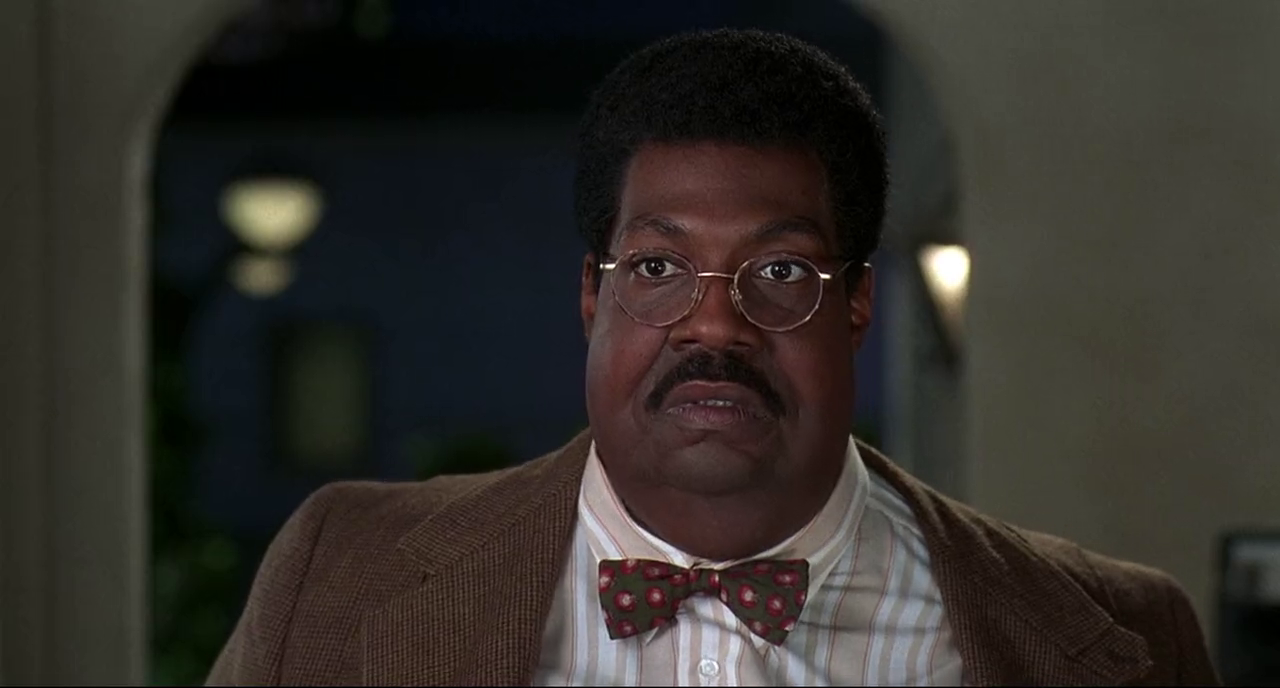
Professor Sherman Klump
The screenplay written by David Sheffield, Barry W. Blaustein and Steve Oedekerk help work in new material regarding the dynamic behind the main character. Professor Sherman Klump (Eddie Murphy) is a lonely overweight fellow who's on a breakthrough in biotechnology. But after going on a date with a promising young woman by the name of Carla Purty (Jada Pinkett Smith) where he's made fun of for his appearance by comedian (Dave Chappelle), he becomes rash and tries his new formula on himself. Thus, resulting in his new persona Buddy Love (also Murphy) and sets to woo Carla without realizing the consequences of his actions. The film was directed by Tom Shadyac also known for his work on Ace Ventura: Pet Detective (1994).

While the script has several writers attached, the comedy works. Just like the original, the story has a similar resemblance to Dr. Jekyll and Mr. Hyde. One character is good hearted and mild mannered, while the alternate personality is the total opposite. This of course puts the protagonist in a difficult situation. Klump wants look like Love, but Love no longer has the same personality. Meanwhile, the more he tries to win Carla's affection, the dean (Larry Miller) notices Klump's beginning to miss class. On top of that, the dean needs Klump to maintain the funding of the college by convincing a special donor named Harlan Hartley (James Coburn) his research is credible. The characters is what splits down the middle here.

While Eddie Murphy is funny no doubt, the characters that make the laughs are the protagonists only. Murphy as Sherman and the rest of his family have the best interactions with each other. Jada Pinkett Smith as Carla Purty is very attractive and also has her moments to shine. Even Sherman's assistant Jason (John Ales) has some good lines. However all the other characters that stand in Sherman's way are not that funny at all. This would be the dean, Hartley and especially Eddie Murphy as Buddy Love. They are surprisingly mean spirited; more than some may be comfortable with. When someone directly threatens to kill you,....that's not something to take lightly. Also Buddy Love is very over the top and obnoxious.

"Does this tuxedo make me look bloated?"
Even more shocking is that some racial slurs are used for comical purposes. That's not exactly a great thing to have. The CGI effects that were used also look out of date which is unfortunate, but the exact opposite goes for the practical ones provided by Rick Baker. The cinematography handled by Julio Macat looked good. Macat also worked on Home Alone (1990) and Ace Ventura: Pet Detective (1994). As for musical score, David Newman worked on the composition. While an official release has never been seen, the score itself is very effective. There are big orchestral cues and also very soft motifs used for Klumps more emotional scenes. Newman also revisits a theme for Klump which makes the experience more enjoyable.

The digital effects and antagonist are probably the things viewers will find the least entertaining. But that doesn't stop the protagonists from looking bad thanks to the story, the practical effects, the camerawork and musical score.

Points Earned --> 7:10

Monday, November 25, 2019

The Boondock Saints II: All Saints Day (2009) Review:

Cult films are some of the most phenomenal things about movies. When a film reaches a cult status, that means it has transcended the odds of becoming something more than just a movie from a certain year. It has managed to leave an impact on a set group of viewers who hold it in high regard. No matter what its initial reviews were when it first came out. This could very well be said about The Boondock Saints (1999), which was dismissed by several, only to arise with significantly large approval. On Rotten Tomatoes, the film has a 91% audience rating. That's extremely high. Unfortunately its sequel would not fare as well, although that was kind of expected. However, some may not be aware of just how bland this sequel is to the original.

Julie Benz
Written and directed again by Troy Duffy, the Boondock Saint brothers Connor (Sean Patrick Flanery) and Murphy MacManus (Norman Reedus) are summoned back to Boston after they learn of one of their priests being killed by someone trying to frame them. The assassin (Daniel DeSanto) framing them is hired by Concezio Yakavetta (Judd Nelson), the son of "Papa Joe" Yakavetta from the original film. All the while FBI Agent Bloom (Julie Benz) now replacing Smecker leads the investigation with characters Greenly (Bob Marley), Duffy (Brian Mahoney) and Dolly (David Ferry) returning. Aside from a few extra new faces, the plot is practically the same to that of the first. This sequel is an exercise in regurgitation and not much more than that.

Sure, other characters return like II Duce "Poppa" (Billy Connolly) and Rocco (David Della Rocco - for a flashback) but this doesn't mean a whole lot. There's even an appearance from Peter Fonda, who quite honestly does a great job not sounding like his usual self. Unfortunately this is not enough to propel this sequel to a decent entertainment value. The Irish brothers even pickup a new side kick to help them in their "righteous" mission by the name of Romeo (Clifton Collins Jr.). While Collins' character is supposed to add comical elements to the picture, a lot of those moments fall flat. And while Julie Benz displays a convincing southern accent, her purpose is no different from that of Smecker. This isn't the end to the issues though.

From an entertainment perspective, the scenes and dialog put to film are just boring. The conversations held between crime bosses, their cronies or the protagonists themselves is just disengaging. Everyone's screaming and hollering at each other like it's some kind of competition. Much of the dialog itself isn't that diverse either. There's nothing wrong with having cusses thrown in, but to have them take up more than 75% of every sentence said by every character is little much. On top of that, the characters in general are just unappealing to look at. There are multiple faces on screen that just wouldn't make a viewer want to continue to keep their eyes on the screen. Making it worse is the number of slow motion shots used for all the action sequences.

"I knew I never was good at the limbo!"
The action sequences themselves aren't bad, but the fact that they are majority slow motion really pads out the timing on this already long film. For action, the shoot outs and ritual prayers are fun, but they are very small tidbits to the rest of the film. The cinematography was also competently shot thanks to Miroslaw Baszak, who makes the movie look very much like Adam Kane's work from the first film. Baszak also worked on Land of the Dead (2005). As for music, Jeff Danna returns to compose for the score, who incorporates the same kind of musical elements from the original. Whether it be opera, electronic synthesizers or regular orchestra, the music is wildly all over the place. Just like the film, so good luck enjoying it.

The original film may have captivated its audience by somehow capturing lightning in a bottle, but that is not this film. The film may be professionally made, but all the components that make it up from the dialog, cardboard cutout characters, overly drawn out action and messy music make it a very tiresome viewing experience.

Points Earned --> 3:10